
Zumwalt-class destroyer
Overview
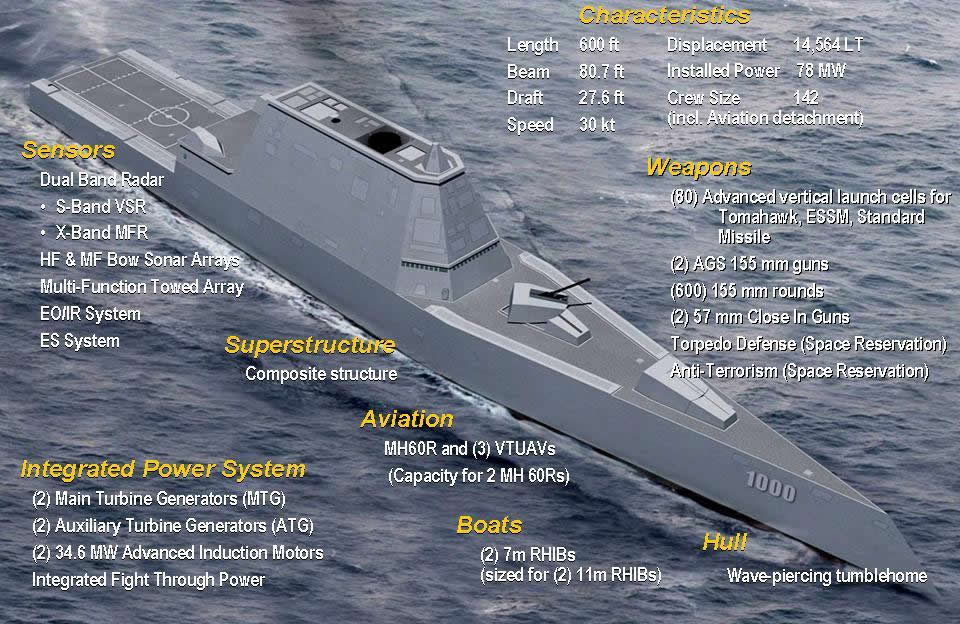
The Zumwalt-class destroyer represents the U.S. Navy's most ambitious attempt at next-generation surface warfare, embodying radical design philosophies that have both fascinated and frustrated naval analysts since its inception. Originally conceived as the DD(X) program to provide naval gunfire support for amphibious operations, the class evolved into a technology demonstrator that prioritizes stealth, electric propulsion, and advanced automation over traditional metrics like missile capacity. Strategically, the Zumwalt was designed to operate in contested littoral environments where traditional destroyers would be vulnerable to shore-based anti-ship missiles. Its angular, tumblehome hull design provides a radar cross-section comparable to a fishing boat despite displacing nearly 16,000 tons. However, the class has struggled to find its operational niche as the Navy's priorities shifted toward great power competition in blue water, where the Arleigh Burke's proven Aegis system and larger VLS capacity offer more relevant capabilities. The design philosophy behind Zumwalt reflects the Navy's early 2000s assumption that future conflicts would focus on littoral warfare and power projection ashore. This led to revolutionary features like the 155mm Advanced Gun System (AGS), integrated power system, and minimal crew requirements through extensive automation. However, cost overruns, technical challenges, and changing strategic priorities truncated the program from 32 planned hulls to just three operational vessels. In the current threat environment, Zumwalt occupies an awkward position. Its stealth capabilities and advanced sensors make it potentially valuable for reconnaissance and strike missions in contested areas, but its limited air defense capability and expensive operational costs raise questions about its utility compared to conventional destroyers. Recent efforts to repurpose the class as a hypersonic missile platform may finally provide the operational relevance that has eluded it since commissioning, though this represents a significant departure from its original land-attack mission.
Deployment Map
Home ports from known hull assignments. Operating areas reflect typical AORs — individual deployments will vary.
Timeline
Specifications
Armament
Peripheral VLS system, can accommodate Standard missiles, Tomahawk, ESSM
Currently non-operational due to $800k per round ammunition cost
Standard Phalanx CIWS mounts
Future installation planned, requires VLS modification
Doctrine & Employment
Role
Technology demonstrator and developmental platform designed to pioneer next-generation surface warfare capabilities, specifically stealth-enabled land attack operations in contested littoral environments.
Design Philosophy
Prioritized revolutionary stealth shaping, electric propulsion, and crew reduction through automation over proven combat systems and magazine depth. Designers sacrificed traditional destroyer attributes like helicopter facilities, robust air defense suites, and large missile magazines to achieve radar cross-section reduction and accommodate the massive Advanced Gun System that ultimately became unaffordable.
Employment
Intended to operate independently or in small task groups to provide precision fires against land targets from standoff distances, leveraging stealth characteristics to penetrate defended coastal areas. Original concept envisioned supporting Marine Corps amphibious operations with sustained naval gunfire support using the Advanced Gun System. Due to cost overruns and program truncation, the three hulls now serve primarily as test platforms for integrating emerging technologies like hypersonic weapons and directed energy systems.
Threat Context
Originally designed for the post-Cold War 'holiday from history' era when the primary threat was shore-based anti-ship missiles in littoral operations against near-peer competitors. The program's timeline coincided with China's rapid naval modernization and anti-access/area-denial buildup, making the original land-attack focused mission less relevant as blue-water fleet engagement scenarios gained prominence.
How to Compare
Evaluate based on technological innovation and future warfare concepts rather than traditional destroyer metrics like VLS cell count or sustained speed. Focus on radar signature reduction, power generation capacity for directed energy weapons, and automation levels versus conventional destroyers. Magazine depth and air defense capability comparisons highlight the platform's experimental nature rather than operational readiness.
Operational Patterns
Typical Deployment
Limited operational deployments, primarily test and evaluation missions
Deployment Length
6 months
Typical Task Group
Independent operations or specialized strike missions
Readiness
Still working through technical issues and establishing maintenance procedures for unique systems
Key Operating Areas
Peer Comparison Matrix
Type 055 emphasizes traditional destroyer missions with 112 VLS cells and proven systems, while Zumwalt prioritizes stealth and experimental technology. Chinese ship is more conventionally capable.
Video angle: Stealth vs firepower: comparing radical design philosophies in modern destroyer development
Korean destroyer uses proven Aegis system with 128 VLS cells, emphasizing traditional air defense mission over Zumwalt's experimental approach. More operationally relevant but less technologically advanced.
Video angle: Why allies chose conventional designs over revolutionary stealth technology
Burke offers proven reliability, 96 VLS cells, mature Aegis system at one-third the cost. Zumwalt provides stealth and advanced automation but uncertain operational value.
Video angle: The Navy's $23 billion mistake: why conventional destroyers beat revolutionary designs
British destroyer focuses on area air defense with advanced SAMPSON radar, while Zumwalt emphasizes multi-mission stealth capability. Both represent experimental approaches with mixed results.
Video angle: Allied experiments: comparing British and American next-generation destroyer programs
Russian frigate emphasizes anti-ship and land-attack missions with Kalibr missiles, smaller but more focused than Zumwalt's multi-mission approach. More operationally active despite smaller size.
Video angle: Size vs mission focus: why Russia's smaller warships may be more effective than America's super-destroyers
Combat History
No combat deployments to date. All three hulls have been primarily involved in testing, training, and capability development rather than operational missions.
The lack of combat history reflects the class's troubled development and uncertain operational role, unusual for a major surface combatant
USS Zumwalt conducted first live-fire exercises with conventional weapons systems during Pacific deployment, testing Standard missiles and defensive systems.
Demonstrated basic combat systems functionality, though AGS remained non-operational
Known Vulnerabilities
Air defense capability
Limited air defense compared to Arleigh Burke class, with only 80 VLS cells and no dedicated long-range air search radar
Context: Critical weakness in contested environments where air threats are primary concern
Mitigation: Designed to operate with escort vessels providing air defense umbrella
Operational costs
Extremely high operating costs estimated at $22.5 million per hull annually, roughly 50% higher than Burke-class
Context: Limits deployment frequency and operational utility in budget-constrained environment
Mitigation: Navy exploring ways to reduce crew requirements and maintenance costs
Primary weapon system failure
AGS ammunition costs of $800,000-$1M per round made primary weapon system economically unfeasible
Context: Fundamental mission failure requiring complete rethinking of platform purpose
Mitigation: CPS hypersonic missile integration intended to provide new primary mission
Limited fleet integration
Unique systems and small fleet size create training, maintenance, and operational integration challenges
Context: Difficult to integrate into standard carrier strike groups or surface action groups
Mitigation: Specialized mission profiles being developed to leverage unique capabilities
Variants
| Variant | Designation | Years | Count | Status | Key Changes |
|---|---|---|---|---|---|
| DDG-1000 baseline | DDG-1000 to DDG-1002 | 2016-2020 | 3 | active | Original configuration with AGS, minimal changes between hulls due to small production run |
Fleet Roster (3)
| Hull | Name | Variant | Commissioned | Home Port | Status |
|---|---|---|---|---|---|
| DDG-1000 | USS Zumwalt | baseline | 2016-10-15 | San Diego, CA | active |
| DDG-1001 | USS Michael Monsoor | baseline | 2019-01-26 | San Diego, CA | active |
| DDG-1002 | USS Lyndon B. Johnson | baseline | 2022-04-30 | Mayport, FL | active |
Modernization Programmes
Conventional Prompt Strike Integration
Installation of hypersonic missiles in modified VLS cells, removal of AGS systems to make room for additional missile capacity
Impact: Transforms Zumwalt from failed land-attack platform to cutting-edge hypersonic strike asset
Combat Systems Ship Qualification Trials
Final testing and certification of combat systems across all three hulls, addressing software integration issues
Impact: Achieved basic operational capability after years of development challenges
AGS Deactivation
Removal or permanent deactivation of Advanced Gun Systems due to prohibitive ammunition costs and shifting mission requirements
Impact: Eliminates primary intended capability but frees space and weight for alternative weapons systems
Images


Frequently Asked
How many Zumwalt-class destroyer are in service?
3 Zumwalt-class destroyer are currently in service with United States Navy.
When was the first Zumwalt-class destroyer commissioned?
The first Zumwalt-class destroyer entered service in 2016-10-15.
Who builds the Zumwalt-class destroyer?
The Zumwalt-class destroyer is built by General Dynamics Bath Iron Works.
How much does a Zumwalt-class destroyer cost?
Unit cost is approximately $7.5B per hull.
Curated Research
essential
Provides comprehensive historical context for destroyer evolution and the revolutionary nature of Zumwalt's departure from traditional destroyer design principles.
Authoritative Congressional Research Service analysis tracking the program's evolution, cost growth, and strategic rationale changes over time.
recommended
Explains the doctrinal shift that made Zumwalt's original land-attack mission less relevant as surface warfare returned to prominence.
Best source for tracking operational deployments and technology integration milestones of the three Zumwalt hulls.
Leading coverage of Zumwalt's role as testbed for hypersonic weapons and other next-generation technologies.
reference
Comprehensive technical specifications database comparing design parameters against conventional destroyer classes.
Provides doctrinal framework for understanding how stealth and standoff weapons change traditional surface warfare concepts that Zumwalt embodies.
Watch Zumwalt in Action
Iron Command produces in-depth comparison and analysis videos for military equipment.
Watch on YouTube