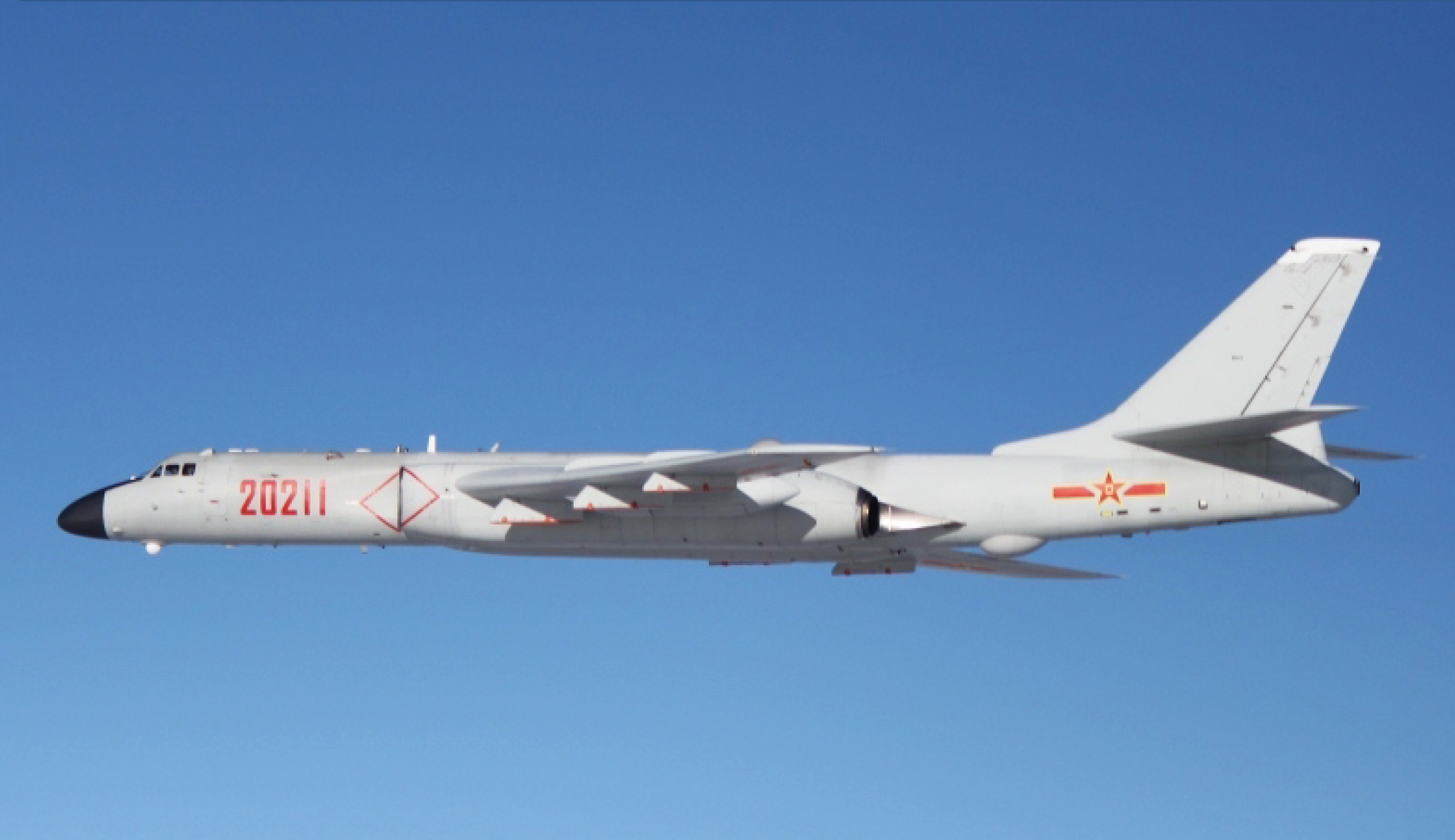
Xian H-6K/N Strategic Bomber
Overview
The Xian H-6K/N represents China's primary strategic bomber capability and serves as the backbone of the PLAAF's long-range strike operations. Based on the Soviet-era Tu-16 Badger design but heavily modernized with indigenous Chinese systems, the H-6K emerged in 2009 as a substantial upgrade featuring new turbofan engines, modern avionics, and crucially, the ability to carry long-range cruise missiles externally. The platform fills a critical gap in China's power projection capabilities, providing a credible conventional and nuclear strike option across the first and second island chains. Strategically, the H-6K/N series serves multiple roles in China's military doctrine: long-range precision strike against high-value targets, anti-ship operations in contested waters, and as a key component of China's nuclear triad. The aircraft regularly conducts flights around Taiwan and through international airspace in the South China Sea, serving both operational training and political signaling functions. Its ability to launch the CJ-10 (DH-10) land-attack cruise missile with a range exceeding 1,500km transforms what was originally a 1950s design into a modern standoff weapons platform. Compared to contemporary strategic bombers, the H-6K represents a pragmatic approach to capability development—leveraging proven airframe design while incorporating modern sensors and weapons systems. While it lacks the stealth characteristics of the B-2 or advanced payload capacity of the B-52H, it provides China with immediate, credible long-range strike capability at a fraction of the development cost. The newer H-6N variant adds aerial refueling capability and can reportedly carry the DF-21 air-launched ballistic missile, significantly extending China's anti-ship and land-attack reach. In the current threat environment, the H-6K/N fleet represents a key escalatory capability in any Taiwan Strait scenario, capable of striking targets across the Pacific while remaining based on the Chinese mainland. Its regular operations near contested territories demonstrate China's growing confidence in power projection, though the platform's survivability against modern integrated air defense systems remains questionable without significant escort and electronic warfare support.
Deployment Map
Home ports from known hull assignments. Operating areas reflect typical AORs — individual deployments will vary.
Timeline
Specifications
Armament
Primary standoff weapon
High-speed sea-skimming
Uncertain deployment status
Secondary capability
Operational Patterns
Typical Deployment
Long-range strike missions, maritime patrol, strategic deterrence flights, territorial assertion operations
Typical Task Group
Often operates with J-11/J-16 fighter escort, Y-8 AEW support, and aerial refueling aircraft
Readiness
High operational tempo with regular long-range training flights; maintenance challenges with older airframe design
Key Operating Areas
Peer Comparison Matrix
B-52H has larger payload capacity and longer range, but H-6K has more modern avionics and is younger design. B-52H better suited for penetrating missions with stealth escorts.
Video angle: Old vs. New: How China's modern H-6K compares to America's veteran B-52H in the Pacific theater
Tu-95MS has significantly longer range and larger payload, but H-6K offers better fuel efficiency and modern systems integration. Both serve similar regional deterrence roles.
Video angle: Allied Bombers: Russia's Tu-95 Bear vs China's H-6K in the new Cold War
B-1B offers supersonic speed and much larger payload capacity, but H-6K provides similar standoff cruise missile capability at lower operational cost and complexity.
Video angle: Speed vs. Economy: America's supersonic B-1B versus China's subsonic H-6K approach to strategic bombing
Tu-22M3 offers supersonic speed and swing-wing design for various mission profiles, while H-6K focuses on subsonic efficiency and proven reliability with modern sensors.
Video angle: Maritime Strike: Russia's swing-wing Tu-22M3 versus China's modernized H-6K for naval warfare
Combat History
First confirmed H-6K flights over South China Sea, demonstrating extended range capabilities against regional targets
Marked China's willingness to use strategic bombers for territorial assertion and power projection
H-6K bombers conducted circumnavigation flights around Taiwan as part of regular training missions
Established pattern of using H-6K for political signaling while building operational experience
Increased frequency of H-6K flights into Taiwan's ADIZ, often coordinated with fighter escorts
Demonstrated integrated long-range strike package capabilities and tested Taiwanese response times
H-6K bombers participated in large-scale exercises around Taiwan following US Congressional delegation visit
Showed integration with broader PLA joint operations and escalatory signaling
Known Vulnerabilities
Survivability Against Modern SAMs
Large RCS and subsonic speed make H-6K extremely vulnerable to modern integrated air defense systems like SM-6, PAC-3, and THAAD
Context: In contested airspace against peer adversaries, survival depends entirely on standoff weapons and escort support
Mitigation: Reliance on long-range cruise missiles and saturation tactics; development of stealth H-20 successor
Aging Airframe Design
Fundamentally 1950s aerodynamic design limits speed, altitude, and maneuverability compared to modern platforms
Context: Cannot match performance characteristics of B-1B, Tu-160, or other modern strategic bombers
Mitigation: Focus on cost-effectiveness and proven reliability rather than cutting-edge performance
Limited Payload Flexibility
External carriage of large missiles creates significant drag and radar signature penalties
Context: Unlike B-52H or Tu-95, cannot carry heavy payloads while maintaining optimal flight characteristics
Mitigation: Development of smaller, more efficient cruise missiles; H-6N improvements to heavy weapon integration
Electronic Warfare Vulnerability
Limited organic EW capability compared to dedicated platforms like EA-18G or Russian equivalents
Context: Requires extensive escort support in electronically contested environments
Mitigation: Integration with J-16D electronic warfare aircraft and improved onboard EW suites
Variants
| Variant | Designation | Years | Count | Status | Key Changes |
|---|---|---|---|---|---|
| H-6K | Base variant | 2009-present | 120 | active | New D-30 engines, glass cockpit, external missile pylons, modern avionics suite, extended range |
| H-6N | Maritime/Nuclear variant | 2018-present | 30 | active | Aerial refueling probe, reinforced centerline pylon for large missiles, modified nose radome |
| H-6J | Naval variant | 2018-present | 30 | active | Naval-specific avionics, anti-ship missile integration, maritime patrol capabilities |
Fleet Roster (2)
| Hull | Name | Variant | Commissioned | Home Port | Status |
|---|---|---|---|---|---|
| N/A | PLAAF H-6K Fleet | H-6K | 2009 | Multiple bases including Neixiang, Leiyang | active |
| N/A | PLAAF/PLAN H-6N Fleet | H-6N | 2018 | Neixiang AB, others | active |
Modernization Programmes
H-6K Mid-Life Upgrade
Avionics upgrades, improved electronic warfare systems, integration of newer cruise missile variants
Impact: Enhanced survivability and precision strike capability against defended targets
H-6N Expansion
Additional H-6N aircraft with confirmed aerial refueling and heavy missile capability
Impact: Significantly extended operational range and ability to threaten second island chain targets
Next-Generation Bomber (H-20)
Stealth strategic bomber development to eventually supplement/replace H-6 fleet
Impact: H-6K/N will likely remain in service for secondary roles and mass capacity
Frequently Asked
How many Xian H-6K/N Strategic Bomber are in service?
2 Xian H-6K/N Strategic Bomber are currently in service with People's Liberation Army Air Force.
When was the first Xian H-6K/N Strategic Bomber commissioned?
The first Xian H-6K/N Strategic Bomber entered service in 2009.
Who builds the Xian H-6K/N Strategic Bomber?
The Xian H-6K/N Strategic Bomber is built by Xi'an Aircraft Industrial Corporation.
What variants of the Xian H-6K/N Strategic Bomber exist?
Known variants include: H-6K, H-6N, H-6J.
How much does a Xian H-6K/N Strategic Bomber cost?
Unit cost is approximately $45M per hull.
Watch Xian H-6K/N Strategic Bomber in Action
Iron Command produces in-depth comparison and analysis videos for military equipment.
Watch on YouTube