
Wasp-class amphibious assault ship
Compare with
Overview
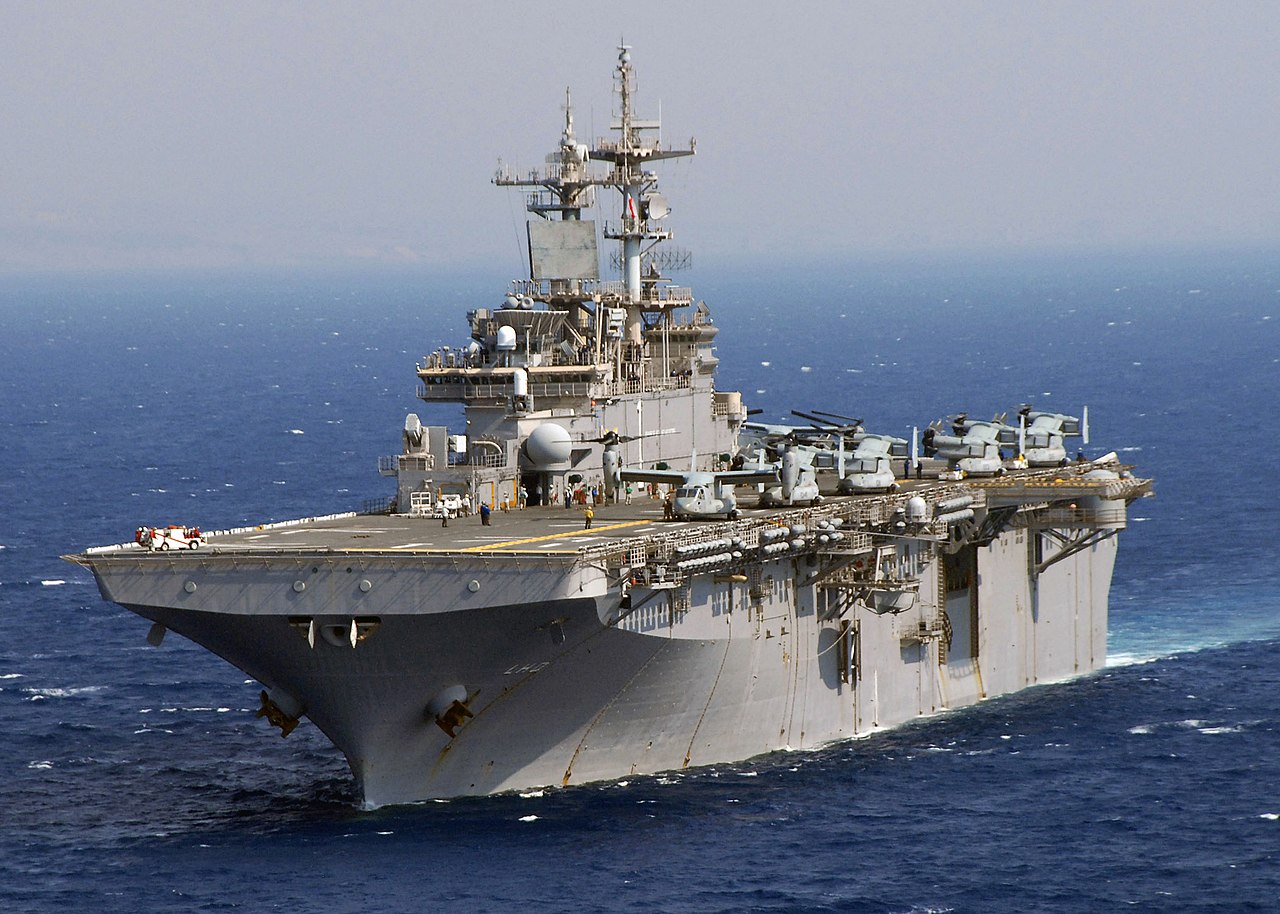
The Wasp-class amphibious assault ship (LHD) represents the backbone of U.S. Marine Corps expeditionary warfare capability, serving as a multi-purpose platform that combines the functions of aircraft carrier, helicopter carrier, and amphibious transport dock. These vessels are designed around the concept of 'power projection from the sea,' capable of launching and sustaining Marine Expeditionary Units (MEUs) anywhere in the world within 72 hours of crisis onset. Each Wasp-class ship can embark a reinforced Marine battalion of approximately 1,800 personnel along with their vehicles, equipment, and air support. The class's strategic importance lies in its flexibility and self-sufficiency. Unlike traditional aircraft carriers that require extensive escort groups, LHDs operate as the centerpiece of Amphibious Ready Groups (ARGs), providing their own defensive capabilities while projecting power ashore through multiple vectors: vertical assault via helicopter and tiltrotor aircraft, conventional amphibious landing via well deck operations, and close air support through embarked Harrier jump jets or F-35B Lightning II aircraft. This multi-domain approach makes them particularly valuable in contested littoral environments where traditional carrier operations might be too risky or logistically complex. In the current threat environment, Wasp-class ships face evolving challenges from peer competitors' anti-access/area-denial (A2/AD) capabilities, particularly in the South China Sea and other contested waters. Their large radar signature and limited air defense compared to fleet carriers make them vulnerable to saturation missile attacks, yet their distributed lethality concept and ability to operate in austere environments provide unique advantages. The integration of F-35B aircraft has significantly enhanced their strike capability, effectively transforming them into light carriers when configured for aviation-centric missions. Compared to international peers like the UK's Queen Elizabeth-class or Japan's Izumo-class helicopter destroyers (being converted for F-35B operations), the Wasp class offers superior amphibious capability through its well deck and larger Marine contingent capacity. However, purpose-built carriers like the Queen Elizabeth-class can carry more fixed-wing aircraft when configured purely for aviation missions. The Wasp class's true advantage lies in its operational flexibility – it can rapidly reconfigure between roles as mission requirements change, making it an invaluable asset for both high-intensity conflict and humanitarian operations.
Deployment Map
Home ports from known hull assignments. Operating areas reflect typical AORs — individual deployments will vary.
Timeline
Specifications
Armament
Point defense against missiles and aircraft
Medium-range air defense
Short-range anti-missile defense
Anti-small boat defense
Towed torpedo decoy
Doctrine & Employment
Role
Enabling forward presence and crisis response by providing mobile sea bases for Marine Expeditionary Units, extending American military reach without dependence on overseas bases or host nation permission.
Design Philosophy
Prioritized aircraft capacity and well deck capability over armor and defensive systems, accepting vulnerability to focus on power projection rather than survivability in contested environments. Designers emphasized versatility and rapid response over specialization, creating a platform capable of multiple mission sets but optimized for none, trading focused effectiveness for operational flexibility.
Employment
Typically operates as the centerpiece of an Amphibious Ready Group (ARG) with two accompanying amphibious ships (LPD and LSD), embarking a 2,200-Marine MEU with integrated aviation, ground, and logistics elements. Conducts operations ranging from humanitarian assistance to forcible entry, often positioning within 50-100 nautical miles of target coastlines. ARGs frequently integrate with Carrier Strike Groups for major operations while maintaining independent crisis response capability across multiple geographic combatant commands simultaneously.
Threat Context
Originally designed during the Cold War for operations against Soviet naval aviation and submarines, assuming U.S. sea control and limited shore-based threats. Modern threat environment includes anti-ship ballistic missiles, diesel submarines, and integrated coastal defense systems that can engage these large, relatively undefended platforms at ranges exceeding 1,000 kilometers.
How to Compare
Compare on aircraft capacity, well deck volume, and medical facilities rather than sensors or weapons—amphibious assault ships are measured by their ability to deliver and sustain Marines ashore, not engage in naval combat. Speed and range matter less than embarked capacity and versatility, as all modern amphibious platforms accept similar mobility limitations.
Operational Patterns
Typical Deployment
Operates as centerpiece of three-ship Amphibious Ready Group (ARG) with embarked Marine Expeditionary Unit (MEU), conducting 7-month rotational deployments
Deployment Length
7 months
Typical Task Group
ARG composition: 1x LHD, 1x LPD, 1x LSD plus 1-2 escort destroyers/cruisers
Readiness
Steam propulsion requires extensive maintenance periods; typically 30% of class in major maintenance at any time. F-35B operations require specialized maintenance capabilities limiting forward deployment flexibility.
Key Operating Areas
Peer Comparison Matrix
QE-class larger (65,000 tons vs 40,500), carries more F-35Bs (24-36 vs 6-20) but lacks amphibious capability and well deck. QE-class is pure aircraft carrier while Wasp is multi-mission platform.
Video angle: Light carrier comparison: specialized vs multi-role approach to naval aviation
Izumo smaller (27,000 tons), being modified for F-35B but lacks amphibious assault capability. More focused on ASW and air defense than power projection. No well deck or Marine capacity.
Video angle: Pacific allies' F-35B platforms: different approaches to distributed maritime operations
Similar size (40,000 tons) and mission profile but lacks fixed-wing capability currently. More modern design with better survivability features but unproven in combat operations. Represents direct challenge to US amphibious dominance in Pacific.
Video angle: Amphibious warfare face-off: battle-tested vs modern design philosophy
Smaller (27,000 tons) but more modern design with ski-jump for STOVL operations. More fuel-efficient diesel propulsion but less aviation capacity. Represents newer generation amphibious design concepts.
Video angle: Generational comparison: Cold War design vs modern efficiency-focused platforms
Smaller (21,000 tons), helicopter-only operations, more focused on humanitarian and peacekeeping missions. Less combat capability but greater operational flexibility in low-threat environments.
Video angle: Mission focus comparison: expeditionary warfare vs crisis response platforms
Combat History
USS Wasp (LHD-1) conducted combat operations in the Persian Gulf, launching Harrier sorties against Iraqi targets during the four-day bombing campaign.
First major combat deployment demonstrating the class's ability to operate as a light carrier in high-threat environments.
USS Bataan (LHD-5) served as a forward staging base in the Arabian Sea, launching Special Operations raids into Afghanistan using embarked helicopters and Marines.
Proved the platform's value for unconventional warfare and special operations support in landlocked theaters.
USS Boxer (LHD-4) and USS Kearsarge (LHD-3) conducted the largest amphibious assault since Inchon, landing 15th MEU in southern Iraq while Harriers provided close air support.
Validated the class's core mission of large-scale amphibious warfare in contested environments.
USS Kearsarge (LHD-3) conducted combat search and rescue missions over Libya, recovering downed F-15E crew using embarked MV-22 Osprey and Marine rescue teams.
Demonstrated flexibility in conducting CSAR operations in contested airspace.
USS Boxer (LHD-4) reportedly destroyed Iranian drone using electronic warfare systems, marking first documented use of directed energy weapons from the class.
Showcased evolving defensive capabilities against emerging drone threats.
LHD-6 suffered catastrophic fire during maintenance period in San Diego, burning for four days before being declared total loss due to structural damage.
Highlighted vulnerability to internal fires and led to enhanced fire suppression protocols across the class.
Known Vulnerabilities
Air Defense Saturation
Limited magazine depth (16 Sea Sparrow + 42 RAM missiles) makes the class vulnerable to coordinated missile saturation attacks, particularly anti-ship ballistic missiles and hypersonic weapons.
Context: Chinese DF-21D and DF-26 missiles specifically target high-value amphibious vessels; current defensive load insufficient for sustained high-threat operations.
Mitigation: Emphasis on ARG-level defense coordination and standoff operations; consideration of additional RAM launchers.
Signature Management
Large radar cross-section and infrared signature make detection easy at long range, while steam propulsion creates distinctive acoustic signature for submarine detection.
Context: Modern surveillance systems and satellite tracking make concealment nearly impossible in contested areas like South China Sea.
Mitigation: Limited stealth modifications possible; reliance on electronic warfare and deception rather than signature reduction.
Fire Suppression
Bonhomme Richard fire exposed critical weaknesses in shipboard firefighting during maintenance periods and highlighted aviation fuel fire risks during combat operations.
Context: High aviation fuel loads (5570 tonnes JP-5) create catastrophic fire risk if containment fails; complex internal spaces impede firefighting access.
Mitigation: Enhanced fire suppression systems, improved damage control training, and modified maintenance protocols implemented fleet-wide.
Well Deck Vulnerability
Ballast operations for well deck flooding create stability concerns and limit maneuverability; open well deck presents vulnerability to underwater attack during landing operations.
Context: Landing operations require stationary positioning with degraded defensive posture, creating window of vulnerability in contested environments.
Mitigation: Emphasis on pre-landing area clearance and coordinated defensive positioning with escort vessels.
Variants
| Variant | Designation | Years | Count | Status | Key Changes |
|---|---|---|---|---|---|
| Baseline Wasp-class | LHD-1 to LHD-8 | 1989-2009 | 8 | active | Original configuration designed for AV-8B Harrier operations, traditional steam propulsion, basic Ship Self-Defense System |
Fleet Roster (8)
| Hull | Name | Variant | Commissioned | Home Port | Status |
|---|---|---|---|---|---|
| LHD-1 | USS Wasp | Baseline | 1989-07-29 | Norfolk, VA | active |
| LHD-2 | USS Essex | Baseline | 1992-10-17 | San Diego, CA | active |
| LHD-3 | USS Kearsarge | Baseline | 1993-10-16 | Norfolk, VA | active |
| LHD-4 | USS Boxer | Baseline | 1995-02-11 | San Diego, CA | active |
| LHD-5 | USS Bataan | Baseline | 1997-09-20 | Norfolk, VA | active |
| LHD-6 | USS Bonhomme Richard | Baseline | 1998-08-15 | N/A | decommissioned (fire damage 2020) |
| LHD-7 | USS Iwo Jima | Baseline | 2001-06-30 | Mayport, FL | active |
| LHD-8 | USS Makin Island | Baseline | 2009-10-24 | San Diego, CA | active |
Modernization Programmes
F-35B Integration
Flight deck modifications, enhanced aviation fuel systems, and communications upgrades to support F-35B Lightning II operations. Includes heat-resistant deck coatings and modified landing systems.
Impact: Transforms LHDs into credible light carriers with 5th generation fighter capability, significantly enhancing strike range and survivability.
Ship Self-Defense System Modernization
Upgrade to SSDS Mk 2 Mod 4, integrating improved radar processing, electronic warfare systems, and counter-drone capabilities. Enhanced threat detection and engagement automation.
Impact: Improved ability to counter modern missile and drone threats, reduced crew workload during combat operations.
Enterprise Air Surveillance Radar (EASR)
Installation of AN/SPY-6(V)4 Enterprise Air Surveillance Radar to replace legacy AN/SPS-52 systems, providing improved air picture and missile defense coordination.
Impact: Enhanced air defense coordination capability and improved detection of low-observable threats.
Amphibious Combat Vehicle Integration
Well deck modifications and support systems for new ACV-P1 vehicles replacing legacy AAV-7s, including enhanced communication systems and maintenance facilities.
Impact: Improved ship-to-shore capability with faster, more survivable amphibious vehicles.
Images



Recent News
Frequently Asked
How many Wasp-class amphibious assault ship are in service?
7 Wasp-class amphibious assault ship are currently in service with United States Navy / United States Marine Corps.
When was the first Wasp-class amphibious assault ship commissioned?
The first Wasp-class amphibious assault ship entered service in 1989-07-29.
Who builds the Wasp-class amphibious assault ship?
The Wasp-class amphibious assault ship is built by Ingalls Shipbuilding (Huntington Ingalls Industries).
How much does a Wasp-class amphibious assault ship cost?
Unit cost is approximately $1.2B per hull.
Curated Research
essential
Provides comprehensive analysis of Wasp-class requirements, costs, and capabilities within broader amphibious fleet context.
Definitive technical and operational history of U.S. amphibious ship development including detailed Wasp-class design evolution.
Current Marine Corps doctrine defining how Wasp-class ships will operate in distributed maritime operations against peer competitors.
recommended
Examines how anti-access threats challenge traditional amphibious operations and Wasp-class employment concepts.
Leading amphibious warfare theorist whose writings extensively cover operational employment of large amphibious platforms.
reference
Comprehensive technical specifications and configuration details for all Wasp-class variants.
Regular technical analyses and operational assessments of amphibious platforms including Wasp-class modernization programs.
Primary venue for current operational assessments and future concepts for amphibious warfare by serving officers.
Watch Wasp in Action
Iron Command produces in-depth comparison and analysis videos for military equipment.
Watch on YouTubeSources