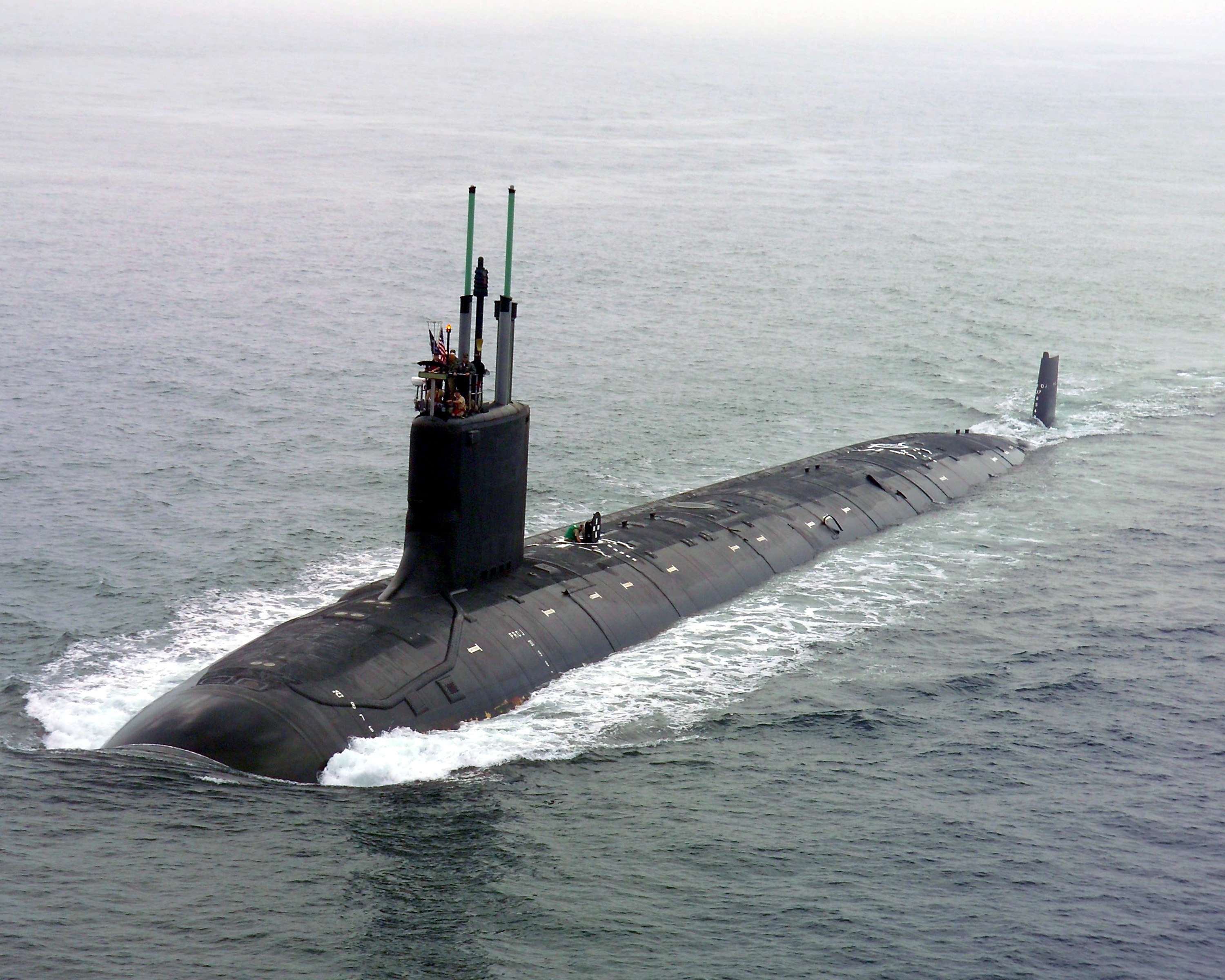
Virginia-class nuclear attack submarine
Compare with
Overview
The Virginia-class (SSN-774) represents the U.S. Navy's current generation nuclear attack submarine, designed to replace the Los Angeles-class boats and maintain American undersea dominance in the 21st century. These submarines embody a shift from Cold War open-ocean hunting to littoral operations, special operations support, and multi-domain warfare, featuring advanced sonar arrays, flexible payload capabilities, and extensive intelligence-gathering systems. Strategically, the Virginia-class serves as the backbone of America's subsurface fleet, tasked with anti-submarine warfare, land attack, intelligence collection, and special operations support. The design philosophy emphasized modularity and upgradability, with each block incorporating significant technological improvements while maintaining cost discipline through construction innovations like modular assembly. In today's threat environment, Virginia-class boats are America's primary counter to China's expanding submarine fleet and Russia's modernized nuclear boats. Their acoustic superiority, advanced combat systems, and flexible mission capabilities make them arguably the world's most capable attack submarines. The class has proven its worth in operations against ISIS, providing precision Tomahawk strikes, and in intelligence operations that remain classified. Compared to international peers, Virginia-class submarines maintain acoustic and sensor advantages over most competitors, though newer Chinese and Russian designs are closing capability gaps. The ongoing Block V production and Virginia Payload Module integration ensure these boats will remain relevant through the 2070s, bridging to the future SSN(X) program while maintaining America's undersea edge in great power competition.
Deployment Map
Home ports from known hull assignments. Operating areas reflect typical AORs — individual deployments will vary.
Timeline
Specifications
Armament
Primary land-attack capability
Anti-ship and anti-submarine
Encapsulated for tube launch
Replaces torpedoes for mining missions
Doctrine & Employment
Role
Multi-domain undersea warfare platform designed to maintain American submarine superiority through flexible deterrence, power projection, and sea control in contested littoral environments where traditional surface forces cannot operate safely.
Design Philosophy
Designers prioritized modularity and multi-mission capability over pure speed and deep-ocean performance, trading the extreme diving depth of Seawolf-class for lower costs and greater flexibility. The Virginia Payload Module sacrifices some hydrodynamic efficiency for massive strike capacity, reflecting the shift from pure anti-submarine warfare to land-attack and multi-domain operations.
Employment
Virginia-class submarines typically operate independently or in small task groups, conducting extended patrols of 3-6 months in forward areas including the South China Sea, Norwegian Sea, and Mediterranean. They serve as intelligence collection platforms, Tomahawk strike assets, and special operations motherships, often coordinating with carrier strike groups while maintaining operational independence. Command relationships vary from direct COCOM control for strategic missions to integration with numbered fleet operations for conventional warfare.
Threat Context
Originally designed to counter improved Kilo and Akula-class submarines in littoral waters, the Virginia-class now faces an expanded threat matrix including China's growing submarine force, advanced air-independent propulsion boats, and integrated anti-submarine warfare networks. The threat has evolved from primarily submarine-versus-submarine engagements to operating within multi-layered A2/AD environments where detection means rapid engagement by multiple platforms.
How to Compare
Compare Virginia-class boats primarily on sensor integration, payload flexibility, and stealth characteristics rather than raw speed or diving depth—modern submarine warfare prioritizes information dominance and strike capacity over kinematic performance. The most relevant comparisons focus on sonar suite sophistication, vertical launch capacity, and ability to operate in shallow, acoustically challenging waters where traditional submarine advantages are reduced.
Operational Patterns
Typical Deployment
Six-month deployments for intelligence gathering, presence operations, and strike missions. Operate independently or as part of CSG/ESG
Deployment Length
6 months
Typical Task Group
Independent operations or integrated with carrier strike groups, amphibious ready groups
Readiness
High operational tempo straining maintenance schedules. Some boats experiencing delayed availability due to shipyard capacity limitations
Key Operating Areas
Peer Comparison Matrix
Similar capabilities but smaller fleet size. Astute has pump-jet propulsor advantage but fewer VLS tubes. Both share intelligence and operate jointly in some areas.
Video angle: Allied submarine cooperation vs independent capabilities - how NATO submarine warfare actually works
Chinese boats significantly noisier but improving rapidly with each variant. Type 093B approaching early Virginia acoustic levels. Simpler weapons fit but adequate for regional missions.
Video angle: Acoustic warfare evolution - how China is closing the submarine stealth gap
Yasen matches Virginia in many areas, potentially superior in some acoustic frequencies. More missile tubes but less reliable construction. Limited numbers due to cost.
Video angle: Old rivals, new technology - how Russian submarine design philosophy differs from American approach
Newer design with some advanced features, smaller but more automated. Different strategic focus on deterrent patrol support vs multi-mission capability.
Video angle: Design philosophy differences - automation vs crew capability in modern submarine warfare
Air-independent propulsion diesels vs nuclear power. Lower capability but much lower cost, suitable for different mission sets and navies.
Video angle: Nuclear vs conventional submarines - when does the extra capability justify the massive cost difference
Combat History
USS John Warner conducted first Virginia-class combat deployment, launching Tomahawk missiles against ISIS targets in Syria. Demonstrated precision strike capability from Eastern Mediterranean.
First operational combat use of Virginia-class, validating land-attack mission in real-world conditions
Multiple Virginia-class boats conducted intelligence gathering missions in disputed waters, with several incidents remaining classified. Known to include close surveillance of adversary naval activities.
Demonstrated intelligence collection capabilities and ability to operate in contested environments undetected
USS John Warner participated in coordinated strike against Syrian chemical weapons facilities, launching multiple Tomahawk Block IV missiles alongside surface combatants.
Showcased integration with joint strike packages and precision targeting capabilities
Virginia-class submarines maintained covert presence during heightened tensions with Iran, providing intelligence and deterrent effect during tanker incidents.
Demonstrated deterrent value and surveillance capabilities in critical maritime chokepoints
USS Connecticut (Seawolf-class) collision highlighted navigation challenges, but Virginia-class boats continued operations in South China Sea without incident, demonstrating superior navigation systems.
Contrasted reliability and safety systems between submarine classes in challenging operating environments
Known Vulnerabilities
Production bottleneck
Construction limited to 1.2-1.3 boats annually despite requirement for 2+ boats to maintain fleet size as Los Angeles-class retires. Shipyard capacity and skilled workforce constraints limit expansion.
Context: China is building submarines faster than US, potentially achieving numerical parity in Western Pacific by 2030s
Mitigation: Increased funding for shipyard infrastructure, workforce development programs, and supplier base expansion
Acoustic signature growth
As boats age and components wear, acoustic signatures may degrade. Maintenance standards and component replacement cycles critical to maintaining stealth advantage.
Context: Adversary passive sonar capabilities improving, reducing margin for acoustic degradation
Mitigation: Enhanced maintenance protocols, component monitoring systems, and acoustic signature verification
Command and control vulnerability
Heavy reliance on satellite communications and networked systems creates potential electronic warfare vulnerabilities. GPS jamming and communication disruption pose operational challenges.
Context: Near-peer adversaries developing sophisticated EW capabilities specifically targeting US C4ISR systems
Mitigation: Alternative navigation systems, hardened communications, and reduced electromagnetic signature protocols
Crew training pipeline
Nuclear submarine crews require extensive training, creating personnel bottlenecks. Retention challenges in competitive job market affecting experienced operator availability.
Context: Expanding submarine fleet requires more qualified personnel as commercial nuclear sector competes for same skill sets
Mitigation: Enhanced retention bonuses, improved training facilities, and accelerated qualification programs
Variants
| Variant | Designation | Years | Count | Status | Key Changes |
|---|---|---|---|---|---|
| Block I | SSN-774 to SSN-783 | 2004-2008 | 10 | active | Initial production variant with basic Virginia configuration, 12 VLS tubes, BQQ-10 sonar |
| Block II | SSN-784 to SSN-791 | 2009-2015 | 8 | active | Improved sonar processing, enhanced special operations capabilities, cost reduction measures |
| Block III | SSN-792 to SSN-801 | 2016-2019 | 10 | active | Redesigned bow with Large Aperture Bow array replacing spherical array, improved acoustic performance |
| Block IV | SSN-802 to SSN-811 | 2020-2024 | 10 | building | Continued LAB improvements, enhanced electronic warfare systems, preparation for Block V systems |
| Block V | SSN-812+ | 2025+ | 9 | building | Virginia Payload Module with 28 additional Tomahawk tubes, extended hull, enhanced mission flexibility |
Fleet Roster (25)
| Hull | Name | Variant | Commissioned | Home Port | Status |
|---|---|---|---|---|---|
| SSN-774 | USS Virginia | Block I | 2004-10-23 | Pearl Harbor, HI | active |
| SSN-775 | USS Texas | Block I | 2006-09-09 | Pearl Harbor, HI | active |
| SSN-776 | USS Hawaii | Block I | 2007-05-05 | Pearl Harbor, HI | active |
| SSN-777 | USS North Carolina | Block I | 2008-05-03 | Groton, CT | active |
| SSN-778 | USS New Hampshire | Block I | 2008-10-25 | Groton, CT | active |
| SSN-779 | USS New Mexico | Block I | 2010-03-27 | Groton, CT | active |
| SSN-780 | USS Missouri | Block I | 2010-07-31 | Groton, CT | active |
| SSN-781 | USS California | Block I | 2011-10-29 | Groton, CT | active |
| SSN-782 | USS Mississippi | Block I | 2012-06-02 | Groton, CT | active |
| SSN-783 | USS Minnesota | Block I | 2013-09-07 | Groton, CT | active |
| SSN-784 | USS North Dakota | Block II | 2014-10-25 | Groton, CT | active |
| SSN-785 | USS John Warner | Block II | 2015-08-01 | Norfolk, VA | active |
| SSN-786 | USS Illinois | Block II | 2016-10-29 | Groton, CT | active |
| SSN-787 | USS Washington | Block II | 2017-10-07 | Norfolk, VA | active |
| SSN-788 | USS Colorado | Block III | 2018-03-17 | Pearl Harbor, HI | active |
| SSN-789 | USS Indiana | Block III | 2018-09-29 | Bremerton, WA | active |
| SSN-790 | USS South Dakota | Block II | 2019-02-02 | Groton, CT | active |
| SSN-791 | USS Delaware | Block III | 2020-04-04 | Norfolk, VA | active |
| SSN-792 | USS Vermont | Block III | 2020-04-18 | Groton, CT | active |
| SSN-793 | USS Oregon | Block III | 2022-05-28 | Pearl Harbor, HI | active |
| SSN-794 | USS Montana | Block III | 2023-06-25 | Kitsap, WA | active |
| SSN-795 | USS Hyman G. Rickover | Block III | 2023-07-29 | Norfolk, VA | active |
| SSN-796 | USS New Jersey | Block IV | 2024 | TBD | building |
| SSN-797 | USS Iowa | Block IV | 2024 | TBD | building |
| SSN-798 | USS Massachusetts | Block IV | 2025 | TBD | building |
Modernization Programmes
Virginia Payload Module (VPM)
Block V boats receive 84-foot hull extension with 28 additional Tomahawk launch tubes, quadrupling land-attack firepower. Includes enhanced command and control systems.
Impact: Transforms Virginia from tactical to strategic strike platform, compensating for Ohio SSGN retirement
Large Aperture Bow (LAB) Array
Block III+ boats feature redesigned bow with larger, more sensitive sonar array replacing traditional spherical array. Significantly improves detection range and resolution.
Impact: Major acoustic advantage over earlier blocks and competitor submarines, enhanced ASW capability
Advanced Processor Build (APB)
Upgraded sonar processing computers with enhanced algorithms for target detection, classification, and tracking. Includes AI-assisted threat recognition.
Impact: Maintains sonar superiority as adversary submarines become quieter, improves operator effectiveness
Integrated Imaging System
Next-generation photonics masts with enhanced electro-optical sensors, electronic surveillance measures, and communications capabilities.
Impact: Improved situational awareness and intelligence collection in littoral environments
Images




Frequently Asked
How many Virginia-class nuclear attack submarine are in service?
22 Virginia-class nuclear attack submarine are currently in service with United States Navy, with 3 under construction.
When was the first Virginia-class nuclear attack submarine commissioned?
The first Virginia-class nuclear attack submarine entered service in 2004-10-23.
Who builds the Virginia-class nuclear attack submarine?
The Virginia-class nuclear attack submarine is built by General Dynamics Electric Boat / Huntington Ingalls Industries Newport News.
What variants of the Virginia-class nuclear attack submarine exist?
Known variants include: Block I, Block II, Block III, Block IV, Block V.
How much does a Virginia-class nuclear attack submarine cost?
Unit cost is approximately $3.4B per hull.
Curated Research
essential
Ron O'Rourke's definitive CRS analysis provides comprehensive program history, cost analysis, and strategic context for Virginia-class development.
Provides authoritative technical specifications and comparative analysis of Virginia-class variants against international submarine programs.
Premier open-source submarine analyst providing detailed technical analysis and operational insights on Virginia-class developments.
recommended
CSBA report contextualizes Virginia-class role within broader fleet architecture debates and future submarine requirements.
RUSI analysis of submarine warfare evolution and how Virginia-class capabilities align with emerging underwater warfare concepts.
reference
Comprehensive database entry with specifications, construction timeline, and fleet status for all Virginia-class boats.
Official U.S. Navy doctrinal publication establishing the conceptual framework for submarine employment in naval warfare.
Watch Virginia in Action
Iron Command produces in-depth comparison and analysis videos for military equipment.
Watch on YouTube