
Vikrant-class aircraft carrier
Overview
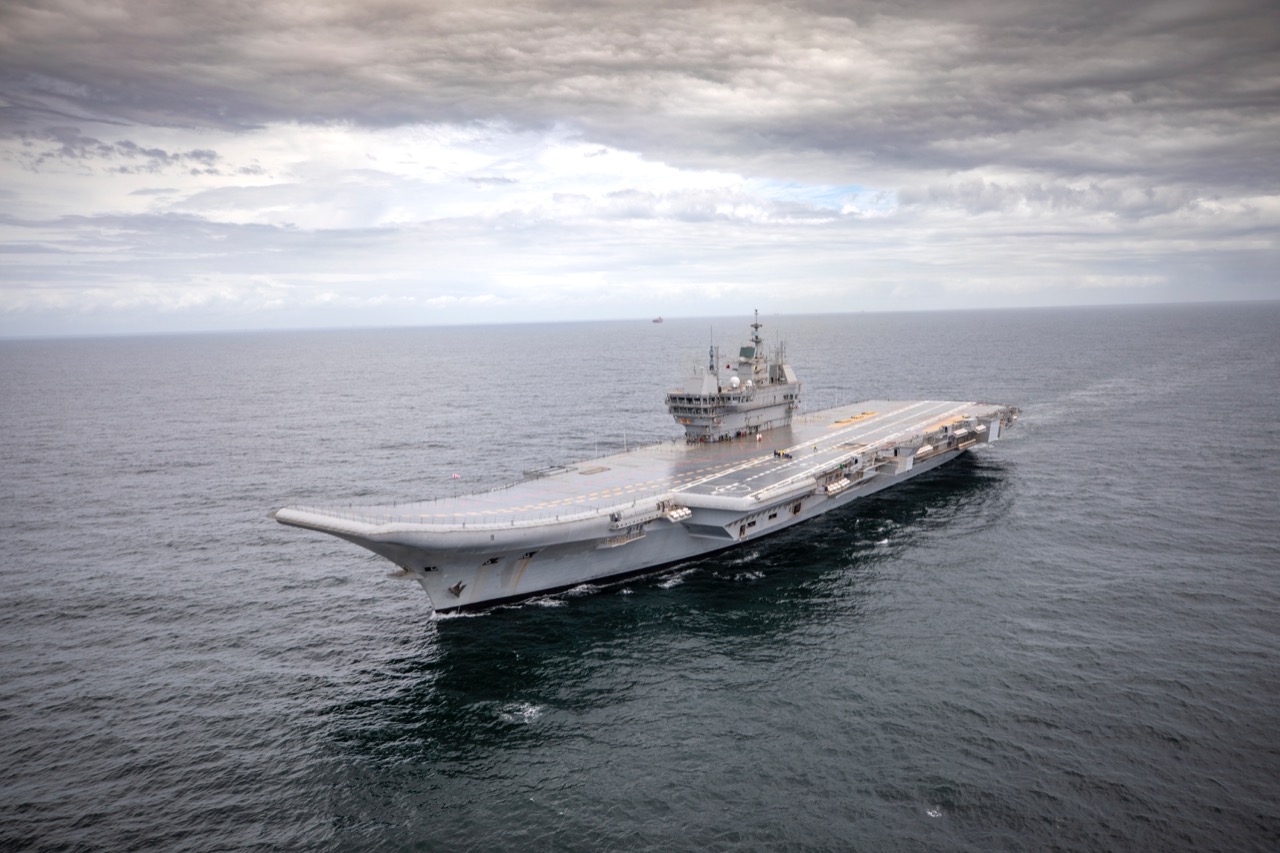
The Vikrant-class represents India's ambitious leap into indigenous aircraft carrier construction, marking the nation's emergence as a blue-water naval power. INS Vikrant (IAC-1), commissioned in September 2022, is India's first domestically-built aircraft carrier and the cornerstone of the Indian Navy's carrier aviation renaissance. At 45,000 tonnes, she's significantly larger than India's aging INS Vikramaditya and incorporates modern stealth features, advanced sensors, and a ski-jump configuration optimized for MiG-29K operations. Strategically, the Vikrant-class addresses India's critical need for power projection across the Indian Ocean Region, particularly as Chinese naval presence expands through the Belt and Road Initiative. The carrier's design philosophy emphasizes modularity and growth potential, with space reserved for future systems including potential electromagnetic aircraft launch systems. Her air wing of 30+ aircraft provides India with genuine expeditionary strike capability, complementing land-based assets in scenarios ranging from humanitarian assistance to high-intensity conflict. While impressive for a first indigenous effort, Vikrant faces significant capability gaps compared to contemporary carriers. Her ski-jump limits aircraft payload and fuel capacity compared to catapult-equipped vessels, and her air wing lacks organic AEW aircraft, relying instead on helicopters with limited radar horizon. The integration of MiG-29Ks, while providing multi-role capability, represents a compromise solution given delays in indigenous fighter development. In the current threat environment, Vikrant's primary value lies in deterrence and presence operations rather than high-end warfighting against peer adversaries. Her sensor suite and defensive systems are adequate for operations in permissive or contested environments but would struggle against saturation missile attacks. Nevertheless, she represents a crucial stepping stone toward India's planned three-carrier navy and demonstrates growing indigenous shipbuilding capabilities that will inform future designs, including the larger INS Vishal with planned electromagnetic catapults.
Deployment Map
Home ports from known hull assignments. Operating areas reflect typical AORs — individual deployments will vary.
Timeline
Specifications
Armament
30mm rotary cannon, 5000 rpm
Vertically launched, active radar homing
Primary fixed-wing component
E-801M Oko radar system
SAR and utility missions
Doctrine & Employment
Role
Regional power projection and sea lane control in the Indian Ocean, establishing India as the dominant naval force from the Arabian Sea to the Malacca Straits while providing credible deterrence against peer competitors.
Design Philosophy
Prioritized indigenous construction capability and operational autonomy over maximum capability, accepting a smaller air wing (30 aircraft vs 50+ on larger carriers) to achieve domestic shipbuilding expertise and reduced foreign dependency. Emphasized conventional STOBAR configuration using proven ski-jump technology rather than more complex catapult systems, trading aircraft payload capacity for design simplicity and maintenance reliability.
Employment
Operates as the centerpiece of a carrier battle group typically including destroyers, frigates, submarines, and support vessels, conducting extended patrols in the Arabian Sea, Bay of Bengal, and broader Indian Ocean. Primary missions include air superiority over naval task forces, strike operations against surface targets, and providing air cover for amphibious operations. Command structure integrates with shore-based maritime patrol aircraft and satellite surveillance to create layered reconnaissance and strike capabilities across India's maritime domain.
Threat Context
Designed primarily to counter Chinese naval expansion in the Indian Ocean and Pakistani maritime threats, with emphasis on controlling critical sea lanes and projecting power to distant island territories. The threat environment has intensified since conception with China's expanding submarine presence, advanced anti-ship missiles, and establishment of overseas naval facilities, requiring enhanced defensive capabilities and extended operational ranges.
How to Compare
Compare primarily on air wing composition and sortie generation rates rather than raw tonnage - India's STOBAR configuration fundamentally differs from CATOBAR systems. Focus on operational radius and endurance capabilities versus regional peers, as sustained presence in the vast Indian Ocean matters more than maximum aircraft capacity for India's specific geographic challenges.
Operational Patterns
Typical Deployment
Carrier battle group operations in Indian Ocean, presence missions, power projection exercises
Deployment Length
4 months
Typical Task Group
2-3 destroyers/frigates, 1-2 submarines, 1 fleet tanker, 1 supply ship
Readiness
Limited by single-carrier operations until second carrier or major Vikramaditya overhaul completion
Key Operating Areas
Peer Comparison Matrix
Queen Elizabeth is larger (65,000t vs 45,000t) with more advanced F-35B aircraft but similar ski-jump limitations. Both lack catapults but QE has larger air wing capacity.
Video angle: Medium power carrier comparison - ski-jump vs catapult trade-offs and air wing capabilities
Liaoning is older Soviet design with similar ski-jump but larger displacement (60,000t). Both operate with limited AEW but Chinese J-15 has longer range than MiG-29K.
Video angle: Indo-Pacific carrier rivalry - comparing China vs India's carrier aviation approach
Kuznetsov influenced Vikrant's design but is larger and combines carrier/cruiser roles with heavy missile armament. Vikrant is purely aviation-focused.
Video angle: Evolution from Soviet carrier concepts to modern indigenous design
Charles de Gaulle is nuclear-powered with catapults and advanced Rafale aircraft, representing more sophisticated but expensive approach to medium carrier operations.
Video angle: Nuclear vs conventional power for medium navies - capability vs cost analysis
Garibaldi represents previous generation light carrier design. Vikrant shows evolution toward larger, more capable indigenous carrier construction for emerging naval powers.
Video angle: Evolution of carrier aviation for medium naval powers
Combat History
INS Vikrant conducted first operational patrol in Arabian Sea with full air wing, including MiG-29K operations and helicopter trials
Demonstrated initial operational capability and air wing integration following commissioning
Participated in quadrilateral naval exercise with US, Japanese, and Australian forces, conducting air defense and strike missions
First major international exercise participation, validating interoperability with allied forces
Known Vulnerabilities
Limited Air Wing Capability
Ski-jump configuration severely limits aircraft payload and fuel capacity compared to catapult-equipped carriers. MiG-29K cannot take off with full fuel and weapon load simultaneously.
Context: Reduces effective combat radius and strike payload in high-threat environments where maximum range and firepower are critical
Mitigation: Future carriers planned with electromagnetic catapults; current focus on maximizing operational efficiency
Lack of Organic AEW
Relies on Ka-31 helicopters for airborne early warning rather than fixed-wing AEW aircraft, limiting radar horizon and persistence
Context: Critical vulnerability in contested airspace where early warning of incoming threats is essential for survival
Mitigation: Exploring indigenous AEW helicopter upgrades and potential future fixed-wing solutions
Limited Air Defense
Barak 8 provides medium-range capability but lacks the layered defense of US/European carriers. No long-range SAMs or comprehensive CIWS coverage
Context: Vulnerable to saturation missile attacks from peer adversaries, particularly in confined waters like Arabian Sea approaches
Mitigation: Relies on escort vessels for extended air defense; future upgrades may include additional missile systems
Maintenance and Logistics
First-of-class challenges with maintenance procedures, spare parts availability, and crew training on new indigenous systems
Context: Operational availability could be compromised during initial service years while procedures are refined
Mitigation: Extensive training programs and maintenance contracts with shipyard for initial support
Variants
| Variant | Designation | Years | Count | Status | Key Changes |
|---|---|---|---|---|---|
| IAC-1 (Vikrant) | IAC-1 | 2013-2022 | 1 | active | Initial production variant with ski-jump, indigenous combat management system, modular design for future upgrades |
| IAC-2 (Planned) | IAC-2 | TBD | — | planned | Planned sister ship with potential improvements based on operational experience, possible EMALS integration |
Fleet Roster (1)
| Hull | Name | Variant | Commissioned | Home Port | Status |
|---|---|---|---|---|---|
| IAC-1 | INS Vikrant | IAC-1 | 2022-09-02 | Visakhapatnam | active |
Modernization Programmes
Air Wing Expansion
Integration of additional MiG-29K variants and potential indigenous fighter aircraft trials
Impact: Enhanced strike capability and reduced dependence on foreign aircraft
Combat System Upgrades
Upgrade of CMS with enhanced data links, improved EW suite, and integration of indigenous missiles
Impact: Better situational awareness and defensive capabilities
TEDBF Integration
Integration of Twin Engine Deck Based Fighter to replace or supplement MiG-29K fleet
Impact: Indigenous fighter capability reducing foreign dependence
Images




Frequently Asked
How many Vikrant-class aircraft carrier are in service?
1 Vikrant-class aircraft carrier are currently in service with Indian Navy.
When was the first Vikrant-class aircraft carrier commissioned?
The first Vikrant-class aircraft carrier entered service in 2022-09-02.
Who builds the Vikrant-class aircraft carrier?
The Vikrant-class aircraft carrier is built by Cochin Shipyard Limited.
What variants of the Vikrant-class aircraft carrier exist?
Known variants include: IAC-1 (Vikrant), IAC-2 (Planned).
How much does a Vikrant-class aircraft carrier cost?
Unit cost is approximately $3.1B per hull.
Curated Research
essential
Provides comprehensive analysis of India's maritime doctrine and the strategic rationale behind indigenous carrier development.
Authoritative assessment of IAC-1's capabilities within India's broader naval modernization strategy.
Premier Indian think tank providing indigenous perspective on naval doctrine and carrier employment strategies.
Official doctrinal framework explaining India's maritime strategy and carrier employment philosophy.
recommended
Essential reference for understanding carrier operations doctrine and employment principles applicable to INS Vikrant.
Ongoing analysis of Indian Ocean naval developments and carrier operations by leading defense analysts.
reference
Comprehensive technical specifications and configuration details for comparative analysis.
Watch Vikrant in Action
Iron Command produces in-depth comparison and analysis videos for military equipment.
Watch on YouTube