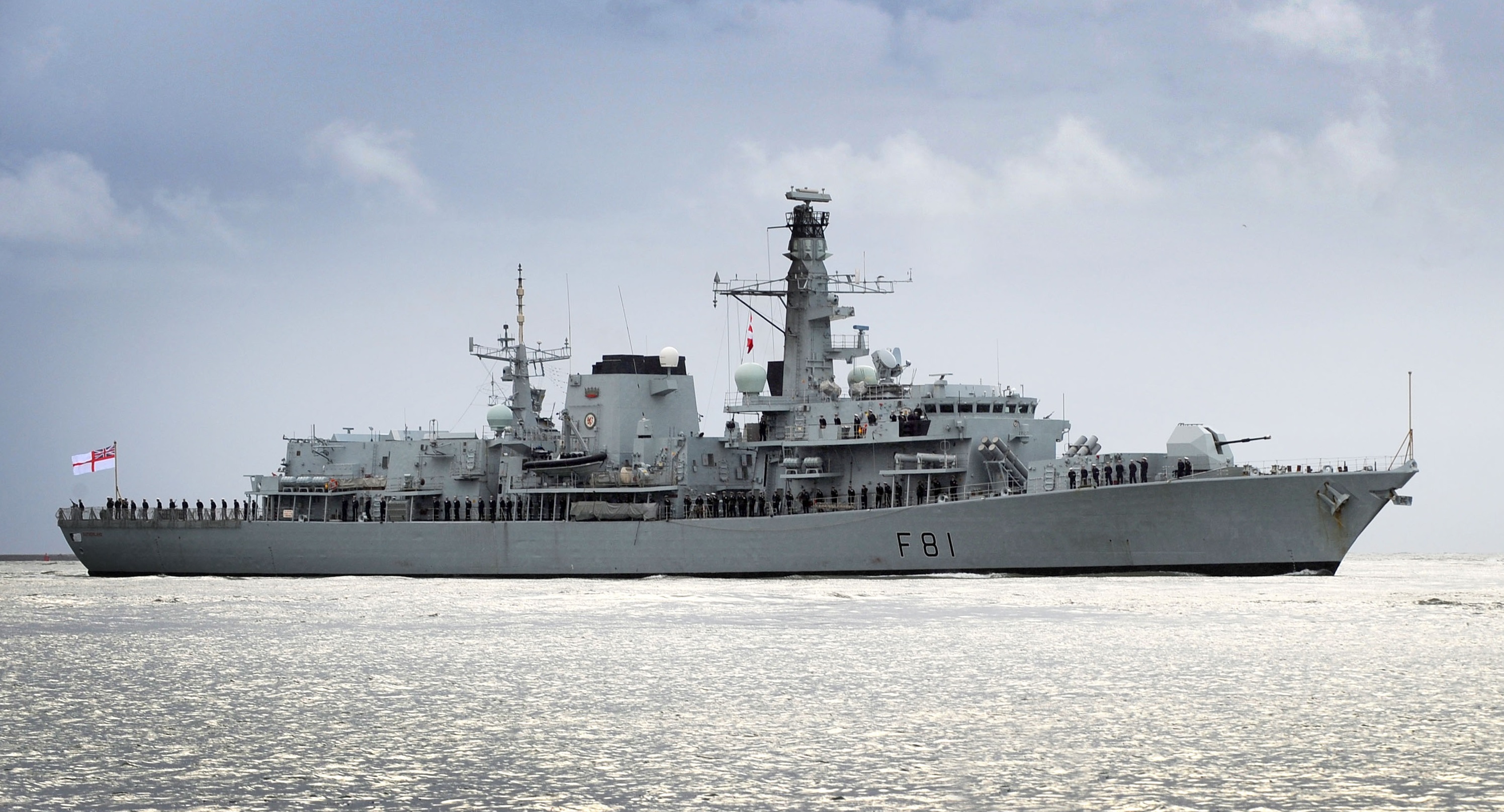
Type 23 Duke-class frigate
Overview
The Type 23 Duke-class frigate represents the Royal Navy's primary general-purpose frigate, designed during the Cold War for anti-submarine warfare but evolved into a multi-mission platform. Originally built to hunt Soviet submarines in the North Atlantic, these ships have proven remarkably adaptable, serving as the backbone of Royal Navy surface operations for over three decades. The Type 23's design philosophy emphasized stealth and ASW capability over raw firepower. Its angled superstructure and radar-absorbent materials reduced its radar signature, while the CODLAG propulsion system allowed for ultra-quiet operations essential for submarine hunting. The class pioneered several technologies including the sophisticated Sonar 2087 towed array system and was among the first NATO frigates to integrate vertical launch systems. In today's threat environment, the Type 23 serves as Britain's primary escort vessel, conducting everything from Falklands patrols to Middle East operations and NATO exercises. However, the class shows its age against modern threats - its 32-cell VLS and limited air defense radar struggle against saturation attacks that would challenge contemporary surface combatants. The Sea Ceptor missile upgrade has improved point defense, but the ships lack the magazine depth and sensor capability of newer designs. Compared to contemporary frigates like the French FREMM or German F125, the Type 23 trades raw capability for operational flexibility and proven reliability. While newer platforms boast larger VLS arrays and more sophisticated radars, few match the Duke class's track record of sustained operations in demanding environments. The class represents the last generation of specialized ASW platforms before navies shifted toward more generalized multi-mission designs.
Deployment Map
Home ports from known hull assignments. Operating areas reflect typical AORs — individual deployments will vary.
Timeline
Specifications
Armament
Replaced Sea Wolf, active radar homing
Being retired without replacement
Fully automated gun system
Not fitted to all hulls
Ship and helicopter launched
Remote controlled, anti-surface/air
Doctrine & Employment
Role
Flexible maritime presence and crisis response within NATO's integrated defence framework, designed to operate independently or as part of task groups where dedicated ASW capability is essential.
Design Philosophy
Prioritised acoustic stealth and sensor performance over magazine depth and multi-mission flexibility, accepting a light weapons fit to maximise ASW effectiveness. The design sacrificed speed and heavy armament for exceptional quieting measures and sonar capability, reflecting Cold War assumptions that finding submarines mattered more than engaging multiple surface threats. Later upgrades added Sea Ceptor and improved radar, but the fundamental ASW-first architecture remains unchanged.
Employment
Type 23s typically deploy as single-ship patrols for constabulary duties, pair with carriers for ASW screening, or integrate into NATO task groups as the primary submarine hunting asset. They excel in forward presence missions where their endurance and sensor suite provide persistent surveillance capability. Command relationships vary from independent operations under Fleet Command to tactical integration under carrier or amphibious task group commanders, with their Sea Ceptor and helicopter giving them credible self-defence against air and surface threats.
Threat Context
Originally designed to counter quiet Soviet nuclear submarines in the North Atlantic, particularly the Akula and Sierra classes that could threaten NATO sea lanes. The threat has evolved from peer submarine warfare to irregular maritime challenges, hybrid warfare, and the re-emergence of Russian submarine activity, though now Chinese subsurface expansion also drives requirements. Modern operations emphasise constabulary roles and crisis response rather than wartime ASW, but the Type 23's core ASW capability remains relevant against both Russian and emerging threats.
How to Compare
Compare on sonar performance, helicopter integration, and operational endurance rather than VLS count or top speed—ASW-focused frigates prioritise sensor capability over raw firepower. Magazine depth matters less than acoustic signature and the ability to prosecute submarine contacts effectively through helicopter coordination. Measure success by patrol duration, acoustic stealth, and multi-mission adaptability rather than point defence capability, as these platforms are force multipliers for task group ASW rather than standalone combatants.
Operational Patterns
Typical Deployment
Independent patrol, small task group escort, or as part of Carrier Strike Group screen
Deployment Length
8 months
Typical Task Group
Often operates independently or with RFA support vessel, occasionally as part of CSG or with allied navies
Readiness
Availability rates declining due to age, typically 6-8 ships operationally available at any time. Extended maintenance periods increasingly common.
Key Operating Areas
Peer Comparison Matrix
FREMM has larger VLS capacity (16-32 cells plus Sylver A70), more modern sensors, and better multi-mission capability, but Type 23 has superior ASW specialization with Sonar 2087.
Video angle: ASW specialist vs multi-mission generalist - different naval philosophies in frigate design
F125 emphasizes low-intensity operations with larger crew spaces and extended endurance but limited high-intensity warfare capability compared to Type 23's combat focus.
Video angle: Combat frigate vs stabilization platform - NATO allies' different operational priorities
Similar displacement but 054A has 32 VLS cells for longer-range SAMs, more modern electronics, but likely inferior ASW capability and crew training standards.
Video angle: Western ASW expertise vs Chinese volume production and modern systems
Gorshkov has superior firepower with 16-cell Redut VLS plus Kalibr/Oniks capability, but smaller numbers and questionable reliability versus Type 23's proven operational record.
Video angle: Russian firepower focus vs British operational reliability and NATO integration
Similar vintage and capability level with comparable ASW focus, but Indian ships have indigenous sensors and weapons integration challenges that Type 23 avoided through mature systems.
Video angle: Indigenous development challenges vs proven foreign systems integration
Combat History
HMS Argyll and HMS Chatham provided naval gunfire support during Operation Palliser, evacuating civilians and supporting British intervention forces.
First major combat deployment demonstrating the class's expeditionary capability and shore bombardment effectiveness.
HMS Richmond fired Tomahawk Land Attack Missiles at Iraqi targets during the opening phases of the invasion. Multiple Type 23s provided escort and patrol duties in the Persian Gulf.
Validated the class's land attack capability and demonstrated integration with US-led coalition operations.
HMS Cumberland intercepted Somali pirates and conducted boarding operations off the Horn of Africa, part of ongoing EU NAVFOR deployments.
Showcased the class's boarding capabilities and small boat operations in constrained waters.
HMS Montrose intervened when Iranian Revolutionary Guard boats attempted to impede British-flagged tanker British Heritage, conducting a standoff that prevented seizure.
Demonstrated the class's role in freedom of navigation operations and its capability against Iranian fast attack craft.
HMS Richmond and HMS Diamond conducted multiple intercepts of Houthi drones and missiles targeting commercial shipping, using Sea Ceptor missiles and 30mm guns.
First operational use of Sea Ceptor in combat, validating the missile system upgrade and demonstrating air defense capability against asymmetric threats.
Known Vulnerabilities
Limited magazine depth
Only 32 VLS cells provides insufficient missile inventory for sustained high-threat operations or saturation attack scenarios.
Context: Modern peer adversaries can launch coordinated attacks with dozens of anti-ship missiles, potentially overwhelming the defensive capacity.
Mitigation: Reliance on layered defense with other platforms and close-in weapon systems, but fundamentally limits independent operation in contested environments.
Obsolete anti-ship capability
Harpoon missiles being retired without replacement, leaving no dedicated anti-surface warfare missile beyond helicopter-launched weapons.
Context: Severely limits ability to engage enemy surface combatants beyond gun range, particularly problematic given modern naval engagement distances.
Mitigation: Future anti-ship missile planned but timeline uncertain. Currently relies on embarked helicopter or other platforms for long-range surface engagement.
Aging hull and propulsion
Oldest ships approaching 35 years service with increasing mechanical reliability issues and higher maintenance requirements affecting availability.
Context: Extended deployments become more challenging as engineering systems require more frequent maintenance, impacting operational tempo.
Mitigation: Accelerated replacement with Type 26, but timeline means some hulls will operate well beyond optimal service life.
Limited multi-threat capability
Single-band radar and modest computing power limits ability to simultaneously prosecute multiple target tracks in complex threat environments.
Context: Modern warfare scenarios involve multiple simultaneous threats (air, surface, subsurface) requiring rapid engagement prioritization.
Mitigation: ARTISAN radar upgrade helps but fundamental combat system architecture limits compared to modern equivalents with multiple sensor fusion.
Variants
| Variant | Designation | Years | Count | Status | Key Changes |
|---|---|---|---|---|---|
| Batch 1 | F229-F234 | 1990-1993 | 6 | active | Original configuration with Sea Wolf VLS, Type 996 radar, basic combat system |
| Batch 2 | F235-F237 | 1993-1996 | 4 | active | Improved electronics, enhanced Type 996 radar, upgraded NAUTIS combat system |
| Batch 3 | F238-F240 | 1996-2002 | 6 | active | Type 997 Artisan radar preparation, improved sonar processing, enhanced crew facilities |
Fleet Roster (13)
| Hull | Name | Variant | Commissioned | Home Port | Status |
|---|---|---|---|---|---|
| F229 | HMS Lancaster | Batch 1 | 1992-05-01 | Portsmouth | active |
| F230 | HMS Norfolk | Batch 1 | 1990-06-02 | Portsmouth | decommissioned 2021 |
| F231 | HMS Argyll | Batch 1 | 1991-05-31 | Devonport | active |
| F232 | HMS Marlborough | Batch 1 | 1991-06-14 | Portsmouth | decommissioned 2023 |
| F233 | HMS Iron Duke | Batch 1 | 1993-03-20 | Portsmouth | active |
| F234 | HMS Monmouth | Batch 1 | 1993-09-24 | Devonport | active |
| F235 | HMS Montrose | Batch 2 | 1994-06-02 | Devonport | active |
| F236 | HMS Westminster | Batch 2 | 1994-05-13 | Portsmouth | active |
| F237 | HMS Northumberland | Batch 2 | 1994-11-04 | Devonport | active |
| F238 | HMS Richmond | Batch 3 | 1995-06-23 | Portsmouth | active |
| F239 | HMS Somerset | Batch 3 | 1996-09-06 | Devonport | active |
| F240 | HMS Grafton | Batch 3 | 1997-05-29 | Portsmouth | active |
| F241 | HMS Sutherland | Batch 3 | 1997-07-10 | Devonport | active |
Modernization Programmes
Sea Ceptor Integration
Replacement of Sea Wolf VLS with 32-cell Sea Ceptor (CAMM) system, providing improved range and capability against modern air threats including sea-skimming missiles.
Impact: Significantly enhanced air defense capability with active radar homing missiles and improved reaction time.
ARTISAN Radar Upgrade
Installation of BAE Systems ARTISAN 3D radar replacing older Type 996/997 systems, providing better detection against low-RCS targets and improved tracking capability.
Impact: Enhanced situational awareness and target detection, particularly against stealth aircraft and sea-skimming missiles.
Sonar 2087 Installation
Integration of advanced towed array sonar system providing significantly improved submarine detection range and classification capability in littoral environments.
Impact: Maintains world-class ASW capability relevant to modern submarine threats, particularly quiet diesel-electric boats.
Life Extension Programme (LEP)
Planned major upgrade programme including new combat system, enhanced VLS capacity, and life extension to 2040s. Cancelled in favor of Type 26 acceleration.
Impact: Limits class capability growth; ships will retire with current systems rather than receiving major upgrades.
Images


Frequently Asked
How many Type 23 Duke-class frigate are in service?
11 Type 23 Duke-class frigate are currently in service with Royal Navy.
When was the first Type 23 Duke-class frigate commissioned?
The first Type 23 Duke-class frigate entered service in 1990-06-02.
Who builds the Type 23 Duke-class frigate?
The Type 23 Duke-class frigate is built by BAE Systems (formerly Yarrow Shipbuilders, Swan Hunter).
What variants of the Type 23 Duke-class frigate exist?
Known variants include: Batch 1, Batch 2, Batch 3.
How much does a Type 23 Duke-class frigate cost?
Unit cost is approximately $250M per hull.
Curated Research
essential
Norman Friedman's definitive analysis of Type 23 design evolution and the Royal Navy's frigate requirements during the Cold War transition.
Official UK Ministry of Defence assessment of Type 23 capability gaps and Type 26 transition timeline.
Authoritative UK defence analysis covering Type 23 modernisation programs and Royal Navy surface combatant strategy.
recommended
RUSI analysis of how Type 23 capabilities fit within evolving Royal Navy force structure and threat environment.
Royal Navy's official doctrinal publication explaining how frigates like the Type 23 contribute to maritime security and power projection concepts.
Navy Lookout provides detailed coverage of Type 23 operations, upgrades, and retirement planning with insider Royal Navy perspective.
reference
Comprehensive technical specifications and modification history for all Type 23 variants and upgrade programs.
Watch Type 23 Duke in Action
Iron Command produces in-depth comparison and analysis videos for military equipment.
Watch on YouTubeSources