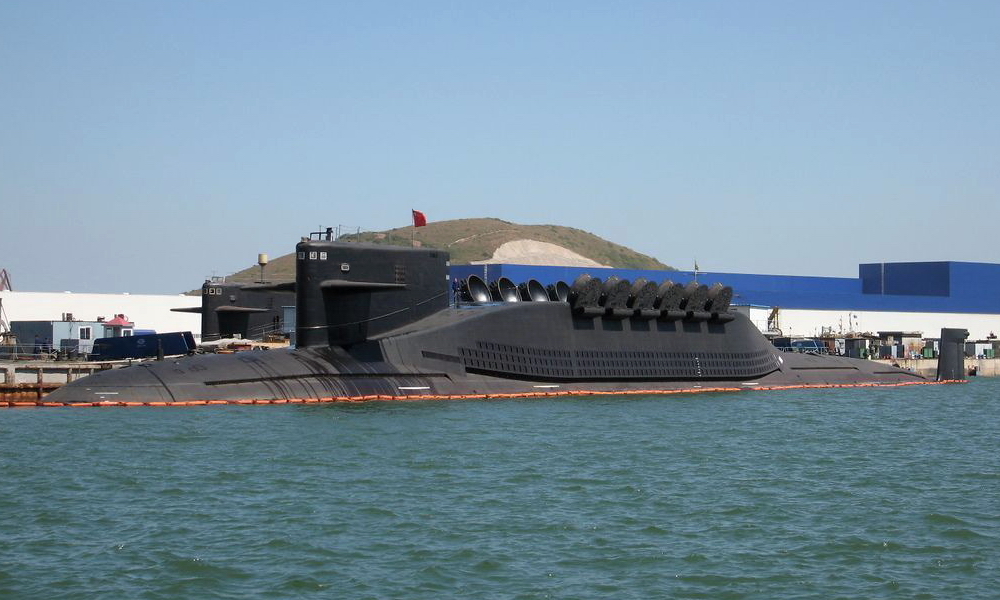
Type 094 Jin-class Nuclear-Powered Ballistic Missile Submarine
Overview
The Type 094 Jin-class represents China's first credible sea-based nuclear deterrent, marking Beijing's transition from a land-based to a true nuclear triad. These nuclear-powered ballistic missile submarines (SSBNs) form the cornerstone of China's second-strike capability, providing survivable nuclear assets that can strike targets across the Pacific and potentially the continental United States from protected bastions in the South China Sea. Designed as China's answer to American Ohio-class and Russian Borei-class SSBNs, the Jin-class reflects both China's nuclear ambitions and its technological limitations. The submarines feature a distinctive turtle-back design housing 12 JL-2 submarine-launched ballistic missiles, each capable of carrying multiple nuclear warheads. However, the class suffers from significant acoustic signatures and reliability issues that limit its operational effectiveness compared to Western counterparts. Strategically, the Type 094 serves dual purposes: providing China with a survivable nuclear deterrent and projecting power into the Pacific. The submarines operate primarily from Hainan Island's underground naval base at Yulin, using the geographic protection of Chinese territorial waters and the noise background of busy shipping lanes to mask their movements. This operational pattern reflects China's "bastion strategy" – protecting SSBNs in near-shore waters rather than deploying them globally. In the current threat environment, the Jin-class represents a game-changer for Pacific security dynamics. While technologically inferior to American SSBNs, their mere existence forces U.S. and allied navies to dedicate significant ASW resources to tracking and potentially countering these platforms. The ongoing development of the improved Type 094A variant and next-generation Type 096 suggests China views sea-based deterrence as critical to its long-term strategic competition with the United States.
Deployment Map
Home ports from known hull assignments. Operating areas reflect typical AORs — individual deployments will vary.
Timeline
Specifications
Armament
Three-stage solid-fuel MIRV capable, estimated 3-8 warheads per missile
Wire-guided, wake-homing capability
Capability unconfirmed, may carry YJ-82 or similar through torpedo tubes
Doctrine & Employment
Role
Provides China's assured second-strike nuclear deterrent through survivable sea-based platforms, enabling Beijing to credibly threaten retaliation even after absorbing a first strike. Essential for China's transition from minimum deterrence to a survivable nuclear triad that can hold American homeland targets at risk.
Design Philosophy
Designers prioritized rapid deployment of a credible sea-based deterrent over acoustic stealth and build quality, accepting higher noise signatures than contemporary Western SSBNs to field capability quickly. The enlarged hull accommodates 12 missile tubes but sacrificed hydrodynamic efficiency and stealth for manufacturing simplicity using proven Type 093 attack submarine technology. China chose evolutionary development over revolutionary design to minimize technical risk and accelerate fielding of second-strike capability.
Employment
Type 094s operate from Hainan Island naval base, conducting deterrent patrols within protected bastions in the South China Sea under cover of land-based air defense and surface combatants. Each submarine carries 12 JL-2 submarine-launched ballistic missiles with ranges of approximately 7,400km, requiring forward deployment to threaten CONUS targets. Operations are tightly controlled by Central Military Commission with direct command authority over nuclear release, reflecting China's centralized nuclear command structure and no-first-use policy.
Threat Context
Developed during the 2000s to counter perceived American first-strike capabilities and regional containment strategies, particularly after observing U.S. precision strike capabilities in Iraq and Afghanistan. The threat environment has since evolved to include advanced ASW capabilities from U.S., Japanese, and Australian forces operating sophisticated sonar networks and underwater sensors throughout the first island chain. Modern threats include persistent surveillance by nuclear attack submarines and the growing deployment of theater missile defenses that could potentially intercept JL-2 warheads.
How to Compare
Compare based on survivability factors - acoustic signature, patrol areas, and missile range - rather than pure technical specifications, as SSBN effectiveness depends on remaining undetected and reaching launch positions. Missile payload and accuracy matter less than the credibility of penetrating enemy defenses and reaching protected patrol areas. Consider command and control integration and basing infrastructure, as Chinese SSBNs operate under different doctrinal constraints than Western counterparts with more centralized nuclear release authority.
Operational Patterns
Typical Deployment
Bastion patrols in South China Sea, occasional transits to deeper Pacific waters
Deployment Length
2 months
Typical Task Group
Usually operates alone, sometimes with Type 093 SSN escort or surface vessel protection
Readiness
Estimated 1-2 submarines on patrol at any given time due to maintenance requirements and crew training cycles
Key Operating Areas
Peer Comparison Matrix
Ohio-class carries 20 Trident D5 missiles vs 12 JL-2s, significantly quieter operation, global deployment capability, proven reliability over decades of operation
Video angle: David vs Goliath: How China's first-generation SSBN stacks up against America's proven nuclear deterrent
Borei-class more advanced acoustically, carries 16 Bulava SLBMs, similar turtle-back design philosophy but better execution
Video angle: Russia's nuclear submarine technology transfer to China and where the student diverged from the teacher
Vanguard smaller but much quieter, carries 16 Trident D5s, designed for solo global operations vs bastion strategy
Video angle: Quality vs Quantity: How Britain's four submarines compare to China's growing SSBN force
French submarines carry 16 shorter-range M51 SLBMs, emphasize independent deterrent vs great power competition, similar fleet size
Video angle: Independent deterrents: How middle powers France and China approach sea-based nuclear weapons differently
Combat History
First confirmed operational patrol by a Type 094 submarine in the South China Sea, marking China's achievement of a credible sea-based nuclear deterrent
Historic milestone establishing China's nuclear triad and changing Pacific strategic balance
Successful JL-2 SLBM test launch from Type 094 submarine in Bohai Sea, demonstrating full operational capability
Confirmed the platform's ability to conduct nuclear strikes from concealed positions
Type 094 conducted 90-day patrol in South China Sea, longest known deployment for the class
Demonstrated improved reliability and crew endurance for sustained deterrent operations
Known Vulnerabilities
Acoustic Signature
Type 094 submarines are significantly noisier than Western SSBNs, with estimated noise levels 10-20 dB higher than Ohio-class submarines
Context: Makes detection by advanced ASW systems much easier, limiting operational areas and requiring geographic protection
Mitigation: Type 094A incorporated some noise reduction measures, but fundamental design limitations remain
Operational Range Limitations
JL-2 missiles cannot reach continental US targets from Chinese territorial waters, requiring submarines to venture into potentially hostile areas
Context: Forces submarines to operate farther from protective bastions, increasing vulnerability to ASW forces
Mitigation: JL-3 missile development aims to address range limitations; improved escort capabilities being developed
Limited Numbers and Reliability
Small fleet size and reported mechanical reliability issues limit sustained deterrent patrols
Context: Reduces credibility of deterrent posture and limits China's ability to maintain continuous at-sea presence
Mitigation: Type 096 program aims to provide larger, more reliable fleet; increased maintenance capabilities at Yulin base
Geographic Constraints
Must transit through chokepoints like Miyako Strait or Luzon Strait to reach open ocean, creating predictable patrol routes
Context: US and allied ASW forces can position assets at chokepoints to track and potentially interdict submarines
Mitigation: Development of alternative routes; increased surface and air escort capabilities in contested areas
Variants
| Variant | Designation | Years | Count | Status | Key Changes |
|---|---|---|---|---|---|
| Type 094 (Original) | 409-414 (estimated hull numbers) | 2007-2015 | 4 | active | Initial production variant with basic JL-2 capability, higher acoustic signature |
| Type 094A (Improved Jin) | 415-416 (estimated) | 2015-present | 2 | active | Improved acoustic dampening, upgraded sonar systems, possible JL-3 SLBM compatibility |
Fleet Roster (6)
| Hull | Name | Variant | Commissioned | Home Port | Status |
|---|---|---|---|---|---|
| 409 (estimated) | Unknown | Type 094 | 2007 | Yulin Naval Base, Hainan | active |
| 410 (estimated) | Unknown | Type 094 | 2009 | Yulin Naval Base, Hainan | active |
| 411 (estimated) | Unknown | Type 094 | 2011 | Yulin Naval Base, Hainan | active |
| 412 (estimated) | Unknown | Type 094 | 2013 | Yulin Naval Base, Hainan | active |
| 413 (estimated) | Unknown | Type 094A | 2015 | Yulin Naval Base, Hainan | active |
| 414 (estimated) | Unknown | Type 094A | 2016 | Yulin Naval Base, Hainan | active |
Modernization Programmes
Type 094A Upgrade Program
Acoustic signature reduction, improved sonar systems, enhanced communications, possible JL-3 missile integration capability
Impact: Reduced detectability and improved tactical effectiveness, though still significantly noisier than Western equivalents
JL-3 SLBM Integration
Integration of longer-range JL-3 SLBM with 12,000+ km range and improved MIRV capabilities
Impact: Would enable strikes on CONUS from Chinese territorial waters, dramatically expanding deterrent reach
Type 096 Replacement Program
Next-generation SSBN with significantly improved acoustic performance, 16-24 missile tubes, and advanced stealth features
Impact: Expected to provide near-peer capability with Western SSBNs and global deployment capability
Images


Frequently Asked
How many Type 094 Jin-class Nuclear-Powered Ballistic Missile Submarine are in service?
6 Type 094 Jin-class Nuclear-Powered Ballistic Missile Submarine are currently in service with People's Liberation Army Navy (PLAN).
When was the first Type 094 Jin-class Nuclear-Powered Ballistic Missile Submarine commissioned?
The first Type 094 Jin-class Nuclear-Powered Ballistic Missile Submarine entered service in 2007.
Who builds the Type 094 Jin-class Nuclear-Powered Ballistic Missile Submarine?
The Type 094 Jin-class Nuclear-Powered Ballistic Missile Submarine is built by Bohai Shipbuilding Heavy Industrial Corporation.
What variants of the Type 094 Jin-class Nuclear-Powered Ballistic Missile Submarine exist?
Known variants include: Type 094 (Original), Type 094A (Improved Jin).
How much does a Type 094 Jin-class Nuclear-Powered Ballistic Missile Submarine cost?
Unit cost is approximately $1.8B per hull.
Curated Research
essential
Authoritative Congressional Research Service analysis of PLAN submarine development including detailed Type 094 capabilities and strategic implications.
Leading Western expert on Chinese naval development with extensive primary source research on PLAN submarine programs and nuclear strategy.
Official U.S. Navy intelligence assessment of global submarine threats including detailed analysis of Chinese SSBN capabilities and limitations.
recommended
CSIS analysis examining China's submarine industrial base and production challenges affecting Type 094 construction quality and capabilities.
Comprehensive examination of China's nuclear doctrine and force structure development including the role of sea-based deterrent forces.
Carnegie Endowment analysis of Chinese nuclear strategy evolution and the strategic role of sea-based deterrent forces.
reference
Technical specifications and development timeline for Type 094 program with details on missile systems and operational capabilities.
Watch Type 094 Jin in Action
Iron Command produces in-depth comparison and analysis videos for military equipment.
Watch on YouTube