
Type 055 Renhai-class destroyer
Iron Command Video Analysis
Arleigh Burke vs Type 055 — Which Destroyer Actually Wins?
Overview
The Type 055 Renhai-class destroyer represents China's most advanced surface combatant and arguably the world's most capable destroyer currently in service. With its 13,000-ton displacement, it's technically a cruiser-sized platform that the PLAN designates as a destroyer, reflecting China's strategic messaging about its naval expansion. The Type 055 was designed as a multi-mission platform capable of air defense, anti-surface warfare, anti-submarine warfare, and land attack — serving as both an escort for Chinese carrier strike groups and as an independent power projection asset. Strategically, the Type 055 represents China's arrival as a blue-water naval power capable of challenging U.S. naval dominance in the Western Pacific and beyond. Its 112-cell VLS system can accommodate a full spectrum of Chinese missiles including the YJ-18 anti-ship missile, HHQ-9B long-range SAMs, and potentially the DF-21D anti-ship ballistic missile. The integrated mast design houses sophisticated phased-array radars and electronic warfare systems, giving it sensor capabilities that rival or exceed most Western destroyers. The platform's design philosophy emphasizes stealth, automation, and multi-domain warfare capabilities. With a crew of only 310 personnel managing a ship larger than most cruisers, the Type 055 demonstrates China's advances in naval automation and damage control systems. Its dual-band radar configuration and comprehensive electronic warfare suite make it a formidable opponent in contested electromagnetic environments. In the current threat environment, the Type 055 fundamentally alters the naval balance in the Indo-Pacific. Its long-range sensors and missiles extend China's anti-access/area-denial (A2/AD) bubble well beyond the first island chain, complicating U.S. and allied naval operations. Compared to peers like the Arleigh Burke Flight III or Type 45, the Type 055 carries significantly more missiles and has superior long-range strike capabilities, though questions remain about its combat systems integration and crew training standards.
Deployment Map
Home ports from known hull assignments. Operating areas reflect typical AORs — individual deployments will vary.
Timeline
Specifications
Armament
Can accommodate HHQ-9B SAM, YJ-18 AShM, CJ-10 LACM, Yu-8 ASW missiles
Single-barrel, 40 rounds/min
Gatling gun system, 10,000 rounds/min
RAM-equivalent short-range interceptor
Yu-7 lightweight torpedoes
Doctrine & Employment
Role
Area air defense flagship for PLAN carrier strike groups and expeditionary task forces, designed to project Chinese naval power beyond the first island chain while providing theater-level command and control capabilities.
Design Philosophy
Chinese designers prioritized maximum VLS capacity (112 cells) and sensor integration over traditional destroyer attributes like speed and maneuverability, accepting a cruiser-sized displacement to achieve cruiser-level capabilities. The design sacrifices cost-effectiveness and operational flexibility for raw firepower and sensor capability, reflecting China's willingness to build fewer, more capable platforms rather than larger numbers of smaller vessels. This represents a clear shift from the PLAN's historical emphasis on quantity over quality.
Employment
Typically deployed as the air defense coordinator for multi-ship task groups, either escorting carriers or leading surface action groups in contested waters. The Type 055 serves as both a sensor platform and missile magazine, cueing fires from other vessels while managing the overall air picture. Its large VLS capacity allows it to function as an arsenal ship, carrying land-attack missiles for joint fires missions. The platform's sophisticated C4I systems enable it to serve as a task force flagship, coordinating multi-domain operations across the electromagnetic spectrum.
Threat Context
Designed to operate in a multi-threat environment dominated by advanced aircraft, anti-ship cruise missiles, and submarine threats from technologically sophisticated adversaries like the US Navy and JMSDF. The threat environment has evolved to include hypersonic weapons, distributed maritime operations, and enhanced electronic warfare capabilities since the Type 055's initial design phase. China's assessment of likely operating environments has shifted from primarily defensive operations within the first island chain to expeditionary operations requiring sustained power projection.
How to Compare
Compare primarily on VLS cell count, radar detection ranges, and C4I integration capabilities rather than traditional metrics like speed or cost-effectiveness, as the Type 055 represents a different design philosophy emphasizing maximum capability per hull. Sensor fusion and multi-domain coordination capabilities matter more than single-platform performance metrics. Magazine depth and sustained firing rates become critical when evaluating the Type 055's role as both sensor platform and arsenal ship in distributed operations.
Operational Patterns
Typical Deployment
Carrier strike group escort, independent surface action groups, territorial defense patrols
Deployment Length
4 months
Typical Task Group
Operates with Type 052D destroyers, Type 054A frigates, and supply ships in surface action groups
Readiness
High operational tempo with multiple hulls regularly at sea; maintenance performed at Dalian and Shanghai facilities
Key Operating Areas
Peer Comparison Matrix
Type 055 carries 16 more VLS cells and has larger displacement, but Flight III has more mature Aegis combat system and proven crew training. Type 055 emphasizes stealth and automation while Burke prioritizes proven reliability.
Video angle: David vs Goliath: Can American experience overcome Chinese technological advancement?
Type 45 has superior air defense radar (SAMPSON) but carries far fewer missiles (48 vs 112 cells). Type 055 is larger, more automated, and has better land-attack capability. Both emphasize advanced sensors over missile quantity.
Video angle: Quality vs Quantity: British precision engineering versus Chinese mass production philosophy
Korean destroyer uses proven Aegis system with 128 VLS cells, but older design philosophy and less stealth features. Type 055 more modern but unproven in combat. Similar displacement and multi-mission capability.
Video angle: East Asian naval arms race: Allied tech versus indigenous Chinese development
Russian frigate smaller (4,500 tons vs 13,000) but carries advanced Tsirkon hypersonic missiles. Type 055 larger sensor suite and more missiles but conventional weapons. Different naval philosophy: Russian long-range precision vs Chinese area control.
Video angle: Allied approaches: Russian missile technology versus Chinese integrated warfare systems
Japanese destroyer uses Aegis baseline 7 with 96 VLS cells, smaller but proven combat system. Type 055 larger, more modern sensors, but Atago benefits from U.S. integration and training. Both designed for area air defense in contested Pacific environment.
Video angle: Island chain defenders: Japanese-American cooperation versus Chinese naval expansion
Combat History
Multiple Type 055s conducted freedom of navigation challenges against U.S. Navy operations, demonstrating advanced tracking and shadowing capabilities.
First operational deployment showed the platform's sensor range and ability to maintain contact with U.S. surface action groups at extended distances.
Type 055 destroyers participated in live-fire missile exercises following Speaker Pelosi's Taiwan visit, launching various missile types from VLS cells.
Demonstrated operational missile launch capabilities and integration of multiple weapon systems in high-tension environment.
Nanchang (101) transited through Miyako Strait with carrier Shandong, marking first Type 055 passage through key chokepoint.
Showcased platform's role in extending Chinese naval reach beyond first island chain and carrier escort capabilities.
Known Vulnerabilities
Combat System Integration
While technically advanced, the integrated combat system lacks the decades of refinement seen in Aegis. Sensor fusion and multi-target engagement capabilities remain largely untested in complex electromagnetic warfare environments.
Context: Against sophisticated EW threats from U.S./allied forces, system performance under jamming is questionable.
Mitigation: PLAN conducting extensive training exercises and reportedly receiving technical assistance from Russian naval systems experts.
Crew Training and Doctrine
PLAN crews have limited blue-water operational experience compared to U.S. Navy counterparts. Damage control and multi-domain warfare tactics are still developing.
Context: In sustained high-intensity naval combat, crew experience becomes critical for survivability and mission effectiveness.
Mitigation: Increased deployment tempo and joint exercises with Russian Navy to gain operational experience.
Supply Chain Dependencies
Key components including advanced semiconductors, precision manufacturing for radar systems, and specialized alloys still rely partially on foreign suppliers vulnerable to sanctions.
Context: Extended conflict could limit maintenance capabilities and production of replacement systems.
Mitigation: Massive investment in domestic semiconductor and advanced manufacturing capabilities through civil-military fusion programs.
Variants
| Variant | Designation | Years | Count | Status | Key Changes |
|---|---|---|---|---|---|
| Type 055 | 101-108 (currently known hulls) | 2020-present | 8 | active | Initial production variant with Type 346B radar, 112-cell VLS, comprehensive sensor suite |
Fleet Roster (8)
| Hull | Name | Variant | Commissioned | Home Port | Status |
|---|---|---|---|---|---|
| 101 | Nanchang | Type 055 | 2020-01-12 | Qingdao | active |
| 102 | Lhasa | Type 055 | 2021-03-02 | Qingdao | active |
| 103 | Anshan | Type 055 | 2021-04-23 | Dalian | active |
| 104 | Wuxi | Type 055 | 2021-12-26 | Dalian | active |
| 105 | Dalian | Type 055 | 2022-04-11 | Sanya | active |
| 106 | Yan'an | Type 055 | 2022-04-11 | Sanya | active |
| 107 | Zunyi | Type 055 | 2022-07-17 | Qingdao | active |
| 108 | Xianyang | Type 055 | 2022-12-26 | Dalian | active |
Modernization Programmes
Type 055A Development
Improved variant reportedly featuring enhanced radar systems, possible integration of hypersonic missiles, and upgraded electronic warfare suite.
Impact: Would maintain technological edge over emerging Western destroyer upgrades and extend missile strike range significantly.
Hypersonic Weapon Integration
Integration of DF-21D anti-ship ballistic missiles and potentially DF-ZF hypersonic glide vehicles into VLS cells.
Impact: Would provide unprecedented long-range precision strike capability against high-value naval targets.
Images


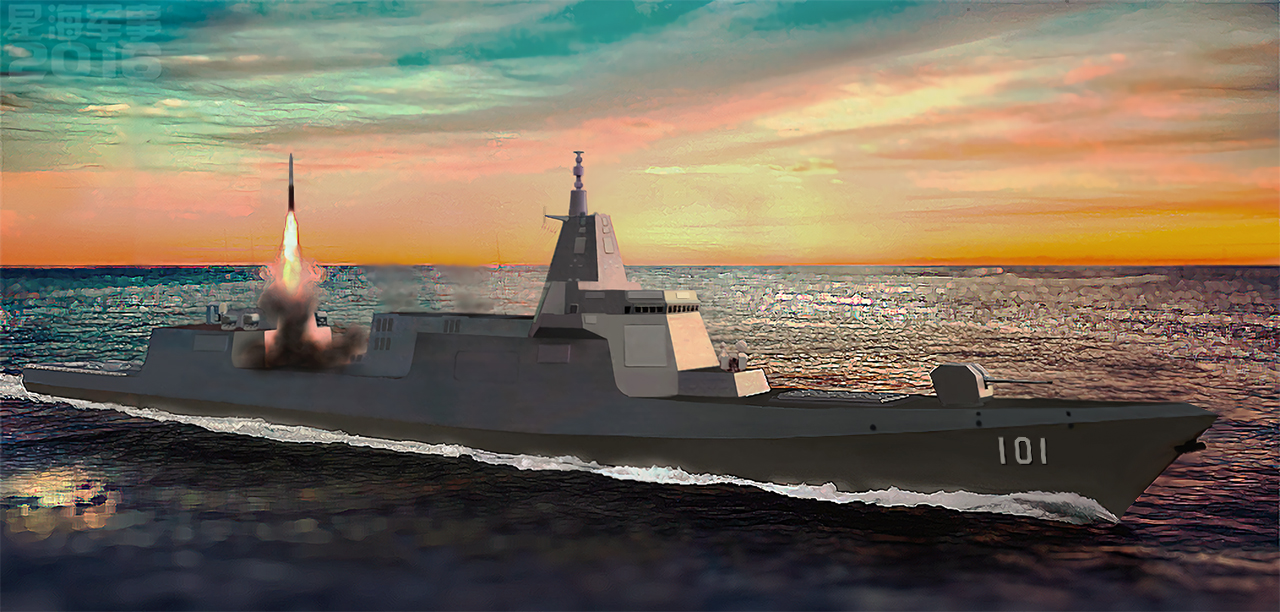


Frequently Asked
How many Type 055 Renhai-class destroyer are in service?
8 Type 055 Renhai-class destroyer are currently in service with People's Liberation Army Navy (PLAN).
When was the first Type 055 Renhai-class destroyer commissioned?
The first Type 055 Renhai-class destroyer entered service in 2020-01-12.
Who builds the Type 055 Renhai-class destroyer?
The Type 055 Renhai-class destroyer is built by Jiangnan Shipyard, Dalian Shipyard.
How much does a Type 055 Renhai-class destroyer cost?
Unit cost is approximately $900M per hull.
Curated Research
essential
Ron O'Rourke's comprehensive analysis of PLAN modernization provides essential context for understanding the Type 055's role in China's broader naval strategy.
Andrew Erickson's expert analysis of PLAN shipbuilding priorities and industrial capacity provides crucial insights into Type 055 production and deployment strategies.
recommended
DoD's annual China Military Power report provides official US assessment of Type 055 capabilities and their implications for regional military balance.
Andreas Rupprecht's detailed examination of PLAN surface combatant development provides technical and operational context for the Type 055's design choices.
CSIS analysis of PLAN transformation and the Type 055's role in achieving blue-water naval capabilities for global power projection.
reference
Comprehensive technical specifications and development history of the Type 055 platform with detailed sensor and weapons system information.
Watch Type 055 Renhai in Action
Iron Command produces in-depth comparison and analysis videos for military equipment.
Watch on YouTube