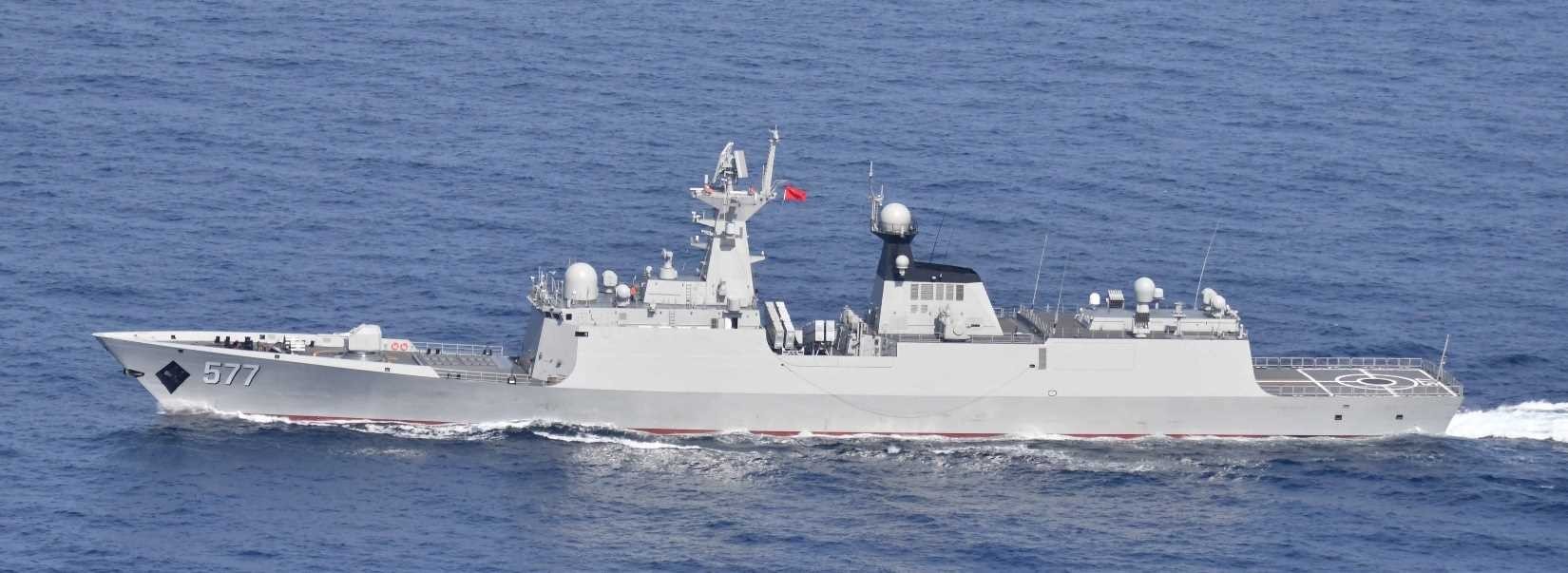
Type 054A Jiangkai II-class frigate
Overview
The Type 054A Jiangkai II-class frigate represents China's first truly modern, blue-water capable surface combatant and the backbone of the People's Liberation Army Navy's (PLAN) expanding fleet. With 40 hulls commissioned between 2008-2023, it is the most numerous modern warship in Chinese service and arguably the most successful frigate design of the 21st century in terms of production numbers and operational impact. Strategically, the Type 054A serves as China's primary escort vessel for carrier strike groups, amphibious ready groups, and independent task forces operating in the South China Sea, Western Pacific, and increasingly in global anti-piracy and diplomatic missions. Its design philosophy emphasizes balanced multi-mission capability rather than specialization, with adequate air defense, anti-surface, and anti-submarine warfare capabilities packaged in a cost-effective hull that can be mass-produced. The platform's significance lies not just in its individual capabilities—which are roughly equivalent to contemporary European frigates like the French FREMM or German F125—but in its role as the foundation of China's naval expansion. The Type 054A demonstrated China's ability to produce modern, reliable warships at scale and served as a technological stepping stone to more advanced designs like the Type 052D destroyer. In the current threat environment, the Type 054A's 32-cell VLS system armed with HHQ-16 medium-range SAMs provides credible area air defense, while its YJ-83 anti-ship missiles and ASW suite make it a well-rounded combatant. However, its limitations become apparent when compared to the latest Western frigates—particularly in radar capability, electronic warfare systems, and VLS cell count—reflecting China's still-developing naval technology base during its design period.
Deployment Map
Home ports from known hull assignments. Operating areas reflect typical AORs — individual deployments will vary.
Timeline
Specifications
Armament
VLS-launched, active radar guidance
Sea-skimming, subsonic
Stealth turret design
7-barrel gatling guns, 5800 rpm
Carries lightweight torpedo
324mm, acoustic homing
Doctrine & Employment
Role
Multi-domain area denial within the first and second island chains, serving as China's primary tool for establishing sea control in contested waters while providing credible anti-air warfare protection for high-value units.
Design Philosophy
Prioritized sensor integration and vertical launch capability over speed and endurance, accepting a modest 27-knot top speed to maximize magazine depth with 32 VLS cells. Designers emphasized multi-mission flexibility and reduced radar signature over specialized anti-submarine warfare capabilities, trading dedicated towed array sonar for hull-mounted systems to reduce complexity and cost.
Employment
Typically operates in task groups of 2-4 frigates with destroyer leadership, providing layered air defense for carrier strike groups or amphibious ready groups. Conducts independent patrol missions in South China Sea and East China Sea, often supported by Type 903A replenishment ships for extended deployments. Increasingly deployed on distant water operations including Gulf of Aden anti-piracy missions and showing-the-flag operations in Indian Ocean and Mediterranean.
Threat Context
Originally designed to counter U.S. carrier aviation and Tomahawk missile threats in Taiwan Strait scenarios, with HHQ-16 SAM system specifically chosen to engage subsonic cruise missiles. Threat environment has evolved to include hypersonic weapons and distributed lethality concepts, driving recent upgrades to combat management systems and electronic warfare suites.
How to Compare
Compare primarily on air defense magazine depth and sensor integration rather than anti-submarine warfare capabilities - the Type 054A prioritizes area air defense over ASW specialization. Speed comparisons are less relevant as all modern frigates accept 25-30 knots as adequate, focus instead on combat system architecture and multi-mission flexibility.
Operational Patterns
Typical Deployment
Carrier strike group escort, independent task group operations, anti-piracy patrols, territorial waters enforcement
Deployment Length
4 months
Typical Task Group
2-3 Type 054As with Type 052D destroyer, supply ship, and submarine support
Readiness
High operational tempo has strained maintenance cycles; some hulls showing wear from intensive South China Sea patrols
Key Operating Areas
Peer Comparison Matrix
FREMM has superior radar (EMPAR AESA), more VLS cells (16-32 Aster + 16 Scalp), but Type 054A has better cost-effectiveness and larger production run. FREMM emphasizes quality, Type 054A emphasizes quantity.
Video angle: Mass production vs high-tech: comparing naval philosophies through frigate design choices
Gorshkov has superior anti-ship firepower (Kalibr missiles), more advanced stealth shaping, but much smaller production numbers and reliability issues. Type 054A prioritizes proven systems over cutting-edge capability.
Video angle: Reliability vs capability: Russian innovation vs Chinese mass production in modern frigate design
Constellation emphasizes network warfare and Aegis integration with 32 VLS cells but costs 3x more than Type 054A. Type 054A trades advanced networking for affordability and proven systems.
Video angle: The new frigate competition: US network warfare vs Chinese mass production strategies
Type 26 is ASW-specialized with ultra-quiet propulsion and advanced sonar, while Type 054A is general-purpose. Type 26 costs 5x more but offers superior ASW capability in specific scenarios.
Video angle: Specialist vs generalist: comparing ASW-focused and multi-role frigate approaches
Similar displacement and mission but Shivalik uses mix of Russian, Israeli, and Indian systems vs Chinese domestic systems on Type 054A. Both emphasize regional power projection but different industrial approaches.
Video angle: Indian Ocean rivalry: comparing Chinese and Indian approaches to naval modernization
Combat History
Type 054As began regular rotations as part of PLAN anti-piracy task forces, marking China's first sustained blue-water naval operations. Multiple hulls have conducted hundreds of escort missions.
Demonstrated China's ability to sustain global naval operations and validated the Type 054A's long-range capabilities and reliability
Frigate Weifang (550) evacuated 449 Chinese nationals and 225 foreign nationals from Yemen during civil war, operating independently in Red Sea.
First major non-combatant evacuation operation by modern PLAN frigate, showcasing diplomatic and humanitarian mission capabilities
Multiple Type 054As participated in naval exercises with Russian, Indian, and other navies, demonstrating interoperability and advanced tactics.
Showed maturation of PLAN surface warfare doctrine and integration with international naval standards
Type 054As regularly intercept and shadow US and allied naval vessels during freedom of navigation operations, with multiple close encounters reported.
Primary PLAN asset for asserting territorial claims and challenging foreign naval presence in disputed waters
Known Vulnerabilities
Air Defense Radar
Type 382 radar uses older rotating array technology, limiting simultaneous target tracking and engagement compared to modern AESA systems. Detection range against low-RCS targets is questionable.
Context: Makes the class vulnerable to coordinated missile attacks and reduces effectiveness against 5th generation aircraft and advanced anti-ship missiles
Mitigation: Batch 2 ships have improved radar processing, but fundamental limitations remain until mid-life upgrades
Electronic Warfare
Limited electronic attack capabilities and relatively basic electronic support measures compared to contemporary Western frigates. Vulnerable to jamming of datalinks and sensors.
Context: Critical weakness in contested electromagnetic environments like Taiwan Strait or against US/allied forces with advanced EW capabilities
Mitigation: Upgrade programs focus on ESM/ECM improvements, but hardware limitations constrain effectiveness
VLS Magazine Depth
Only 32 VLS cells limits sustained combat operations and forces difficult trade-offs between air defense and strike missions. Cannot reload at sea.
Context: In high-intensity conflict, Type 054As would quickly exhaust missile inventory, requiring frequent return to port or vulnerable at-sea replenishment
Mitigation: Tactical employment emphasizes coordination with other platforms, but fundamental limitation remains
Anti-Submarine Warfare
ASW sensors and processing are adequate but not exceptional. Towed array sonar is shorter and less capable than latest Western systems.
Context: Limits effectiveness against quiet nuclear submarines, particularly important given submarine threats to Chinese carrier groups
Mitigation: PLAN doctrine emphasizes coordinated ASW with helicopters and specialized ASW vessels
Variants
| Variant | Designation | Years | Count | Status | Key Changes |
|---|---|---|---|---|---|
| Batch 1 | 530-571 | 2008-2018 | 30 | active | Original production standard with Type 382 radar, basic H/ZBJ-1 combat system |
| Batch 2 | 572-579 | 2018-2023 | 10 | active | Improved electronics, upgraded combat management system, enhanced ESM capabilities |
Fleet Roster (40)
| Hull | Name | Variant | Commissioned | Home Port | Status |
|---|---|---|---|---|---|
| 530 | Xuzhou | Batch 1 | 2008-01-27 | Qingdao | active |
| 529 | Zhoushan | Batch 1 | 2008-12-26 | Ningbo | active |
| 570 | Huangshan | Batch 1 | 2009-05-13 | Qingdao | active |
| 571 | Yuncheng | Batch 1 | 2010-02-01 | Qingdao | active |
| 568 | Hengyang | Batch 1 | 2010-10-25 | Zhanjiang | active |
| 569 | Yulin | Batch 1 | 2011-02-25 | Zhanjiang | active |
| 548 | Yiyang | Batch 1 | 2012-02-14 | Zhanjiang | active |
| 549 | Changzhou | Batch 1 | 2012-07-09 | Qingdao | active |
| 550 | Weifang | Batch 1 | 2013-02-25 | Qingdao | active |
| 538 | Yantai | Batch 1 | 2013-12-22 | Qingdao | active |
| 546 | Yancheng | Batch 1 | 2014-03-21 | Ningbo | active |
| 547 | Linyi | Batch 1 | 2014-12-22 | Qingdao | active |
| 598 | Rizhao | Batch 1 | 2015-01-12 | Qingdao | active |
| 515 | Binzhou | Batch 1 | 2015-08-28 | Qingdao | active |
| 516 | Jingzhou | Batch 1 | 2015-12-12 | Zhanjiang | active |
| 539 | Wuhu | Batch 1 | 2016-02-26 | Ningbo | active |
| 531 | Xiangtan | Batch 1 | 2016-06-12 | Zhanjiang | active |
| 532 | Jingmen | Batch 1 | 2016-12-26 | Zhanjiang | active |
| 601 | Nantong | Batch 1 | 2017-01-22 | Ningbo | active |
| 533 | Sanmenxia | Batch 1 | 2017-02-14 | Zhanjiang | active |
| 540 | Wuxi | Batch 1 | 2017-04-19 | Ningbo | active |
| 541 | Huaihua | Batch 1 | 2017-08-22 | Zhanjiang | active |
| 542 | Zaozhuang | Batch 1 | 2017-12-12 | Qingdao | active |
| 543 | Qinzhou | Batch 1 | 2018-01-17 | Zhanjiang | active |
| 544 | Xianning | Batch 1 | 2018-04-04 | Zhanjiang | active |
| 545 | Linfen | Batch 1 | 2018-04-18 | Qingdao | active |
| 551 | Weifang | Batch 1 | 2018-08-22 | Qingdao | active |
| 552 | Hengshui | Batch 1 | 2018-09-25 | Qingdao | active |
| 553 | Jieyang | Batch 1 | 2018-12-28 | Zhanjiang | active |
| 554 | Anyang | Batch 1 | 2019-01-12 | Qingdao | active |
| 572 | Weifang | Batch 2 | 2020-01-17 | Qingdao | active |
| 573 | Liuzhou | Batch 2 | 2020-08-28 | Zhanjiang | active |
| 574 | Sanya | Batch 2 | 2021-01-25 | Zhanjiang | active |
| 575 | Yueyang | Batch 2 | 2021-04-23 | Zhanjiang | active |
| 576 | Daqing | Batch 2 | 2021-12-17 | Qingdao | active |
| 577 | Huanggang | Batch 2 | 2022-06-08 | Zhanjiang | active |
| 578 | Jieyang | Batch 2 | 2022-12-26 | Zhanjiang | active |
| 579 | Nanning | Batch 2 | 2023-04-28 | Zhanjiang | active |
| 580 | Handan | Batch 2 | 2023-08-31 | Qingdao | active |
| 581 | Qiqihar | Batch 2 | 2023-12-26 | Qingdao | active |
Modernization Programmes
Mid-Life Upgrade Program
Early batch hulls receiving upgraded combat management systems, improved ESM/ECM capabilities, and enhanced datalink systems to maintain relevance.
Impact: Extends service life and maintains combat effectiveness against evolving threats, particularly in electronic warfare
Type 054B Development
Next-generation frigate incorporating lessons learned from Type 054A operations, featuring AESA radar, integrated mast, and larger VLS capacity.
Impact: Type 054A production ended in 2023 as focus shifts to more advanced Type 054B design
Images


Frequently Asked
How many Type 054A Jiangkai II-class frigate are in service?
40 Type 054A Jiangkai II-class frigate are currently in service with People's Liberation Army Navy.
When was the first Type 054A Jiangkai II-class frigate commissioned?
The first Type 054A Jiangkai II-class frigate entered service in 2008-01-27.
Who builds the Type 054A Jiangkai II-class frigate?
The Type 054A Jiangkai II-class frigate is built by Hudong-Zhonghua Shipbuilding, Huangpu Shipyard.
What variants of the Type 054A Jiangkai II-class frigate exist?
Known variants include: Batch 1, Batch 2.
How much does a Type 054A Jiangkai II-class frigate cost?
Unit cost is approximately $350M per hull.
Curated Research
essential
Comprehensive analysis of PLAN surface combatant development including detailed Type 054A program assessment and strategic implications.
Andrew Erickson's authoritative analysis of PLAN shipbuilding priorities and the Type 054A's role in fleet modernization.
recommended
Definitive academic analysis of PLAN doctrinal evolution and surface combatant employment concepts including frigate operations.
Official Chinese doctrinal publication outlining 'far seas protection' mission that drives Type 054A employment patterns.
CSBA analysis of A2/AD concepts that explain the Type 054A's design priorities and operational employment.
reference
Comprehensive technical specifications and construction timeline for all Type 054A hulls with regular updates.
Naval War College analysis of PLAN surface combatant doctrine during Type 054A development period.
Watch Type 054A Jiangkai II in Action
Iron Command produces in-depth comparison and analysis videos for military equipment.
Watch on YouTubeSources