Type 052D Luyang III-class destroyer
Overview
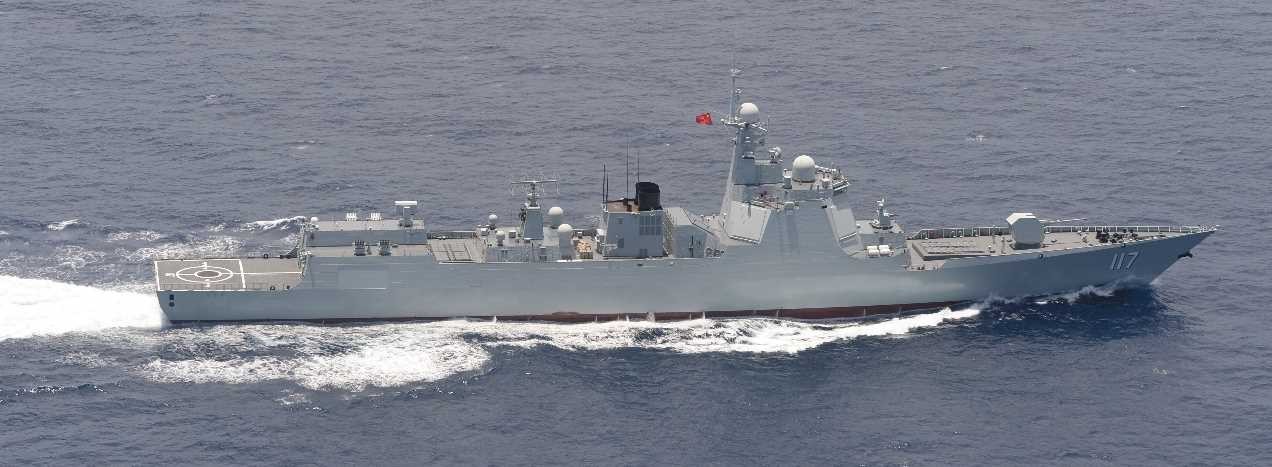
The Type 052D Luyang III-class destroyer represents China's first truly modern multi-mission destroyer, marking the PLAN's transition from a coastal defense force to a blue-water navy capable of power projection. Commissioned beginning in 2014, these vessels are China's answer to the Arleigh Burke class, featuring the indigenous Type 346A AESA radar system and a 64-cell vertical launch system capable of firing a variety of missiles including the YJ-18 supersonic anti-ship missile and HHQ-9 long-range surface-to-air missiles. Strategically, the Type 052D serves as the primary air defense escort for PLAN carrier strike groups and amphibious ready groups, while also providing independent surface action group capability in contested environments like the South China Sea. The design philosophy emphasizes multi-domain warfare capability with particular strength in anti-air warfare, though anti-submarine warfare remains a relative weakness compared to Western counterparts. In the current threat environment, the Type 052D represents China's most capable surface combatant in significant numbers, with production running from 2012 to 2021 before transitioning to the larger Type 052DL variant. These destroyers have been central to China's assertive posture in the South China Sea and represent a credible threat to regional naval forces, particularly when operating in coordinated task groups. Compared to peers like the Arleigh Burke Flight IIA, the Type 052D trades some multi-mission flexibility for specialized anti-surface warfare capability, particularly with its supersonic YJ-18 missiles. However, it suffers from less mature ASW systems and questions remain about the effectiveness of its combat systems in a high-intensity electronic warfare environment against peer adversaries.
Deployment Map
Home ports from known hull assignments. Operating areas reflect typical AORs — individual deployments will vary.
Timeline
Specifications
Armament
Supersonic terminal phase, sea-skimming
Area air defense, BMD capable
Tomahawk equivalent, uncertain integration
130mm/70 caliber, 40 rounds/minute
11,000 rounds/minute, 30mm
VLS-launched ASW weapon
324mm, helicopter-delivered
Doctrine & Employment
Role
Multi-domain sea control within the first and second island chains, serving as the PLAN's primary surface combatant for contested environments where air superiority cannot be guaranteed.
Design Philosophy
Prioritized magazine depth and multi-mission flexibility over specialized anti-submarine warfare capabilities, sacrificing towed array sonar and dedicated ASW helicopter facilities for a larger 64-cell VLS and enhanced air defense radar. Emphasized indigenous systems integration and reduced foreign dependency, accepting initial capability gaps to achieve technological sovereignty.
Employment
Operates as the centerpiece of PLAN surface action groups, typically paired with Type 054A frigates and supported by Type 901 replenishment ships for extended operations. Primarily deployed with the East and South Sea Fleets for Taiwan Strait and South China Sea operations, with increasing North Fleet deployments for anti-access missions in the Yellow Sea. Functions as both independent task group leader and as escort for carrier strike groups, with command authority over frigate and corvette elements.
Threat Context
Designed for high-intensity conflict against peer adversaries with advanced air and missile capabilities, particularly US carrier strike groups and Japanese Maritime Self-Defense Force surface combatants. Originally conceived for A2/AD missions, but threat evolution toward multi-domain operations has expanded requirements to include long-range precision strike and expeditionary operations beyond the first island chain.
How to Compare
Compare primarily on VLS magazine depth, radar detection ranges, and missile engagement envelopes rather than traditional metrics like displacement or speed. Focus on sensor-shooter integration and multi-mission flexibility, as modern surface combats prioritize magazine sustainability and sensor range over maneuverability or single-mission optimization.
Operational Patterns
Typical Deployment
Carrier strike group escort, South China Sea patrol, Taiwan Strait area denial operations
Deployment Length
3 months
Typical Task Group
2-3 Type 052D with Type 055, Type 054A frigates, and replenishment ship
Readiness
High operational tempo in home waters but limited extended deployment capability
Key Operating Areas
Peer Comparison Matrix
Burke has superior ASW capability and combat system maturity, but Type 052D has supersonic anti-ship missiles and newer AESA radar. Burke is larger with more VLS cells (96 vs 64).
Video angle: David vs Goliath comparison - China's newest vs America's workhorse destroyer
Atago uses proven Aegis system but is older design. Type 052D has more modern sensors but less proven combat systems. Similar displacement but different mission focus.
Video angle: East Asian destroyer showdown - Chinese innovation vs Japanese-American partnership
Type 052D is more mature and numerous (25 vs 3 ships). Kolkata has BrahMos supersonic missiles but less capable radar and fewer VLS cells.
Video angle: Asian naval rivalry - quantity vs quality in destroyer design
Type 45 has superior air defense radar (SAMPSON/S1850M) but persistent propulsion problems. Type 052D more reliable but less sophisticated sensors.
Video angle: European sophistication vs Chinese reliability - different approaches to destroyer design
Maya represents Japan's response to Type 052D threat, with BMD focus and Aegis Baseline 9. Type 052D prioritizes anti-surface warfare over BMD.
Video angle: Action-reaction cycle - how Chinese Type 052D drove Japanese Maya-class development
Combat History
Type 052D destroyers participated in major PLAN exercises following The Hague arbitration ruling, demonstrating China's rejection of international law
First major operational deployment showcasing the class as China's primary surface combatant in contested waters
PLAN Type 052D destroyer shadowed USS Decatur during FONOPS near Gaven and Johnson Reefs, leading to near-collision incident
Demonstrated aggressive operational posture and willingness to use Type 052Ds in direct confrontation with US Navy
Multiple Type 052D destroyers conducted high-tempo operations during Taiwan Strait crisis, tracking US and allied naval movements
Established Type 052D as primary platform for Taiwan contingency operations and maritime area denial
Type 052D destroyers provided air defense escort for Liaoning carrier group operations near Taiwan and through Miyako Strait
First major blue-water deployment demonstrating integrated carrier escort capability
Known Vulnerabilities
Anti-Submarine Warfare
ASW capability significantly inferior to Western counterparts, limited towed array sonar, questionable crew training in ASW operations
Context: In a Taiwan scenario, vulnerability to US and allied submarine forces could be decisive
Mitigation: Planned ASW upgrades and increased cooperation with ASW helicopters and MPAs
Electronic Warfare Resilience
Combat systems lack proven performance against sophisticated EW attacks, heavy reliance on Chinese semiconductors of uncertain reliability
Context: US and allied EW capabilities could degrade Chinese C4ISR networks that Type 052D depends on
Mitigation: Unknown extent of EW hardening in newer variants
Logistics and Sustainment
Limited replenishment-at-sea capability, complex maintenance requirements, no overseas basing for extended operations
Context: Operational range effectively limited to first and second island chains without risk
Mitigation: Development of overseas bases and improved replenishment ships
Crew Experience
PLAN crews lack combat experience and intensive training compared to US Navy, rapid expansion straining experienced personnel
Context: In high-intensity combat, training and experience gaps could prove decisive
Mitigation: Increased training tempo and international exercises
Variants
| Variant | Designation | Years | Count | Status | Key Changes |
|---|---|---|---|---|---|
| Type 052D | 172-190 | 2014-2019 | 13 | active | Initial production variant with Type 346A radar and 64-cell VLS |
| Type 052DL | 119-136 | 2018-2021 | 12 | active | Extended hull (+15m), larger hangar, improved sensors, enhanced stealth features |
Fleet Roster (25)
| Hull | Name | Variant | Commissioned | Home Port | Status |
|---|---|---|---|---|---|
| 172 | Kunming | Type 052D | 2014-03-21 | Qingdao | active |
| 173 | Changsha | Type 052D | 2014-08-12 | Sanya | active |
| 174 | Hefei | Type 052D | 2015-12-12 | Qingdao | active |
| 175 | Yinchuan | Type 052D | 2016-07-12 | Qingdao | active |
| 117 | Xining | Type 052D | 2017-01-22 | Qingdao | active |
| 118 | Urumqi | Type 052D | 2017-01-22 | Sanya | active |
| 119 | Guiyang | Type 052DL | 2019-01-31 | Zhanjiang | active |
| 120 | Chengdu | Type 052DL | 2019-12-26 | Zhanjiang | active |
| 121 | Qiqihar | Type 052DL | 2019-12-26 | Qingdao | active |
| 122 | Tangshan | Type 052DL | 2020-08-28 | Qingdao | active |
| 123 | Huainan | Type 052DL | 2020-08-28 | Sanya | active |
| 124 | Kaifeng | Type 052DL | 2021-04-23 | Zhanjiang | active |
| 125 | Zibo | Type 052DL | 2021-04-23 | Qingdao | active |
| 126 | Yan'an | Type 052DL | 2021-12-17 | Sanya | active |
| 127 | Xuzhou | Type 052DL | 2021-12-17 | Zhanjiang | active |
| 128 | Taiyuan | Type 052DL | 2022-04-11 | Qingdao | active |
| 131 | Taiyuan | Type 052DL | 2022-04-11 | Sanya | active |
| 132 | Suzhou | Type 052DL | 2022-10-26 | Zhanjiang | active |
| 133 | Jinan | Type 052DL | 2022-10-26 | Qingdao | active |
| 161 | Hohhot | Type 052D | 2017-07-12 | Sanya | active |
| 162 | Nanning | Type 052D | 2017-12-12 | Zhanjiang | active |
| 163 | Nanchang | Type 052D | 2018-07-12 | Sanya | active |
| 164 | Guilin | Type 052D | 2019-01-12 | Zhanjiang | active |
| 165 | Zhuhai | Type 052D | 2019-07-12 | Sanya | active |
| 166 | Zunyi | Type 052D | 2020-01-12 | Zhanjiang | active |
Modernization Programmes
Type 052D Mid-Life Upgrade
Planned upgrades include enhanced electronic warfare systems, improved combat management systems, and integration of hypersonic missiles
Impact: Would extend service life and maintain relevance against evolving threats
YJ-21 Hypersonic Integration
Integration of YJ-21 hypersonic anti-ship ballistic missile into VLS cells, requires combat system modifications
Impact: Provides capability to engage high-value targets at extreme range with near-impossible interception
ASW Suite Enhancement
Upgrade to towed array sonar systems and improved ASW helicopter integration with Z-20F
Impact: Addresses critical ASW capability gap compared to Western counterparts
Images


Frequently Asked
How many Type 052D Luyang III-class destroyer are in service?
25 Type 052D Luyang III-class destroyer are currently in service with People's Liberation Army Navy (PLAN).
When was the first Type 052D Luyang III-class destroyer commissioned?
The first Type 052D Luyang III-class destroyer entered service in 2014-03-21.
Who builds the Type 052D Luyang III-class destroyer?
The Type 052D Luyang III-class destroyer is built by Jiangnan Shipyard Group / Dalian Shipbuilding Industry Company.
What variants of the Type 052D Luyang III-class destroyer exist?
Known variants include: Type 052D, Type 052DL.
How much does a Type 052D Luyang III-class destroyer cost?
Unit cost is approximately $900M per hull.
Curated Research
essential
Ron O'Rourke's comprehensive analysis provides essential context on PLAN modernization strategy and Type 052D's role in China's naval transformation.
Andrew Erickson's analysis offers critical insights into PLAN doctrine and the Type 052D's place in China's surface combatant hierarchy.
recommended
Provides comprehensive doctrinal context for PLAN surface combatant employment and the strategic rationale behind the Type 052D program.
CSIS assessment contextualizes the Type 052D within broader PLA modernization goals and joint operations concepts.
US Naval War College analysis provides tactical-level insights into Type 052D operational employment and capability assessment.
reference
Comprehensive technical specifications and variant analysis for comparative assessment against peer surface combatants.
Official PLA doctrinal publication outlining naval warfare concepts that drive Type 052D employment patterns and mission requirements.
Watch Type 052D Luyang III in Action
Iron Command produces in-depth comparison and analysis videos for military equipment.
Watch on YouTube