
Triomphant-class submarine
Overview
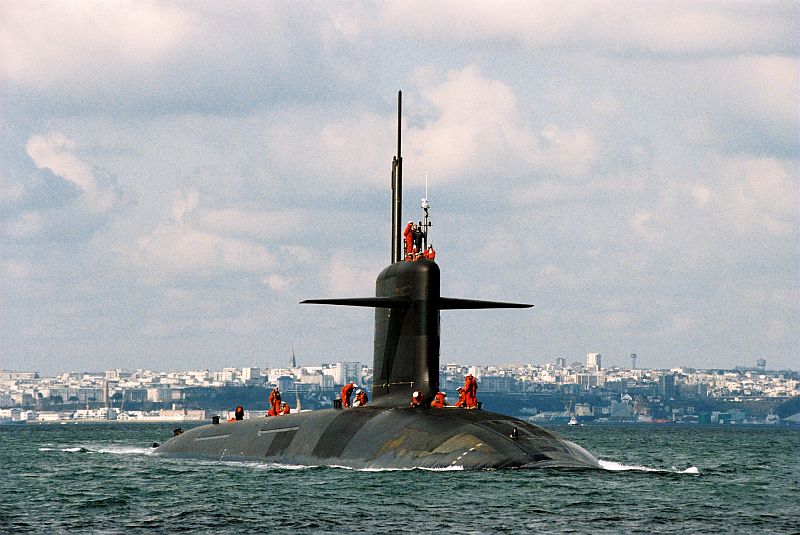
The Triomphant-class submarines (SNLE-NG - Sous-marin Nucléaire Lanceur d'Engins de Nouvelle Génération) represent France's third-generation ballistic missile submarines and the backbone of French nuclear deterrence. These four boats carry France's sea-based nuclear deterrent, operating as the maritime leg of the country's *Force de frappe* nuclear triad. Each submarine carries 16 M45 or M51 submarine-launched ballistic missiles, providing France with a survivable second-strike capability that has proven essential to European strategic stability. Designed during the Cold War but commissioned in the post-Soviet era, the Triomphant class reflects French strategic autonomy and technological sophistication. Unlike their American or British counterparts, these submarines operate independently of NATO's integrated nuclear planning, serving purely French national interests. The class incorporates advanced quieting technologies, including pump-jet propulsion and anechoic coatings, making them among the quietest nuclear submarines in operation. Strategically, the Triomphant class ensures France maintains its position as an independent nuclear power, providing deterrence against both state and sub-state threats. In the current multipolar threat environment, these submarines offer France significant diplomatic leverage and strategic flexibility. Their ability to remain undetected for months while maintaining continuous at-sea deterrent patrols makes them a critical component of European defense architecture. Compared to peers like the British Vanguard class or American Columbia class, the Triomphant submarines are smaller and carry fewer missiles, but they represent a fully indigenous French capability from reactor to warhead. This independence comes at a premium cost but provides France with complete operational sovereignty over its nuclear deterrent - a capability that remains politically essential to French grand strategy and its permanent UN Security Council status.
Deployment Map
Home ports from known hull assignments. Operating areas reflect typical AORs — individual deployments will vary.
Timeline
Specifications
Armament
MIRV warheads, replacing earlier M45 missiles
Wire-guided, dual-purpose anti-ship/anti-submarine
Encapsulated launch from torpedo tubes
Doctrine & Employment
Role
Ensures the credibility and survivability of France's independent nuclear deterrent by providing an undetectable second-strike capability that guarantees unacceptable damage to any aggressor. These submarines exist to make France's nuclear threats credible by operating beyond the reach of first-strike attacks.
Design Philosophy
French designers prioritized stealth and endurance over speed, accepting a relatively modest 25-knot submerged speed to minimize acoustic signature through pump-jet propulsion and anechoic coatings. The design sacrifices weapons versatility for missile capacity, carrying no land-attack cruise missiles to maximize SLBM loadout. Hull size was optimized for Atlantic operations rather than global reach, trading some internal volume for reduced detectability.
Employment
Triomphant-class submarines operate in sustained solo patrols lasting 60-70 days, with one boat always on deterrent patrol while others cycle through maintenance and training. They deploy to patrol areas in the North Atlantic and potentially the Indo-Pacific, maintaining radio silence and avoiding detection through careful route planning and noise discipline. Command authority flows directly from the French President through the Chief of Defence Staff, bypassing NATO command structures to preserve France's strategic autonomy.
Threat Context
Designed during the Cold War's end to penetrate improved Soviet/Russian ASW capabilities while maintaining credible deterrence against regional nuclear powers. The threat environment has evolved to include Chinese ASW expansion in the Indo-Pacific and potential peer competitors with advanced submarine detection technologies, challenging the traditional sanctuary concept of SSBN operations.
How to Compare
Compare Triomphant-class boats primarily on acoustic stealth and missile range rather than speed or payload weight—all modern SSBNs achieve adequate mobility and destructive capacity. The critical dimensions are detectability by adversary ASW assets, patrol endurance without resupply, and missile survivability against ABM systems through penetration aids and multiple warheads.
Operational Patterns
Typical Deployment
Continuous At-Sea Deterrent (FOST - Force Océanique Stratégique) patrols with one submarine on patrol at all times
Deployment Length
2.5 months
Typical Task Group
Solo operations, occasionally coordinated with French SSNs for security
Readiness
High operational tempo with 60-day standard patrols, maintenance windows carefully scheduled to maintain continuous deterrent
Key Operating Areas
Peer Comparison Matrix
Vanguard is larger (15,900 tons) with 16 Trident D5 missiles providing greater range and payload flexibility. Both maintain continuous deterrent patrols but Triomphant represents independent French technology while Vanguard uses US missiles.
Video angle: European nuclear deterrent comparison - independent French vs. Anglo-American cooperation models
Jin-class is larger but significantly noisier with less sophisticated sonar. Triomphant has better stealth characteristics but Jin carries 12 longer-range JL-2 missiles. French boat represents mature technology vs. Chinese rapid development.
Video angle: Established vs. emerging nuclear powers - quality vs. quantity in submarine deterrence
Borei is newer (2013+) and larger with 16 Bulava missiles, but Triomphant likely has superior quieting and sensors. Russian boat benefits from larger fleet size (4+ boats) providing more flexible patrol schedules.
Video angle: NATO vs. Russian nuclear submarine capabilities in the Atlantic theater
Ohio-class is massive (18,750 tons) with 24 Trident D5 missiles, representing overwhelming firepower vs. French minimum deterrence philosophy. US has 14 boats vs. France's 4, showing different strategic approaches to nuclear deterrence.
Video angle: Minimum deterrence vs. maximum capability - French strategic autonomy vs. American nuclear umbrella
Combat History
Le Triomphant collided with HMS Vanguard in the Atlantic while both were on patrol. Both submarines were damaged but returned safely to port.
Highlighted the risks of multiple SSBN patrols in congested waters and the extreme secrecy surrounding nuclear deterrent operations
Le Terrible completed an extended 72-day patrol during COVID-19 lockdowns, maintaining continuous deterrent despite crew isolation protocols.
Demonstrated operational resilience and crew endurance capabilities under extraordinary circumstances
Known Vulnerabilities
Small Fleet Size
Only four submarines means typically one on patrol, one in refit, one in maintenance, and one in training/transit. Limited redundancy compared to US/UK fleets.
Context: Leaves France vulnerable to temporary gaps in deterrent coverage during unexpected maintenance or operational issues
Mitigation: Careful scheduling and increased patrol duration when necessary, plus reliance on air and land-based nuclear forces
Chokepoint Vulnerability
All Triomphant submarines must transit from Brest through relatively constrained European waters to reach patrol areas, potentially exposing them to advanced ASW detection.
Context: Russian and other adversary submarine and sensor networks in the Atlantic could potentially track French SSBNs during transit
Mitigation: Varied transit routes, coordination with allied ASW forces, and use of decoy operations
Industrial Base Dependencies
Reliance on single domestic suppliers for critical components creates potential supply chain vulnerabilities and limits surge production capability.
Context: Extended conflicts could strain France's ability to maintain submarine readiness without allied industrial support
Mitigation: Strategic stockpiling of critical components and some cooperation agreements with allied nations
Variants
| Variant | Designation | Years | Count | Status | Key Changes |
|---|---|---|---|---|---|
| Initial Configuration | S616-S619 | 1997-2010 | 4 | active | Original configuration with M45 missiles, DMUX-80 sonar, K15 reactor |
| M51 Upgraded | S616-S619 | 2010-present | 4 | active | M51 SLBM integration, enhanced sonar processing, improved communications |
Fleet Roster (4)
| Hull | Name | Variant | Commissioned | Home Port | Status |
|---|---|---|---|---|---|
| S616 | Le Triomphant | M51 Upgraded | 1997-03-21 | Île Longue, Brest | active |
| S617 | Le Téméraire | M51 Upgraded | 1999-12-23 | Île Longue, Brest | active |
| S618 | Le Vigilant | M51 Upgraded | 2004-11-26 | Île Longue, Brest | active |
| S619 | Le Terrible | M51 Upgraded | 2010-09-20 | Île Longue, Brest | active |
Modernization Programmes
M51.3 Missile Upgrade
Integration of improved M51.3 missiles with enhanced range, accuracy, and penetration aids. Includes updated fire control systems and missile interfaces.
Impact: Extends deterrent credibility against advanced ballistic missile defenses and increases target flexibility
SNLE-3G Development
Next-generation SSBN program to replace Triomphant class with larger, more capable submarines carrying new-generation SLBMs.
Impact: Will maintain French nuclear deterrent capability through 2080s with enhanced survivability and firepower
Sonar Modernization
Upgrade of DMUX-80 sonar with improved processing capabilities, new towed arrays, and enhanced passive detection range.
Impact: Improves survivability against increasingly sophisticated anti-submarine warfare threats
Images


Frequently Asked
How many Triomphant-class submarine are in service?
4 Triomphant-class submarine are currently in service with French Navy (Marine nationale).
When was the first Triomphant-class submarine commissioned?
The first Triomphant-class submarine entered service in 1997-03-21.
Who builds the Triomphant-class submarine?
The Triomphant-class submarine is built by Naval Group (formerly DCNS).
What variants of the Triomphant-class submarine exist?
Known variants include: Initial Configuration, M51 Upgraded.
How much does a Triomphant-class submarine cost?
Unit cost is approximately $3.2B per hull.
Curated Research
essential
Provides authoritative technical analysis of French SLBM systems and submarine-launched nuclear weapons integration across multiple editions.
Analyzes the strategic logic and operational employment of French SSBNs within the broader context of independent nuclear deterrence.
Leading French strategic analyst's assessment of SSBN force structure requirements and modernization priorities through 2040.
recommended
Primary contractor provides official specifications and capability descriptions for Triomphant-class submarines and M51 missile integration.
Examines French SSBN modernization programs and their relationship to NATO nuclear planning and European strategic autonomy.
reference
Comprehensive technical specifications database with hull numbers, commissioning dates, and system configurations for all four boats.
Historical context for Triomphant-class development decisions and comparison with contemporary American, British, and Russian SSBN programs.
Watch Triomphant in Action
Iron Command produces in-depth comparison and analysis videos for military equipment.
Watch on YouTube