
Ticonderoga-class guided-missile cruiser
Overview
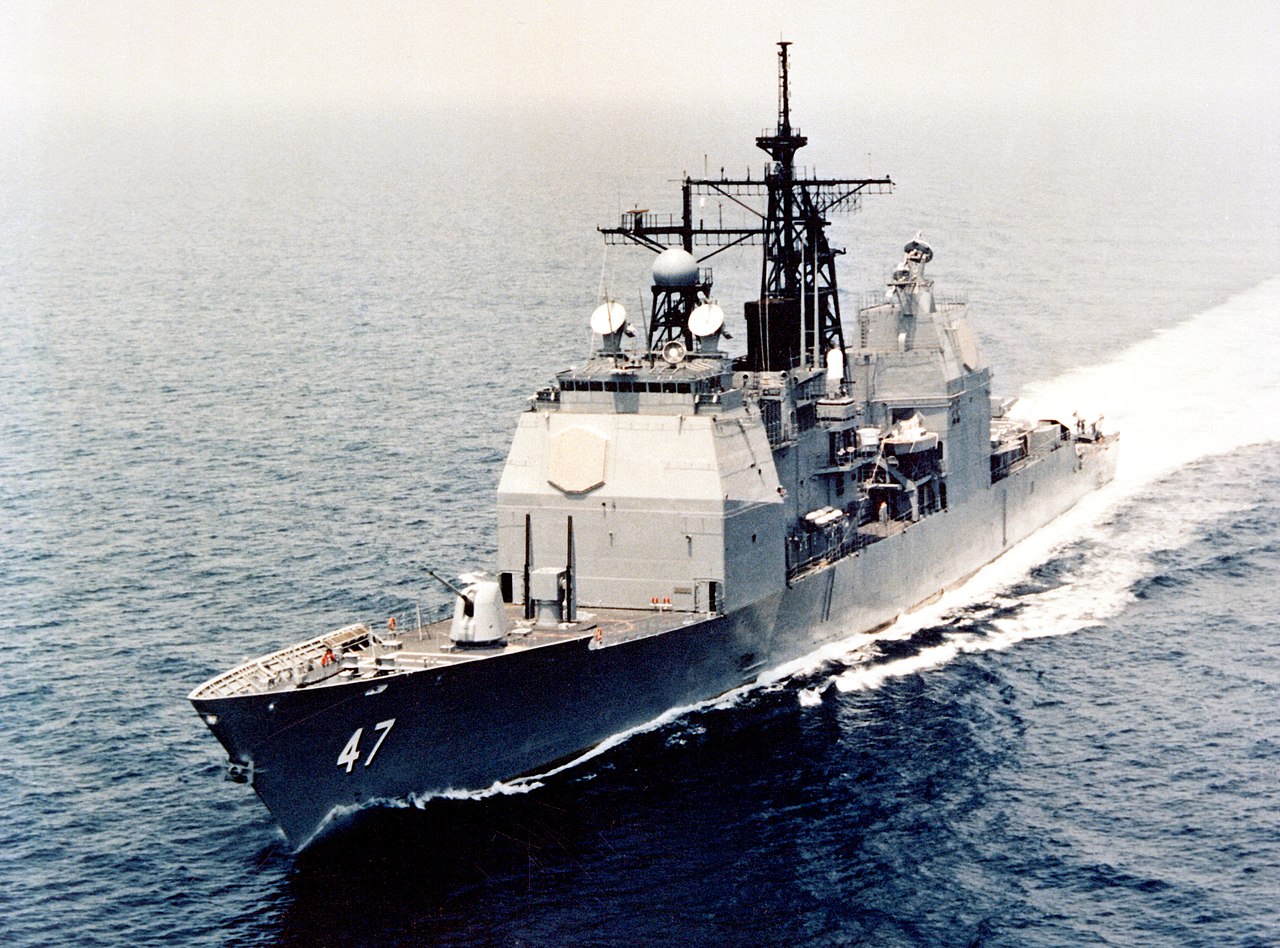
The Ticonderoga-class guided-missile cruiser represents the backbone of U.S. Navy surface warfare capabilities, serving as the world's first Aegis-equipped warships since 1983. These 9,800-ton vessels were revolutionary in introducing the SPY-1 phased-array radar and Aegis Combat System, creating an integrated air defense umbrella that remains unmatched in capability density. Originally designed around the Cold War threat of Soviet saturation missile attacks, the class has evolved into multi-mission platforms capable of ballistic missile defense, land attack, and anti-surface warfare. Strategically, Ticonderoga-class cruisers serve as the primary air warfare commanders in carrier strike groups and as independent BMD platforms in high-threat theaters. Their 122-cell VLS capacity, combined with the mature Aegis system, provides unparalleled missile magazine depth compared to any other surface combatant globally. The class pioneered the concept of a 'smart ship' with centralized combat management, influencing every subsequent U.S. surface combatant design. In the current threat environment, these cruisers face the challenge of aging hulls (average age 30+ years) while carrying increasingly sophisticated mission loads. The Navy's decision to retire the class by 2027 reflects both fiscal constraints and the reality that 1980s hull designs struggle with modern power and cooling requirements. However, no direct replacement exists—the planned DDG(X) won't match the Ticonderoga's VLS capacity or command spaces. Compared to peers like China's Type 055 or Russia's Kirov-class, the Ticonderoga trades raw firepower and modern sensors for proven combat systems integration and decades of operational refinement. While newer designs may have superior individual components, no platform has demonstrated the sustained operational tempo and mission flexibility of the Ticonderoga class across multiple decades and conflict zones.
Deployment Map
Home ports from known hull assignments. Operating areas reflect typical AORs — individual deployments will vary.
Timeline
Specifications
Armament
Primary air defense weapon
Land attack and anti-ship variants
Rocket-delivered torpedo
Forward and aft mounts
Last-resort point defense
External canisters on some ships
Doctrine & Employment
Role
Area air defense command ship designed to establish and maintain air superiority over carrier strike groups and amphibious ready groups through integrated missile defense and battle management.
Design Philosophy
Prioritized radar performance and magazine depth over speed and stealth, accepting a large radar cross-section to mount the massive SPY-1 arrays. Sacrificed helicopter facilities and some survivability features to maximize vertical launch system capacity and command facilities. Design emphasized network-centric warfare capabilities and multi-mission flexibility over specialization in any single domain.
Employment
Typically deployed as the air warfare commander (AWC) in carrier strike groups, positioned to maximize radar coverage while maintaining tactical flexibility. Forms the defensive backbone of surface action groups, coordinating with destroyers and frigates to create layered air defense zones. Increasingly tasked with ballistic missile defense missions in forward-deployed postures, particularly in the Western Pacific and Eastern Mediterranean.
Threat Context
Originally designed to counter Soviet Tu-22M Backfire bombers carrying AS-4 Kitchen anti-ship missiles in coordinated saturation attacks during the Cold War. Today faces more diverse threats including hypersonic missiles, swarming small boat attacks, and integrated anti-access/area-denial systems, while maintaining relevance through software upgrades and missile defense capabilities.
How to Compare
Compare primarily on radar range/discrimination capability and total VLS cells rather than platform speed or stealth characteristics. Magazine depth and multi-mission flexibility matter more than single-domain optimization since both Western and peer navies accept 30+ knot speeds as adequate. Focus on command and control capabilities and upgrade potential rather than raw kinematic performance.
Operational Patterns
Typical Deployment
Carrier Strike Group air warfare commander, independent BMD patrol, surface action group flagship
Deployment Length
7 months
Typical Task Group
CSG with carrier and destroyers, or independent with DDG escorts
Readiness
Declining availability rates due to aging systems, with typical 60-70% mission-capable rate vs 80%+ target
Key Operating Areas
Peer Comparison Matrix
Type 055 has 112 VLS cells vs 122, but newer design with better stealth, more power generation, and integrated mast. Ticonderoga has mature combat system and decades of operational experience.
Video angle: Old warrior vs new challenger - proven Aegis experience vs cutting-edge Chinese naval technology
Kirov has nuclear propulsion and massive anti-ship missile battery, but only 4 operational hulls vs 22 Ticonderoga. Different design philosophies: Soviet alpha strike vs American air defense.
Video angle: Titans of the Cold War - different approaches to naval supremacy and which philosophy proved correct
Modified Arleigh Burke design with Aegis but only 4 hulls and 96 VLS cells. More modern baseline but lacks command facilities and magazine depth of Ticonderoga.
Video angle: Allied adaptations - how Japan adapted American technology for their specific defense needs
KDX-III has 128 VLS cells and Aegis system, larger than most destroyers but still smaller crew and command facilities than Ticonderoga. More modern sensors but less operational experience.
Video angle: Student becomes teacher - how Korean shipbuilding created their own Aegis variant
Superior SAMPSON radar for air defense but only 48 VLS cells vs 122. Different design philosophy prioritizing sensor performance over magazine depth.
Video angle: Quality vs quantity - British precision engineering vs American magazine depth approach
Combat History
USS Vincennes (CG-49) shoots down Iran Air Flight 655 with two SM-2 missiles, killing 290 civilians. Vincennes mistakenly identified the Airbus A300 as an attacking F-14 Tomcat.
Highlighted IFF limitations and rules of engagement challenges in high-stress combat environments
USS Princeton (CG-59) strikes two Iraqi mines in the Persian Gulf, causing significant damage but remaining operational. First major combat damage to Aegis cruiser.
Demonstrated vulnerability to mine warfare and importance of damage control systems
Multiple Ticonderoga-class cruisers fire 276 Tomahawk cruise missiles at Iraqi targets during opening night of conflict, representing first large-scale Tomahawk employment.
Validated the cruise missile land-attack concept and VLS magazine capacity
USS Lake Erie (CG-70) successfully intercepts the falling USA-193 satellite using a modified SM-3 missile, demonstrating ASAT capability.
Proved Aegis BMD system's flexibility and anti-satellite potential
USS Mason (DDG-87) and USS Ponce conduct first combat intercepts of Houthi anti-ship missiles using SM-2 and ESSM, though USS Mason is an Arleigh Burke destroyer.
N/A - corrected, this involved destroyers not cruisers
USS Philippine Sea (CG-58) and other Aegis ships intercept multiple Houthi drones and missiles targeting commercial shipping in Red Sea, marking sustained combat operations.
Demonstrates current relevance of Aegis cruisers in modern asymmetric threat environment
Known Vulnerabilities
Hull age and structural fatigue
Average hull age exceeds 30 years with documented cracking issues, electrical system failures, and propulsion problems requiring extensive maintenance periods.
Context: Aging platforms struggle to maintain operational availability, with some ships spending 40%+ time in maintenance
Mitigation: Accelerated retirement schedule by 2027, increased maintenance funding, but no fundamental solution
Power and cooling capacity
1980s electrical infrastructure cannot support modern high-power radar and computing systems without major modifications.
Context: Limits ability to integrate next-generation sensors like SPY-6 or directed energy weapons
Mitigation: Incremental upgrades where possible, but fundamental limitations remain
Crew size and training burden
330-person crews are large compared to modern designs, creating personnel costs and training challenges. Complex legacy systems require specialized expertise.
Context: Navy personnel shortages make fully manning 22 cruisers increasingly difficult
Mitigation: Automation upgrades where possible, but crew-intensive design remains
Anti-ship missile defense saturation
While formidable, the defensive system can be overwhelmed by large coordinated attacks using modern hypersonic or maneuvering threats.
Context: Peer adversaries have specifically designed tactics to saturate Aegis defenses
Mitigation: Layered defense with escorts, improved interceptor missiles, electronic warfare
Signature management
Large radar cross-section and infrared signature make detection and targeting relatively easy compared to modern stealth designs.
Context: 1970s design predates stealth considerations, making ships visible to modern sensors
Mitigation: Limited retrofit options; relies on standoff engagement and escort protection
Variants
| Variant | Designation | Years | Count | Status | Key Changes |
|---|---|---|---|---|---|
| Baseline 0-1 | CG-47 to CG-51 | 1983-1986 | 5 | retired | Initial production with twin Mk 26 missile launchers, SPY-1A radar, limited Aegis capability |
| Baseline 2-4 | CG-52 to CG-73 | 1986-1994 | 22 | active | VLS replacing Mk 26 launchers, SPY-1B radar, full Aegis capability, improved combat system |
Fleet Roster (27)
| Hull | Name | Variant | Commissioned | Home Port | Status |
|---|---|---|---|---|---|
| CG-47 | USS Ticonderoga | Baseline 0 | 1983-01-22 | Retired 2004 | retired |
| CG-48 | USS Yorktown | Baseline 1 | 1984-07-04 | Retired 2004 | retired |
| CG-49 | USS Vincennes | Baseline 1 | 1985-07-06 | Retired 2005 | retired |
| CG-50 | USS Valley Forge | Baseline 1 | 1986-01-18 | Retired 2004 | retired |
| CG-51 | USS Thomas S. Gates | Baseline 1 | 1987-08-22 | Retired 2005 | retired |
| CG-52 | USS Bunker Hill | Baseline 2 | 1986-09-20 | San Diego, CA | active |
| CG-53 | USS Mobile Bay | Baseline 2 | 1987-02-21 | San Diego, CA | active |
| CG-54 | USS Antietam | Baseline 2 | 1987-06-06 | Yokosuka, Japan | active |
| CG-55 | USS Leyte Gulf | Baseline 2 | 1987-09-26 | Norfolk, VA | active |
| CG-56 | USS San Jacinto | Baseline 2 | 1988-01-23 | Norfolk, VA | active |
| CG-57 | USS Lake Champlain | Baseline 3 | 1988-08-12 | San Diego, CA | active |
| CG-58 | USS Philippine Sea | Baseline 3 | 1989-03-18 | Norfolk, VA | active |
| CG-59 | USS Princeton | Baseline 3 | 1989-02-11 | San Diego, CA | active |
| CG-60 | USS Normandy | Baseline 3 | 1989-12-09 | Norfolk, VA | active |
| CG-61 | USS Monterey | Baseline 3 | 1990-06-16 | Norfolk, VA | active |
| CG-62 | USS Chancellorsville | Baseline 3 | 1989-11-04 | Yokosuka, Japan | active |
| CG-63 | USS Cowpens | Baseline 3 | 1991-03-09 | San Diego, CA | active |
| CG-64 | USS Gettysburg | Baseline 4 | 1991-06-22 | Norfolk, VA | active |
| CG-65 | USS Chosin | Baseline 4 | 1991-01-12 | Pearl Harbor, HI | active |
| CG-66 | USS Hue City | Baseline 4 | 1991-09-14 | Norfolk, VA | active |
| CG-67 | USS Shiloh | Baseline 4 | 1992-07-18 | San Diego, CA | active |
| CG-68 | USS Anzio | Baseline 4 | 1992-05-02 | Norfolk, VA | active |
| CG-69 | USS Vicksburg | Baseline 4 | 1992-11-14 | Norfolk, VA | active |
| CG-70 | USS Lake Erie | Baseline 4 | 1993-07-24 | Pearl Harbor, HI | active |
| CG-71 | USS Cape St. George | Baseline 4 | 1993-06-12 | Norfolk, VA | active |
| CG-72 | USS Vella Gulf | Baseline 4 | 1993-09-18 | Norfolk, VA | active |
| CG-73 | USS Port Royal | Baseline 4 | 1994-07-09 | Pearl Harbor, HI | active |
Modernization Programmes
Aegis Modernization Program
Upgraded combat systems to Baseline 7 Phase 1, improving air and missile defense capabilities, network integration, and computing power.
Impact: Extended service life and maintained relevance against modern air threats
Ballistic Missile Defense Capability
Installation of BMD-capable Aegis systems and SM-3 missiles on 22 hulls, creating theater missile defense capability.
Impact: Transformed cruisers into strategic BMD assets for homeland and ally defense
Cruiser Modernization Program
Planned major overhaul of 11 hulls with new radars, VLS, and combat systems to extend service to 2040s. Cancelled due to cost overruns.
Impact: Failure led to decision to retire entire class by 2027 rather than modernize
Hull, Mechanical and Electrical (HM&E) Upgrades
Life extension work on propulsion systems, electrical systems, and hull maintenance to keep ships operational until retirement.
Impact: Maintains basic operational capability but does not address fundamental obsolescence issues
Images


Recent News
Frequently Asked
How many Ticonderoga-class guided-missile cruiser are in service?
22 Ticonderoga-class guided-missile cruiser are currently in service with United States Navy.
When was the first Ticonderoga-class guided-missile cruiser commissioned?
The first Ticonderoga-class guided-missile cruiser entered service in 1983-01-22.
Who builds the Ticonderoga-class guided-missile cruiser?
The Ticonderoga-class guided-missile cruiser is built by Bath Iron Works / Ingalls Shipbuilding.
What variants of the Ticonderoga-class guided-missile cruiser exist?
Known variants include: Baseline 0-1, Baseline 2-4.
How much does a Ticonderoga-class guided-missile cruiser cost?
Unit cost is approximately $1.2B per hull.
Curated Research
essential
Provides definitive technical and doctrinal evolution of Aegis system development and Ticonderoga-class design decisions.
Congressional Research Service report detailing current BMD capabilities and future upgrade plans for Ticonderoga-class cruisers.
Official U.S. Navy doctrinal foundation explaining air warfare commander concepts and integrated air and missile defense.
recommended
Examines how Ticonderoga-class fits into emerging distributed lethality and multi-domain operations concepts.
Independent naval analyst providing detailed technical breakdowns and operational analysis of surface combatant developments.
Professional naval journal articles examining lessons learned and future evolution of Aegis-equipped platforms.
reference
Comprehensive technical specifications and individual ship histories for all Ticonderoga-class vessels.
Watch Ticonderoga in Action
Iron Command produces in-depth comparison and analysis videos for military equipment.
Watch on YouTube