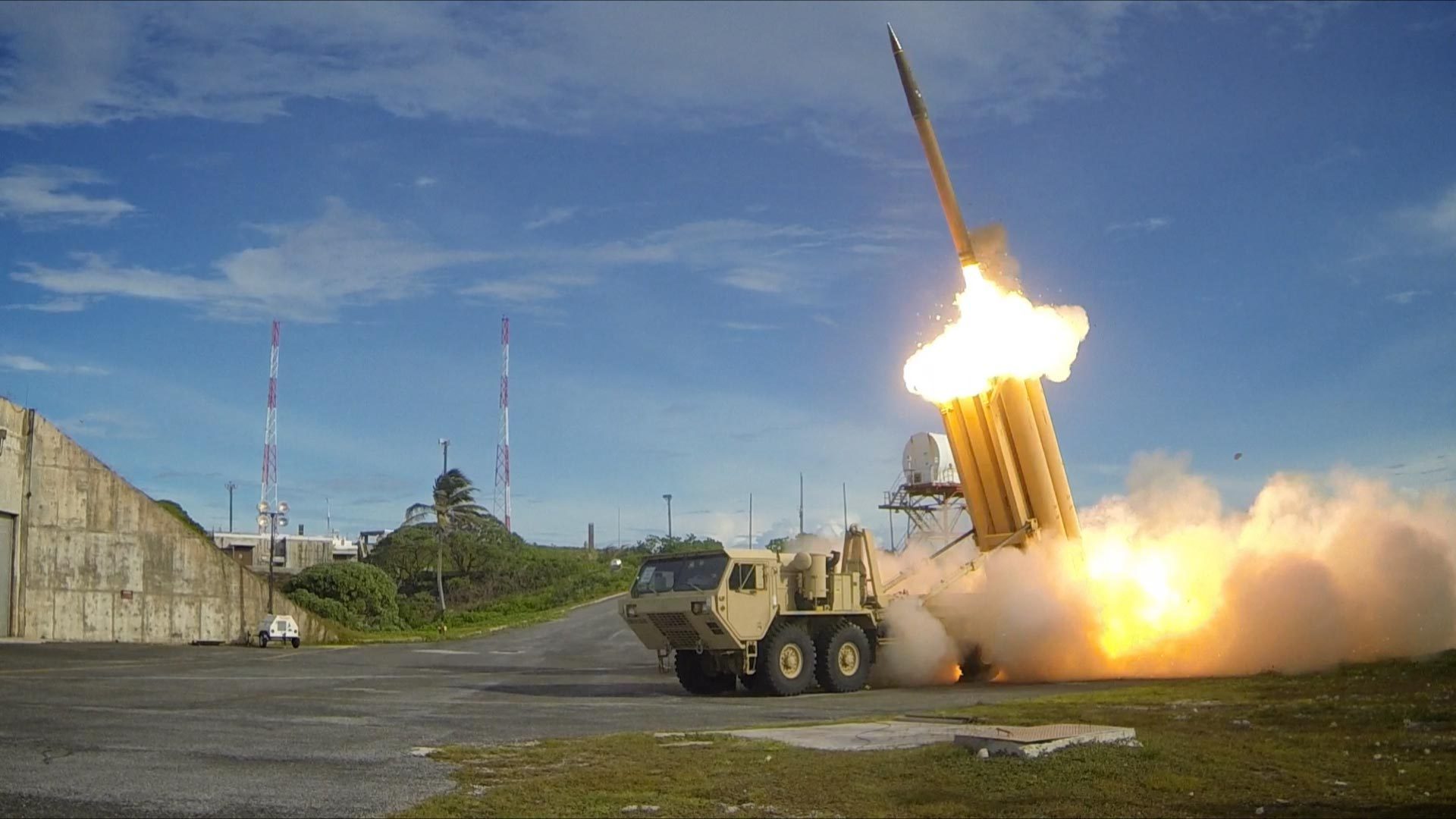
THAAD missile defense system
Compare with
Overview
THAAD — Terminal High Altitude Area Defense — is the U.S. Army's high-tier ballistic-missile interceptor, designed to destroy short-, medium- and intermediate-range ballistic missiles in their terminal phase at high altitude, both inside and just above the atmosphere. Unlike systems that rely on a blast warhead, THAAD uses hit-to-kill: its interceptor physically collides with the incoming warhead, relying on the kinetic energy of the impact to destroy it. A THAAD battery pairs truck-mounted launchers with the powerful AN/TPY-2 X-band radar, which can also operate in a forward-based mode to cue other defences. It fills the gap between the lower-tier Patriot (endo-atmospheric, shorter range) and the exo-atmospheric Aegis BMD/SM-3, providing high-altitude area coverage with an engagement reach of around 200 km and intercept altitudes up to roughly 150 km. For an analyst, THAAD's Indo-Pacific significance is overwhelmingly political. Its 2017 deployment to Seongju in South Korea — to defend against North Korean missiles — triggered a furious Chinese reaction, including economic retaliation against Seoul, because Beijing feared the AN/TPY-2 radar could peer into Chinese territory. THAAD also defends Guam and is central to layered U.S. missile defence, making it both a genuine shield and a recurring flashpoint in regional politics.
Deployment Map
Home ports from known hull assignments. Operating areas reflect typical AORs — individual deployments will vary.
Timeline
Specifications
Armament
Single-stage, no explosive warhead
Doctrine & Employment
Role
High-tier terminal ballistic-missile interceptor providing high-altitude area defence.
Design Philosophy
Kinetic precision over blast — and area coverage between Patriot and Aegis.
Employment
Hit-to-kill interception of ballistic warheads in the terminal phase; AN/TPY-2 radar also cues other defences.
Threat Context
Defends Korea and Guam against ballistic missiles; its radar makes it a recurring China flashpoint.
How to Compare
Read with Patriot (lower) and Aegis/SM-3 (upper) as a layered shield.
Operational Patterns
Typical Deployment
Defends fixed high-value areas (bases, cities) against ballistic missiles; forward radar cues other defences.
Typical Task Group
Layered with Patriot (lower tier) and Aegis BMD (upper tier).
Readiness
Fielded; combat-proven in the Gulf.
Key Operating Areas
Peer Comparison Matrix
SM-3 intercepts exo-atmospherically at longer range from ships; THAAD covers the high terminal layer ashore.
Video angle: The tiers of U.S. missile defence.
Patriot defends a smaller footprint at lower altitude; THAAD provides high-altitude area coverage.
Video angle: Patriot vs THAAD — how they layer.
China's higher-tier interceptor developed for comparable ballistic-missile defence.
Video angle: America's and China's high-tier interceptors.
Combat History
THAAD deployed to Seongju, South Korea, prompting severe Chinese economic retaliation over the AN/TPY-2 radar.
A defensive system that became a major Indo-Pacific diplomatic flashpoint.
A THAAD battery in the UAE intercepted a Houthi ballistic missile — its first reported operational interception.
Combat-proved the hit-to-kill concept.
Known Vulnerabilities
Saturation & decoys
Limited interceptors per battery; vulnerable to salvos and penetration aids.
Context: Mass missile attacks can overwhelm a battery.
Mitigation: Layering with Patriot and Aegis.
Manoeuvring/hypersonic threats
Designed for ballistic trajectories; hypersonic glide vehicles complicate intercept.
Context: DF-17-class threats fly unpredictable paths.
Mitigation: Glide-phase interceptor development.
Variants
| Variant | Designation | Years | Count | Status | Key Changes |
|---|---|---|---|---|---|
| THAAD | — | 2008– | — | active | Terminal high-altitude hit-to-kill BMD |
| THAAD-ER / integration | — | in development | — | building | Improved interceptor and Patriot integration |
Modernization Programmes
IBCS / Patriot integration
Networking THAAD with Patriot and the wider air-defence command system.
Impact: Tighter layered defence and radar sharing.
Images


Frequently Asked
When was the first THAAD missile defense system commissioned?
The first THAAD missile defense system entered service in 2008.
Who builds the THAAD missile defense system?
The THAAD missile defense system is built by Lockheed Martin.
What variants of the THAAD missile defense system exist?
Known variants include: THAAD, THAAD-ER / integration.
Curated Research
essential
Official program data
reference
System and deployments
Watch THAAD missile defense system in Action
Iron Command produces in-depth comparison and analysis videos for military equipment.
Watch on YouTube