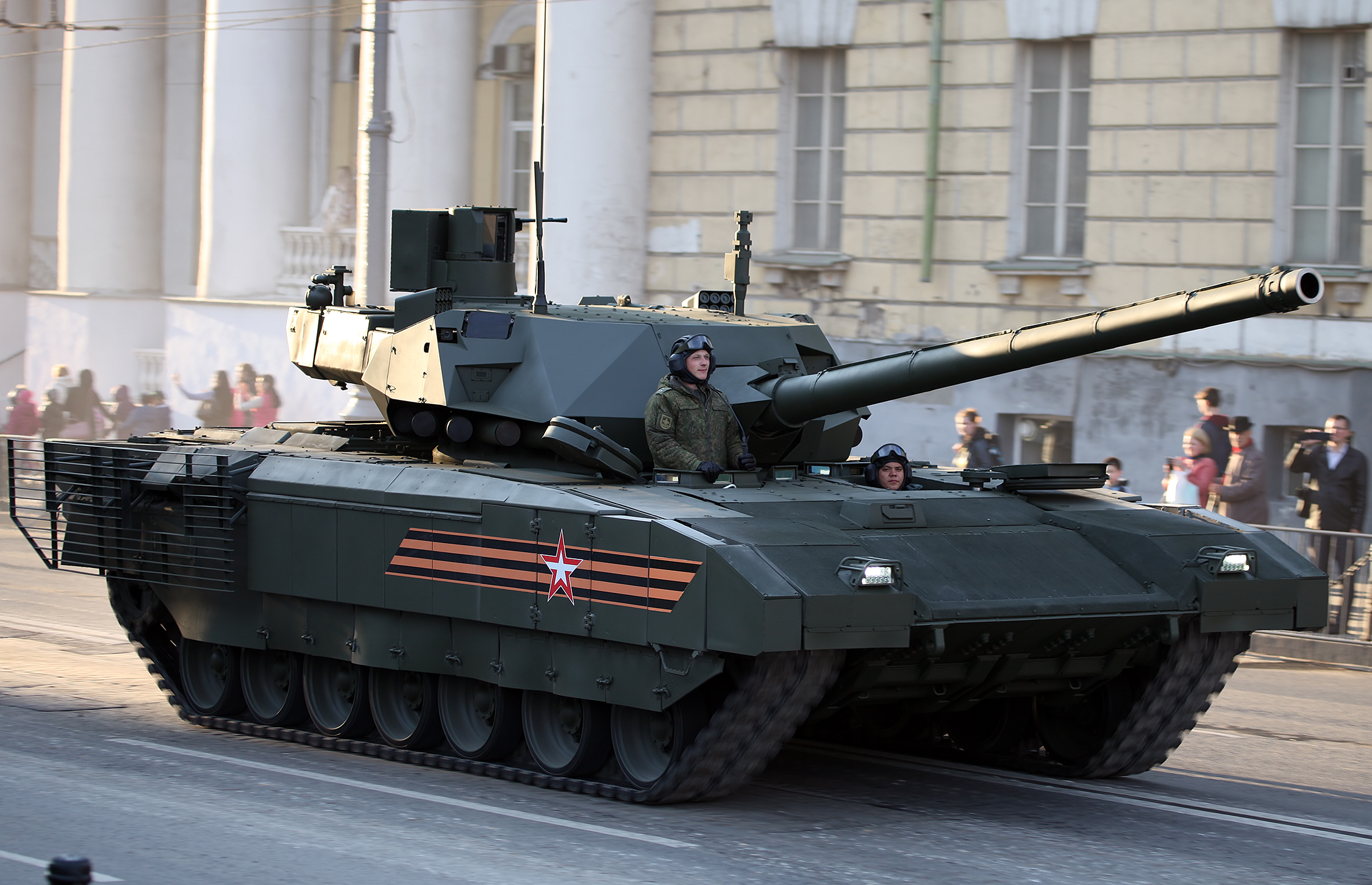
T-14 Armata Main Battle Tank
Overview
The T-14 Armata represents Russia's most ambitious main battle tank program since the T-80, featuring a revolutionary unmanned turret design and crew capsule concept that fundamentally differs from Western tank philosophy. Unveiled in 2015 and entering limited service around 2020, the Armata was designed to leap ahead of NATO armor capabilities with advanced active protection systems, a 125mm smoothbore gun, and modular armor systems. The tank's defining feature is its crew isolation in an armored capsule at the front of the hull, with all three crew members separated from the ammunition and main gun systems. Strategically, the T-14 was intended to restore Russian technological superiority in armored warfare and serve as the foundation for a universal heavy platform family including the T-15 IFV and T-16 recovery vehicle. However, the program has been plagued by production delays, cost overruns, and technical issues. Initial plans for 2,300 units by 2020 have been dramatically scaled back, with current procurement limited to small test batches for evaluation. In the current threat environment, the T-14's significance lies more in its technological demonstration than operational impact. Its advanced fire control systems, claimed ability to fire anti-tank guided missiles through the main gun, and sophisticated sensors represent genuine innovations. However, reliability issues, limited production numbers, and the revealing performance of Russian armor in Ukraine have raised serious questions about the platform's readiness and the broader state of Russian defense manufacturing. Compared to contemporary Western designs like the M1A2 SEPv4 or Leopard 2A8, the T-14 offers theoretical advantages in crew survivability and sensor integration, but lacks the proven reliability, logistical support systems, and combat-tested upgrades that define NATO armor. The tank remains more significant as an indicator of Russian military ambitions than as a current battlefield factor, though its technologies may influence future Russian armor development if production and reliability challenges can be resolved.
Deployment Map
Home ports from known hull assignments. Operating areas reflect typical AORs — individual deployments will vary.
Timeline
Specifications
Armament
Can fire APFSDS, HEAT, HE-FRAG rounds and 9M119 Refleks ATGM
Remotely operated coaxial mount
Commander's remote-controlled station
Hard-kill interceptors and soft-kill countermeasures
Operational Patterns
Typical Deployment
Limited to evaluation units and elite formations; primarily used for testing and training
Typical Task Group
Small platoons or companies for evaluation, not integrated into standard tank battalions
Readiness
Low operational readiness due to maintenance issues and spare parts shortages
Key Operating Areas
Peer Comparison Matrix
Abrams emphasizes proven reliability and extensive upgrade path, while T-14 features more radical design changes but unproven performance. Abrams has extensive combat history and established logistics.
Video angle: Old school proven vs revolutionary untested - which approach wins?
Leopard 2A8 represents evolutionary improvement with modular armor and digital systems, while T-14 attempts revolutionary crew protection design. Both emphasize advanced fire control but Leopard has production maturity.
Video angle: European precision engineering vs Russian innovation - contrasting military industrial approaches
Both feature advanced digital systems and crew protection, but Challenger 3 uses proven Challenger 2 hull while T-14 is clean-sheet design. Challenger 3 has realistic production timeline.
Video angle: Upgrade vs clean-sheet design philosophies in modern MBT development
Both incorporate advanced APS and digital systems, but K2 has achieved successful production and export sales while T-14 remains limited. K2 emphasizes mobility, T-14 emphasizes protection.
Video angle: Asian military innovation vs Russian - who actually delivered on next-gen MBT promises?
Type 99A represents Chinese conventional approach with proven systems, while T-14 shows Russian appetite for radical innovation. Type 99A achieved larger production numbers but less advanced crew protection.
Video angle: Two different paths for Russian and Chinese armor modernization
Combat History
Unconfirmed reports of T-14 deployment near Ukrainian border for evaluation. No confirmed combat engagements documented.
Suggests Russia may have considered combat testing but likely held back due to capture/loss concerns
Single T-14 broke down during rehearsal, replaced by T-34 for actual parade
Public demonstration of ongoing reliability issues affecting even ceremonial operations
Known Vulnerabilities
Production and Reliability
Chronic manufacturing problems, component failures, and extremely limited production numbers. Only ~132 vehicles produced vs original 2,300 planned.
Context: Western sanctions have disrupted supply chains for advanced electronics and materials needed for production
Mitigation: Attempted shift to domestic components and simplified systems, but progress remains slow
Unproven Combat Performance
No confirmed combat experience despite ongoing conflict in Ukraine. Complex systems remain untested under battlefield conditions.
Context: Ukraine conflict has revealed significant shortcomings in Russian armor doctrine and crew training
Mitigation: Limited field testing and evaluation, but reluctance to risk high-value platforms in combat
Logistical Complexity
Advanced digital systems and unique design require specialized maintenance and training that Russian forces may lack at scale
Context: Russian military has struggled with maintaining less complex systems during current operations
Mitigation: Simplified maintenance protocols and enhanced crew training programs, effectiveness uncertain
Cost and Sustainability
Estimated $8M per unit cost is 4-5x higher than upgraded T-72/T-80 variants, making mass procurement unlikely
Context: Russia's defense budget is under pressure from sanctions and ongoing military operations
Mitigation: Focus on T-72/T-80 upgrades for bulk forces while T-14 remains limited to elite units
Variants
| Variant | Designation | Years | Count | Status | Key Changes |
|---|---|---|---|---|---|
| T-14 Object 148 | Initial prototype series | 2010-2014 | 20 | retired | Original development prototypes with various configuration tests |
| T-14 Pre-production | First parade vehicles | 2015-2017 | 20 | retired | Parade-ready vehicles with some systems mocked up or non-functional |
| T-14 Initial Production | First operational batch | 2019-2022 | 92 | active | First combat-capable vehicles with full systems integration |
Fleet Roster (2)
| Hull | Name | Variant | Commissioned | Home Port | Status |
|---|---|---|---|---|---|
| N/A | Development prototypes | Object 148 | 2010-2014 | Kubinka Test Center | retired |
| N/A | Initial production batch | Production | 2019 | 3rd Guards Motor Rifle Division | active |
Modernization Programmes
T-14M Upgrade Program
Enhanced armor package, improved Afghanit APS, upgraded digital systems, and reliability improvements based on initial service experience
Impact: Intended to address early production reliability issues and enhance protection against latest Western ATGMs
Serial Production Restart
Resumed limited production after 2-year halt, focusing on resolving manufacturing and quality control issues
Impact: Critical for achieving meaningful operational numbers and validating platform viability
Images


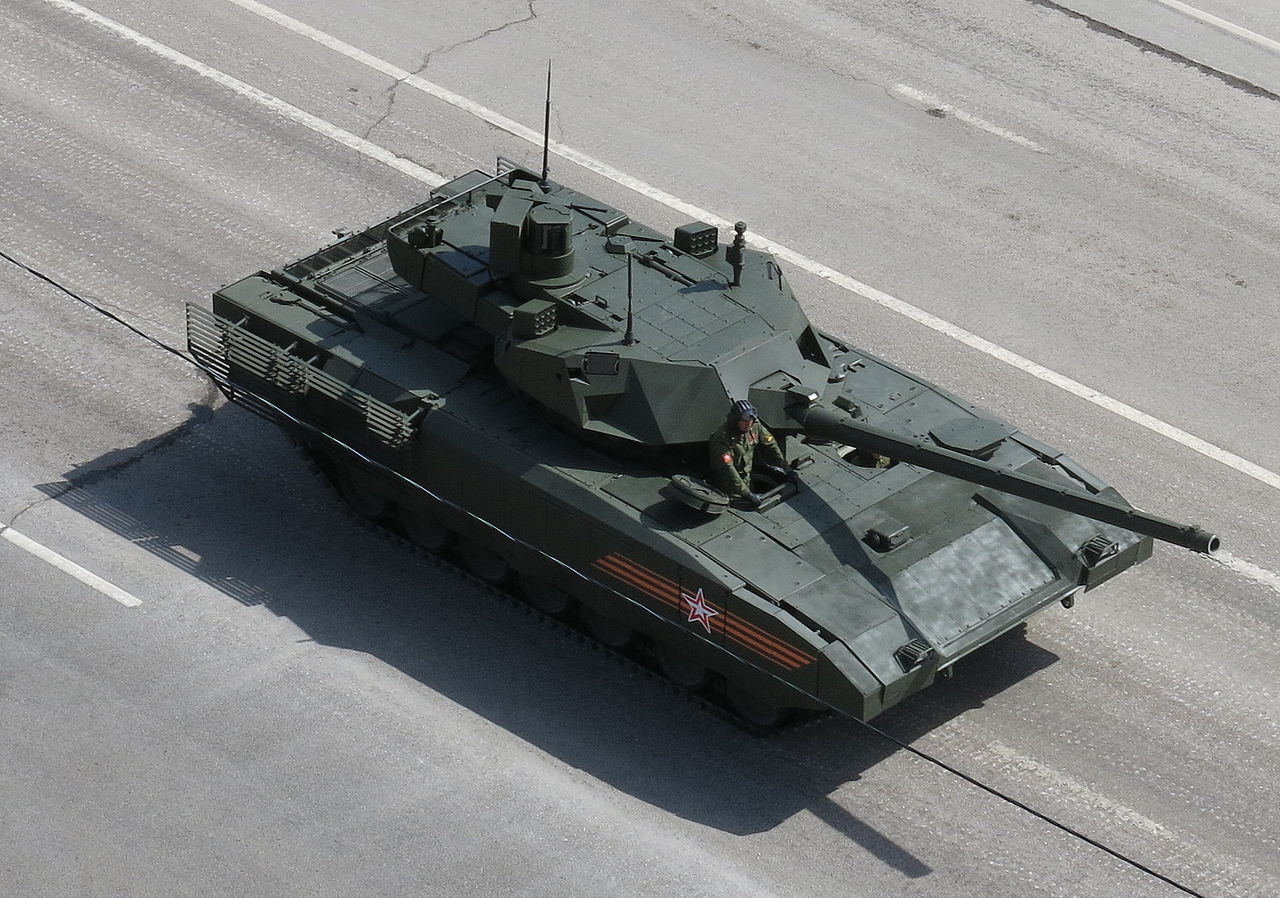


Frequently Asked
How many T-14 Armata Main Battle Tank are in service?
1 T-14 Armata Main Battle Tank are currently in service with Russian Armed Forces.
When was the first T-14 Armata Main Battle Tank commissioned?
The first T-14 Armata Main Battle Tank entered service in 2015.
Who builds the T-14 Armata Main Battle Tank?
The T-14 Armata Main Battle Tank is built by Uralvagonzavod.
What variants of the T-14 Armata Main Battle Tank exist?
Known variants include: T-14 Object 148, T-14 Pre-production, T-14 Initial Production.
How much does a T-14 Armata Main Battle Tank cost?
Unit cost is approximately $8M per hull.
Watch T-14 Armata Main Battle Tank in Action
Iron Command produces in-depth comparison and analysis videos for military equipment.
Watch on YouTubeSources