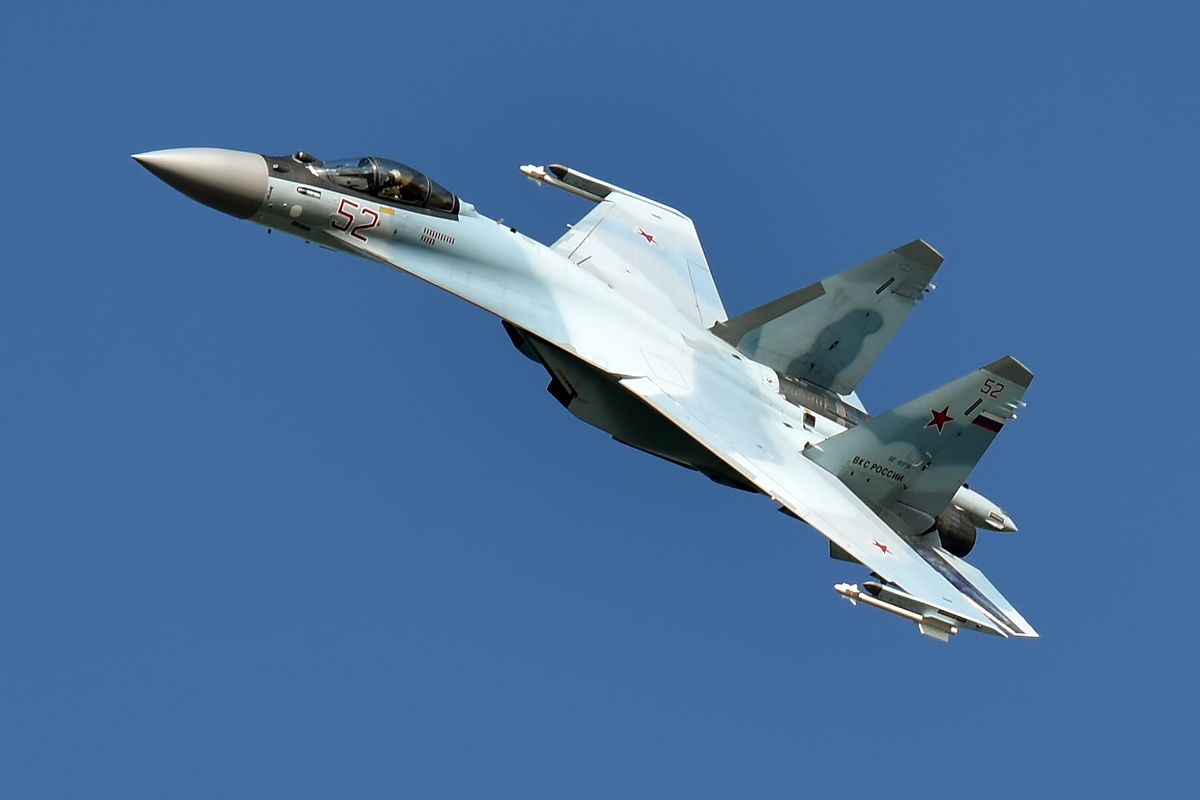
Sukhoi Su-35S Flanker-E
Overview
The Sukhoi Su-35S Flanker-E represents Russia's most advanced operational fourth-generation-plus air superiority fighter, serving as a bridge between legacy Flanker variants and the troubled Su-57 fifth-generation program. Built on the proven Su-27 airframe but extensively modernized with thrust-vectoring engines, advanced radar, and comprehensive electronic warfare systems, the Su-35S is designed to counter Western fourth and fifth-generation fighters through superior maneuverability and sensor integration. Strategically, the Su-35S fills a critical gap in Russian air power projection, providing the VKS with a credible multi-role platform capable of air-to-air dominance and precision ground attack. Its development philosophy emphasizes kinematic performance over stealth, betting that superior agility, powerful radar, and long-range missiles can overcome the stealth advantage of platforms like the F-22 and F-35. The aircraft's 117S engines with 3D thrust vectoring provide unmatched maneuverability at low speeds, while the Irbis-E radar offers detection ranges competitive with Western AESA systems. In the current threat environment, the Su-35S has proven itself in Syria, Ukraine, and various NATO border encounters, demonstrating both its capabilities and limitations. While its performance in Ukraine has been constrained by SAM threats and maintenance issues, it remains one of the most formidable non-stealth fighters globally. Against peer adversaries, the Su-35S relies on its sensor fusion, electronic warfare suite, and long-range R-37M missiles to engage before closing to visual range where its thrust vectoring provides decisive advantage. Compared to contemporaries like the F-15EX, Eurofighter Typhoon, or Rafale, the Su-35S trades radar sophistication and precision munitions integration for raw performance and electronic attack capability. Its operational record suggests effectiveness against less-sophisticated opponents but vulnerability to integrated air defenses and modern stealth platforms, making it a capable but increasingly challenged air superiority asset in high-end conflict scenarios.
Deployment Map
Home ports from known hull assignments. Operating areas reflect typical AORs — individual deployments will vary.
Timeline
Specifications
Armament
Primary BVR missile, active radar homing
Ultra-long-range missile for AWACS/tanker hunting
High off-boresight IR missile with helmet cueing
150 rounds, 1800 rpm rate of fire
SEAD/DEAD and maritime strike capability
GPS/GLONASS or laser-guided munitions
Operational Patterns
Typical Deployment
Air superiority patrols, standoff missile strikes, and defensive counter-air operations
Deployment Length
6 months
Typical Task Group
Operates in pairs or flights of 4, often with A-50 AWACS support
Readiness
Approximately 60-70% availability due to maintenance complexity and parts shortages under sanctions
Key Operating Areas
Peer Comparison Matrix
F-15EX has superior radar (APG-82 AESA) and avionics but lacks thrust vectoring; Su-35S has better maneuverability but larger RCS
Video angle: 4th gen+ shootout: raw performance vs technological sophistication
Typhoon has smaller RCS and superior avionics integration; Su-35S has longer range and more powerful radar
Video angle: European vs Russian design philosophies in modern air combat
Rafale excels in multi-role capability and sensor fusion; Su-35S dominates in air-to-air performance and payload
Video angle: Omni-role fighter vs air superiority specialist comparison
F-22 has overwhelming stealth advantage and superior situational awareness; Su-35S relies on detection avoidance and long-range missiles
Video angle: Stealth vs super-maneuverability: 5th gen vs 4th gen+ evolution
J-16 based on Su-30 with Chinese avionics and weapons; Su-35S has superior engines and flight performance
Video angle: Russian original vs Chinese evolution of Flanker design
Combat History
First combat deployment of 4 Su-35S aircraft to Khmeimim Air Base for air superiority and ground attack missions
Demonstrated operational capability and effectiveness of Irbis-E radar and precision munitions in permissive environment
Su-35S intercepts Israeli F-16I over Lebanon, forcing Israeli withdrawal without engaging targets in Syria
Showcased electronic warfare capabilities and willingness to challenge Israeli air operations
Multiple Su-35S aircraft deployed for air superiority missions, several losses confirmed to Ukrainian SAMs including S-300 and NASAMS
Revealed vulnerability to integrated air defenses and highlighted maintenance/pilot training issues under sustained operations
Su-35S conducting standoff missile strikes with R-37M against Ukrainian aircraft, claimed shoot-downs of MiG-29 and Su-27
Demonstrated long-range missile capability but also reluctance to operate within SAM-contested airspace
Known Vulnerabilities
Radar Cross Section
Large RCS compared to stealth fighters, easily detected by modern AESA radars at extended ranges
Context: Critical weakness against F-22, F-35, and advanced SAM systems like S-400 operated by adversaries
Mitigation: Reliance on electronic warfare and standoff weapons, limited RCS reduction measures implemented
Maintenance and Logistics
Complex thrust vectoring system requires extensive maintenance, limited availability of spare parts under sanctions
Context: Ukrainian conflict exposed low sortie rates and difficulty maintaining operations under pressure
Mitigation: Domestic production increase and simplified maintenance procedures being developed
Pilot Training
Limited flight hours per pilot due to operating costs, insufficient training for complex EW environment operations
Context: Western pilots typically fly 200+ hours annually vs Russian 100-120 hours, impacts proficiency in contested environments
Mitigation: Increased simulator training and selective pilot programs for elite units
Sensor Fusion
Less sophisticated data fusion compared to F-35 or Rafale, pilot workload remains high in multi-threat scenarios
Context: Critical in modern air combat where information superiority determines engagement outcomes
Mitigation: Software upgrades planned but limited by computing architecture
Variants
| Variant | Designation | Years | Count | Status | Key Changes |
|---|---|---|---|---|---|
| Su-35S | Single-seat production variant | 2008-present | 142 | active | 117S engines with TVC, Irbis-E radar, glass cockpit, reduced RCS measures, no canards vs Su-37 demonstrator |
| Su-35UB | Two-seat trainer variant | proposed | — | cancelled | Dual cockpit configuration for training and conversion |
Fleet Roster (1)
| Hull | Name | Variant | Commissioned | Home Port | Status |
|---|---|---|---|---|---|
| RF-95001 | Bort 01 Blue | Su-35S | 2014-02-17 | Dzemgi Air Base | active |
Modernization Programmes
Irbis-E radar upgrade
Software updates for improved multi-target tracking and electronic counter-countermeasures, integration with R-37M missile
Impact: Enhanced BVR capability against stealth targets and improved survivability
Advanced EW suite integration
Khibiny-M electronic warfare system upgrade with AI-assisted threat recognition and response
Impact: Improved survivability against modern SAM systems and AESA radars
Engine life extension
117S engine modifications to extend TBO from 1000 to 1500 hours, improved thrust vectoring actuators
Impact: Reduced maintenance burden and improved operational availability
Images


Frequently Asked
How many Sukhoi Su-35S Flanker-E are in service?
1 Sukhoi Su-35S Flanker-E are currently in service with Russian Aerospace Forces.
When was the first Sukhoi Su-35S Flanker-E commissioned?
The first Sukhoi Su-35S Flanker-E entered service in 2014-02-17.
Who builds the Sukhoi Su-35S Flanker-E?
The Sukhoi Su-35S Flanker-E is built by Sukhoi/KnAAPO.
What variants of the Sukhoi Su-35S Flanker-E exist?
Known variants include: Su-35S, Su-35UB.
How much does a Sukhoi Su-35S Flanker-E cost?
Unit cost is approximately $85M per hull.
Watch Sukhoi Su-35S Flanker-E in Action
Iron Command produces in-depth comparison and analysis videos for military equipment.
Watch on YouTube