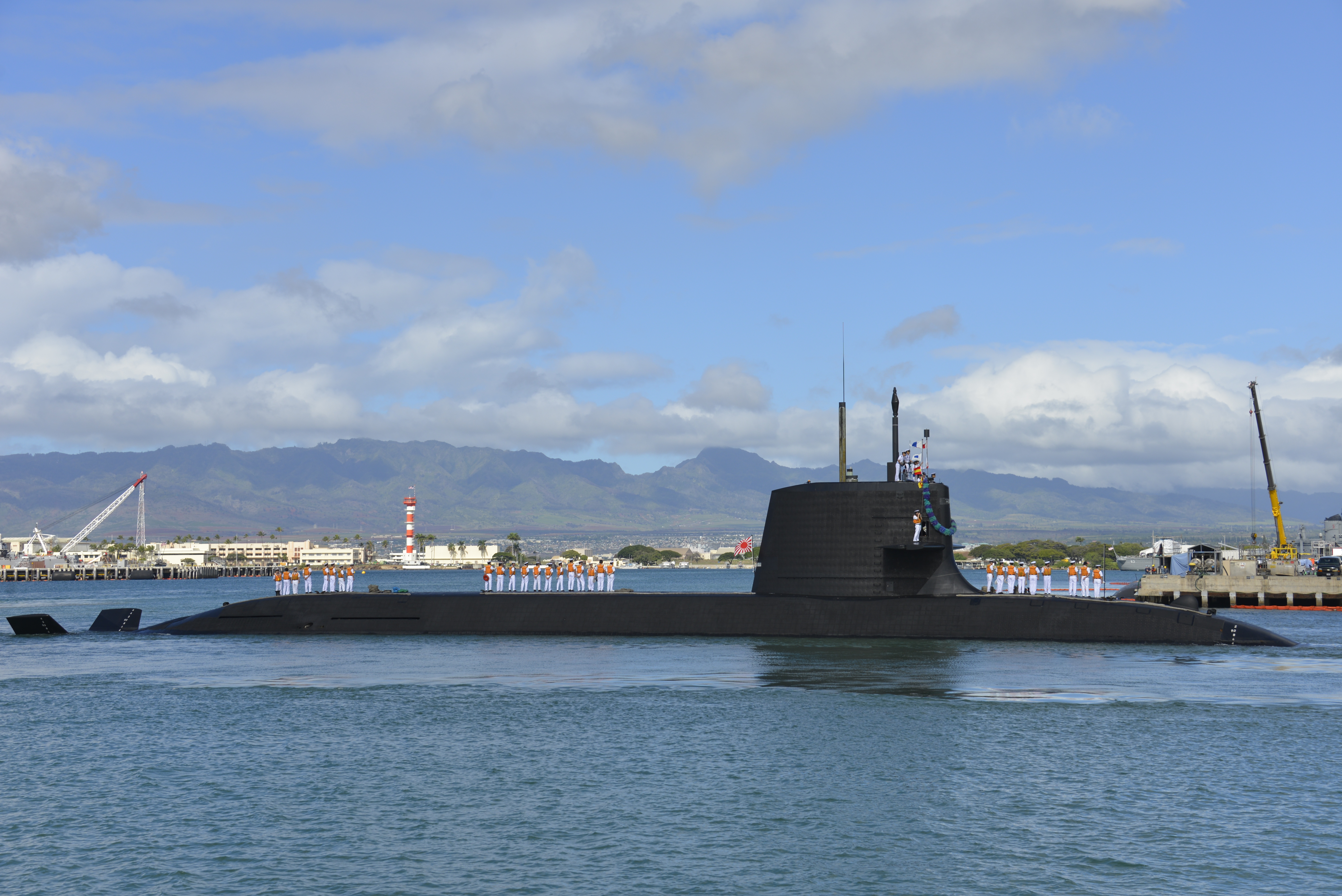
Sōryū-class submarine
Compare with
Overview
The Sōryū-class is Japan's most advanced conventional submarine and represents one of the most sophisticated diesel-electric designs in service today. These boats combine traditional diesel-electric propulsion with Stirling-cycle air-independent propulsion (AIP) systems, giving them extended underwater endurance while maintaining the stealth advantages of non-nuclear power plants. The class serves as the backbone of the JMSDF's submarine force, designed specifically for operations in the challenging acoustic environment of the Western Pacific. Strategically, the Sōryū-class addresses Japan's unique geographic and operational requirements in an era of rising Chinese naval power. With their exceptional quietness, advanced sonar systems, and ability to operate in the shallow, acoustically complex waters around Japan's island chains, these submarines are optimized for anti-submarine warfare and sea denial operations. The boats can remain submerged for weeks using their AIP systems, making them ideal for persistent surveillance and area denial missions. The design philosophy emphasizes stealth over speed, with extensive anechoic coating, advanced hull shaping, and sophisticated noise reduction measures. The Sōryū-class features Japan's indigenous combat management system and represents significant technological advancement over previous JMSDF submarines. Each boat can engage surface vessels with Sub-Harpoon missiles and conduct ASW operations with advanced heavyweight torpedoes, while their sophisticated electronic surveillance measures provide valuable intelligence gathering capabilities. In the current threat environment, the Sōryū-class represents a critical asymmetric capability against larger naval forces. While China operates nuclear submarines with greater speed and endurance, the Sōryū's stealth characteristics and operational familiarity with local waters provide significant defensive advantages. The class has influenced submarine design globally, with several nations studying its AIP integration and noise reduction techniques as models for their own programs.
Deployment Map
Home ports from known hull assignments. Operating areas reflect typical AORs — individual deployments will vary.
Timeline
Specifications
Armament
Primary ASW weapon
Surface attack capability
Doctrine & Employment
Role
Sea denial and maritime domain awareness within the first island chain, designed to detect and attrit potential adversary naval forces approaching Japanese territorial waters.
Design Philosophy
Prioritized stealth and endurance over speed and payload capacity, trading magazine depth for quieting measures and AIP integration. Designers emphasized sensor integration and situational awareness over raw firepower, accepting a smaller torpedo loadout in favor of advanced sonar systems and extended underwater persistence. The conventional propulsion choice sacrificed unlimited underwater endurance for reduced acoustic signature and lower operational costs.
Employment
Operates primarily in single-submarine patrols covering key maritime chokepoints and approaches to the Japanese archipelago. Typically deployed for 2-3 week missions with extended submerged endurance provided by AIP systems. Command structure integrates with JMSDF Maritime Operations Centers for real-time intelligence sharing and coordinated response with surface and air assets. Mission profiles emphasize passive acoustic surveillance, anti-submarine warfare, and anti-surface warfare against high-value targets.
Threat Context
Originally designed during the late Cold War for operations against Soviet Pacific Fleet submarines, but requirements evolved to address the growing Chinese naval presence in the East China Sea and potential Taiwan Strait scenarios. The threat environment has shifted from primarily nuclear submarine targets to a mixed conventional-nuclear submarine threat with increasingly sophisticated anti-submarine warfare capabilities and expanded surface combatant presence.
How to Compare
Compare primarily on underwater endurance and acoustic stealth rather than raw speed or payload - most conventional submarines accept 20+ knot submerged speed as sufficient. AIP endurance duration and sonar detection ranges are the critical performance metrics, not surface speed or torpedo magazine size which matter less in sea denial roles.
Operational Patterns
Typical Deployment
Area denial and surveillance patrols around Japanese territorial waters
Deployment Length
1 months
Typical Task Group
Independent operations, occasional coordination with surface ASW units
Readiness
High availability rate, sophisticated maintenance requirements for AIP systems
Key Operating Areas
Peer Comparison Matrix
Sōryū is larger with greater weapons load and longer range, but Type 212A has more mature fuel cell AIP technology and deeper diving capability
Video angle: Comparing different approaches to AIP technology and their operational trade-offs
Gotland pioneered Stirling AIP but Sōryū represents larger, more capable evolution with better sensors and weapons capacity
Video angle: Evolution of Stirling AIP technology from experimental to operational capability
Scorpène offers modular AIP option and broader weapons compatibility, but Sōryū has superior stealth characteristics and sensor integration
Video angle: Comparing national approaches to conventional submarine design philosophy
Yuan-class has greater numbers and VLS capability but Sōryū maintains significant acoustic advantage and sensor sophistication
Video angle: Submarine warfare in the Western Pacific - quality versus quantity approaches
Attack-class was to be larger conventional version of Barracuda design, Sōryū was proposed alternative emphasizing proven AIP technology
Video angle: The submarine competition that reshaped Indo-Pacific naval balance
Combat History
Sōryū-class submarine reportedly tracked Chinese nuclear submarines transiting first island chain
Demonstrated persistent surveillance capability against nuclear submarine threats
Participated in large-scale ASW exercises with US Navy, successfully evading P-8 Poseidon detection
Validated stealth characteristics against modern ASW sensors
Known Vulnerabilities
Limited missile armament
Lacks vertical launch capability, limited to tube-launched weapons only
Context: Cannot engage land targets or conduct strike missions like nuclear submarines
Mitigation: Focus on core ASW mission rather than multi-role capability
Geographic constraints
Limited by shallow waters and chokepoints around Japanese archipelago
Context: Operational area can be predicted and potentially blocked by adversaries
Mitigation: Leveraging intimate knowledge of local waters and acoustic conditions
Snorkel vulnerability
Must surface periodically to run diesel engines, creating detection opportunity
Context: AIP extends but does not eliminate this requirement entirely
Mitigation: Lithium-ion variants reduce snorkel time significantly
Variants
| Variant | Designation | Years | Count | Status | Key Changes |
|---|---|---|---|---|---|
| Standard Sōryū | SS-501 to SS-511 | 2009-2020 | 11 | active | Initial production standard with Stirling AIP, lithium-ion batteries from SS-511 |
| Lithium-ion variant | SS-512 | 2021 | 1 | active | Lithium-ion batteries replace AIP system, increased underwater speed and endurance |
Fleet Roster (12)
| Hull | Name | Variant | Commissioned | Home Port | Status |
|---|---|---|---|---|---|
| SS-501 | Sōryū | Standard | 2009-03-30 | Kure | active |
| SS-502 | Unryū | Standard | 2010-03-25 | Yokosuka | active |
| SS-503 | Hakuryū | Standard | 2011-03-14 | Kure | active |
| SS-504 | Kenryū | Standard | 2012-03-05 | Yokosuka | active |
| SS-505 | Zuiryū | Standard | 2013-03-06 | Kure | active |
| SS-506 | Kokuryū | Standard | 2014-03-05 | Yokosuka | active |
| SS-507 | Jinryū | Standard | 2015-03-09 | Kure | active |
| SS-508 | Seiryū | Standard | 2016-03-07 | Yokosuka | active |
| SS-509 | Sōryū | Standard | 2017-03-13 | Kure | active |
| SS-510 | Shōryū | Standard | 2018-03-05 | Yokosuka | active |
| SS-511 | Ōryū | Lithium-ion | 2020-03-05 | Kure | active |
| SS-512 | Tōryū | Lithium-ion | 2022-03-09 | Yokosuka | active |
Modernization Programmes
Lithium-ion battery integration
Replacement of AIP system with lithium-ion batteries for improved underwater performance
Impact: Increased submerged speed and simplified maintenance while maintaining extended endurance
Mid-life upgrade program
Sonar system upgrades, combat system modernization, and potential new weapons integration
Impact: Extended service life and improved capability against evolving threats
Images



Frequently Asked
How many Sōryū-class submarine are in service?
12 Sōryū-class submarine are currently in service with Japan Maritime Self-Defense Force.
When was the first Sōryū-class submarine commissioned?
The first Sōryū-class submarine entered service in 2009-03-30.
Who builds the Sōryū-class submarine?
The Sōryū-class submarine is built by Mitsubishi Heavy Industries, Kawasaki Heavy Industries.
What variants of the Sōryū-class submarine exist?
Known variants include: Standard Sōryū, Lithium-ion variant.
How much does a Sōryū-class submarine cost?
Unit cost is approximately $600M per hull.
Curated Research
essential
Provides detailed technical specifications and operational context for the Sōryū-class within the broader JMSDF submarine force structure.
Analyzes the strategic rationale behind Japan's submarine force expansion and the Sōryū-class role in contemporary security challenges.
recommended
Leading open-source analyst tracking Japanese submarine developments with detailed technical analysis and operational assessments.
Compares Japanese and Chinese conventional submarine capabilities and their role in regional maritime competition.
Analyzes the Sōryū-class within Japan's broader maritime defense posture and regional deterrence strategy.
reference
Comprehensive technical database with specifications, construction timeline, and operational status of all Sōryū-class boats.
Places the Sōryū-class within the broader evolution of conventional submarine design and AIP technology development.
Watch Sōryū in Action
Iron Command produces in-depth comparison and analysis videos for military equipment.
Watch on YouTube