
San Antonio-class amphibious transport dock
Compare with
Overview
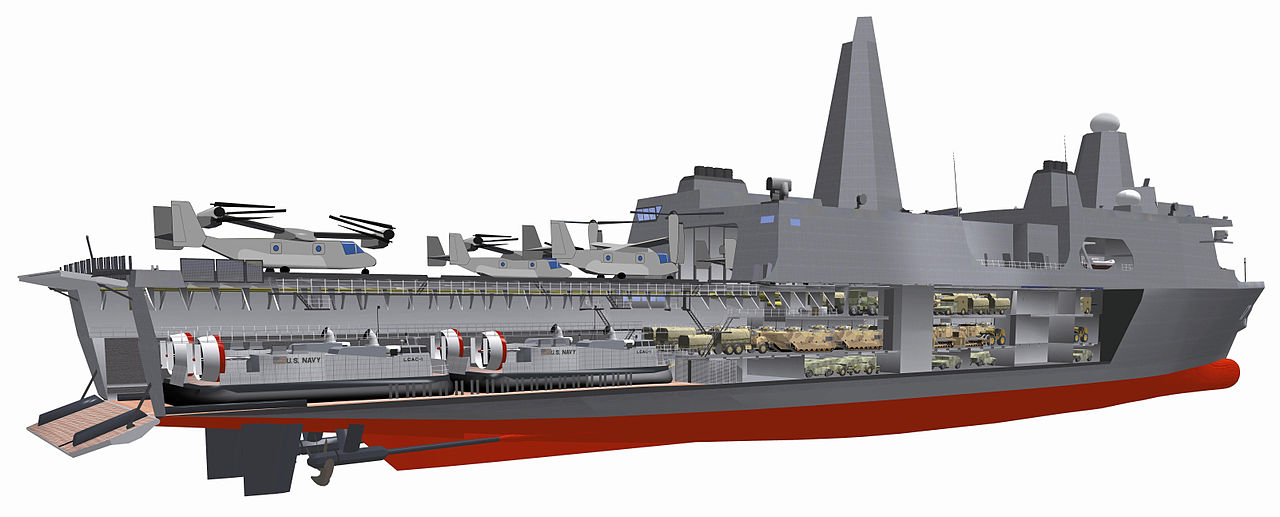
The San Antonio-class amphibious transport dock (LPD-17) represents the backbone of U.S. Navy amphibious operations, designed to transport and land Marines, their equipment, and vehicles in contested environments. These 684-foot vessels combine the functions of multiple previous ship classes into a single, more capable platform optimized for 21st-century expeditionary warfare. Each ship can embark a Marine Expeditionary Unit (MEU) of approximately 800 Marines with their vehicles, equipment, and air support. Strategically, the San Antonio class fills a critical gap in power projection capabilities, serving as the workhorse of Amphibious Ready Groups (ARGs) alongside big-deck amphibious assault ships. The class incorporates advanced command and control systems, making it suitable for serving as a joint task force flagship for smaller operations. Its well deck can accommodate both conventional and advanced landing craft, including the new Ship-to-Shore Connector (SSC) hovercraft that replaces the legacy LCAC. The design philosophy emphasizes survivability, stealth, and flexibility over raw capacity. The class features reduced radar cross-section through angular superstructure design, advanced damage control systems, and comprehensive NBC protection. However, this sophistication came at a steep cost - both in dollars and delivery schedules. Early ships suffered from significant cost overruns and technical problems that delayed the program by years. In today's threat environment, the San Antonio class faces new challenges from advanced anti-ship missiles and area-denial strategies employed by near-peer competitors. While originally designed for uncontested amphibious operations, these ships must now operate in increasingly contested littoral environments where their large size and relatively limited defensive armament present vulnerabilities. Despite these challenges, no other navy operates amphibious vessels with comparable capability, making the class essential for maintaining U.S. global reach and alliance commitments in the Pacific and beyond.
Deployment Map
Home ports from known hull assignments. Operating areas reflect typical AORs — individual deployments will vary.
Timeline
Specifications
Armament
Anti-missile and anti-aircraft defense
Anti-missile and anti-aircraft
Small boat defense
Small boat and personnel defense
Doctrine & Employment
Role
Enables flexible forward presence and crisis response by delivering Marines from ship to shore across the full spectrum of conflict, from humanitarian assistance to high-intensity amphibious assault. Serves as the connector between sea-based expeditionary forces and land-based operations in contested littorals.
Design Philosophy
Prioritized command and control capabilities, survivability, and operational flexibility over pure cargo capacity, accepting higher cost per embarked Marine compared to previous classes. Designers emphasized multi-mission capability and advanced electronics over traditional metrics like troop capacity, sacrificing some efficiency for greatly enhanced operational utility in complex threat environments.
Employment
Typically operates as part of an Amphibious Ready Group (ARG) with an LHA/LHD and LSD, embarking a Marine Expeditionary Unit (MEU) for seven-month deployments. Commands amphibious operations from its sophisticated command and control suite, coordinating surface assault craft, helicopters, and ground forces. During distributed operations, can operate independently or in smaller task groups to support multiple simultaneous objectives across a theater.
Threat Context
Designed in the post-9/11 era for expeditionary operations against non-peer adversaries with limited naval capabilities, emphasizing irregular warfare and stability operations. The threat has evolved toward near-peer competitors with advanced anti-access/area-denial capabilities, forcing adaptation of employment concepts toward more distributed and survivable operations within contested zones.
How to Compare
Compare on command and control sophistication, well deck capacity, and aviation facilities rather than pure troop capacity - modern amphibious doctrine values operational flexibility over raw numbers. Focus on survivability features and sensor integration as these platforms must operate closer to hostile shores than previous generations. Cost per capability matters more than absolute unit cost given the multi-mission requirements.
Operational Patterns
Typical Deployment
Amphibious Ready Group (ARG) deployment with embarked Marine Expeditionary Unit
Deployment Length
7 months
Typical Task Group
3-ship ARG with LHA/LHD and LSD, plus escort combatants
Readiness
Maintenance intensive requiring significant yard time, limited by LCAC/SSC availability
Key Operating Areas
Peer Comparison Matrix
Chinese design emphasizes simpler systems and lower cost but sacrifices command capabilities and survivability features. Similar displacement but different operational concept.
Video angle: East vs West amphibious design philosophy - complexity vs simplicity
More focused on helicopter operations with larger aviation facilities but smaller well deck. Better suited for power projection than traditional beach assault.
Video angle: NATO amphibious capabilities - complementary designs for different mission sets
Smaller and more austere design reflecting constitutional constraints and regional focus. Less capable but more affordable for larger numbers.
Video angle: Alliance interoperability in Pacific amphibious operations
Combines LHD and LPD functions in single hull with ski-jump for fixed-wing aircraft. More aviation-centric than San Antonio class.
Video angle: Multi-role vs specialized amphibious ship design trade-offs
Much smaller and simpler design with limited capability. Reflects resource constraints and different operational requirements for Russian Navy.
Video angle: Great power amphibious capabilities gap - quantity vs quality approaches
Combat History
USS Kearsarge ARG including LPDs provided humanitarian assistance and NEO support during Libya operations
First major operational deployment demonstrating humanitarian mission capability
USS San Antonio positioned in Eastern Mediterranean as part of potential strike force
Demonstrated strategic deterrent value beyond traditional amphibious role
USS Portland conducted first operational test of Solid State Laser - Technology Maturation system, successfully disabling drone target
First shipboard laser weapon engagement by San Antonio class, indicating future directed energy integration
Multiple San Antonio-class ships provided logistical support for Afghanistan evacuation operations
Highlighted role in large-scale evacuation and humanitarian operations
Known Vulnerabilities
Air Defense
Limited area air defense capability with only point defense systems (RAM and Phalanx), vulnerable to coordinated air/missile attack
Context: Against near-peer adversaries with advanced anti-ship missiles, requires escort for survival
Mitigation: Must operate within protective umbrella of other combatants or land-based air defense
Signature Management
Large size and high heat signature from diesel engines make it vulnerable to thermal and radar tracking
Context: Difficult to conceal approach in contested amphibious operations
Mitigation: Some stealth features incorporated but fundamental size limitation remains
Mechanical Reliability
Complex systems integration led to significant reliability issues in early ships, high maintenance requirements
Context: Reduced operational availability affects readiness for rapid deployment
Mitigation: Flight II improvements and ongoing reliability upgrades addressing known issues
Amphibious Doctrine Evolution
Designed for traditional amphibious assault concepts that may be obsolete against advanced A2/AD systems
Context: Large, close-to-shore operations increasingly risky against modern threats
Mitigation: Doctrine evolving toward distributed operations and over-the-horizon approaches
Variants
| Variant | Designation | Years | Count | Status | Key Changes |
|---|---|---|---|---|---|
| Flight I | LPD-17 to LPD-28 | 2006-2019 | 11 | active | Initial production variant with basic systems |
| Flight II | LPD-29 to LPD-30 | 2020-present | 2 | active | Enhanced systems, improved reliability based on lessons learned |
Fleet Roster (13)
| Hull | Name | Variant | Commissioned | Home Port | Status |
|---|---|---|---|---|---|
| LPD-17 | USS San Antonio | Flight I | 2006-01-14 | Norfolk, VA | active |
| LPD-18 | USS New Orleans | Flight I | 2007-03-10 | Sasebo, Japan | active |
| LPD-19 | USS Mesa Verde | Flight I | 2007-12-15 | Norfolk, VA | active |
| LPD-20 | USS Green Bay | Flight I | 2009-01-24 | Sasebo, Japan | active |
| LPD-21 | USS New York | Flight I | 2009-11-07 | Norfolk, VA | active |
| LPD-22 | USS San Diego | Flight I | 2012-05-19 | San Diego, CA | active |
| LPD-23 | USS Anchorage | Flight I | 2014-05-04 | San Diego, CA | active |
| LPD-24 | USS Arlington | Flight I | 2013-04-06 | Norfolk, VA | active |
| LPD-25 | USS Somerset | Flight I | 2014-02-01 | San Diego, CA | active |
| LPD-26 | USS John P. Murtha | Flight I | 2017-05-20 | Norfolk, VA | active |
| LPD-27 | USS Portland | Flight I | 2018-04-21 | San Diego, CA | active |
| LPD-28 | USS Fort Lauderdale | Flight I | 2021-07-31 | Norfolk, VA | active |
| LPD-29 | USS Richard M. McCool Jr. | Flight II | 2021-12-18 | San Diego, CA | active |
Modernization Programmes
Ship-to-Shore Connector Integration
Integration of new SSC hovercraft replacing legacy LCAC, requiring well deck modifications and support systems
Impact: Improved ship-to-shore capability with better payload and reliability
Directed Energy Systems Integration
Installation of high-energy laser systems for close-in defense, following successful Portland trials
Impact: Enhanced self-defense against small boats and UAVs with reduced ammunition dependence
Communications and C4I Upgrade
Upgrade to advanced satellite communications and command systems to support distributed maritime operations
Impact: Better integration with joint forces and enhanced flagship capabilities
Images




Recent News
Frequently Asked
How many San Antonio-class amphibious transport dock are in service?
13 San Antonio-class amphibious transport dock are currently in service with United States Navy.
When was the first San Antonio-class amphibious transport dock commissioned?
The first San Antonio-class amphibious transport dock entered service in 2006-01-14.
Who builds the San Antonio-class amphibious transport dock?
The San Antonio-class amphibious transport dock is built by Huntington Ingalls Industries (formerly Northrop Grumman Shipbuilding).
What variants of the San Antonio-class amphibious transport dock exist?
Known variants include: Flight I, Flight II.
How much does a San Antonio-class amphibious transport dock cost?
Unit cost is approximately $1.8B per hull.
Curated Research
essential
Comprehensive Congressional Research Service analysis of U.S. amphibious warfare ships including detailed LPD-17 program history and capability assessment.
Norman Friedman's authoritative analysis includes detailed coverage of San Antonio-class design evolution and doctrinal employment within modern amphibious warfare concepts.
recommended
CNA analysis examining how amphibious platforms like LPD-17 enable distributed operations in contested environments against near-peer adversaries.
Marine Corps doctrinal publication explaining how LPD-17 platforms support distributed expeditionary advanced base operations in the Pacific.
CSIS analysis of how U.S. amphibious platforms integrate with allied forces and influence international amphibious warfare development.
reference
Real-time tracking of San Antonio-class deployments and operational status for understanding current employment patterns.
Comprehensive technical specifications and program details for all San Antonio-class vessels including variants and modifications.
Watch San Antonio in Action
Iron Command produces in-depth comparison and analysis videos for military equipment.
Watch on YouTubeSources