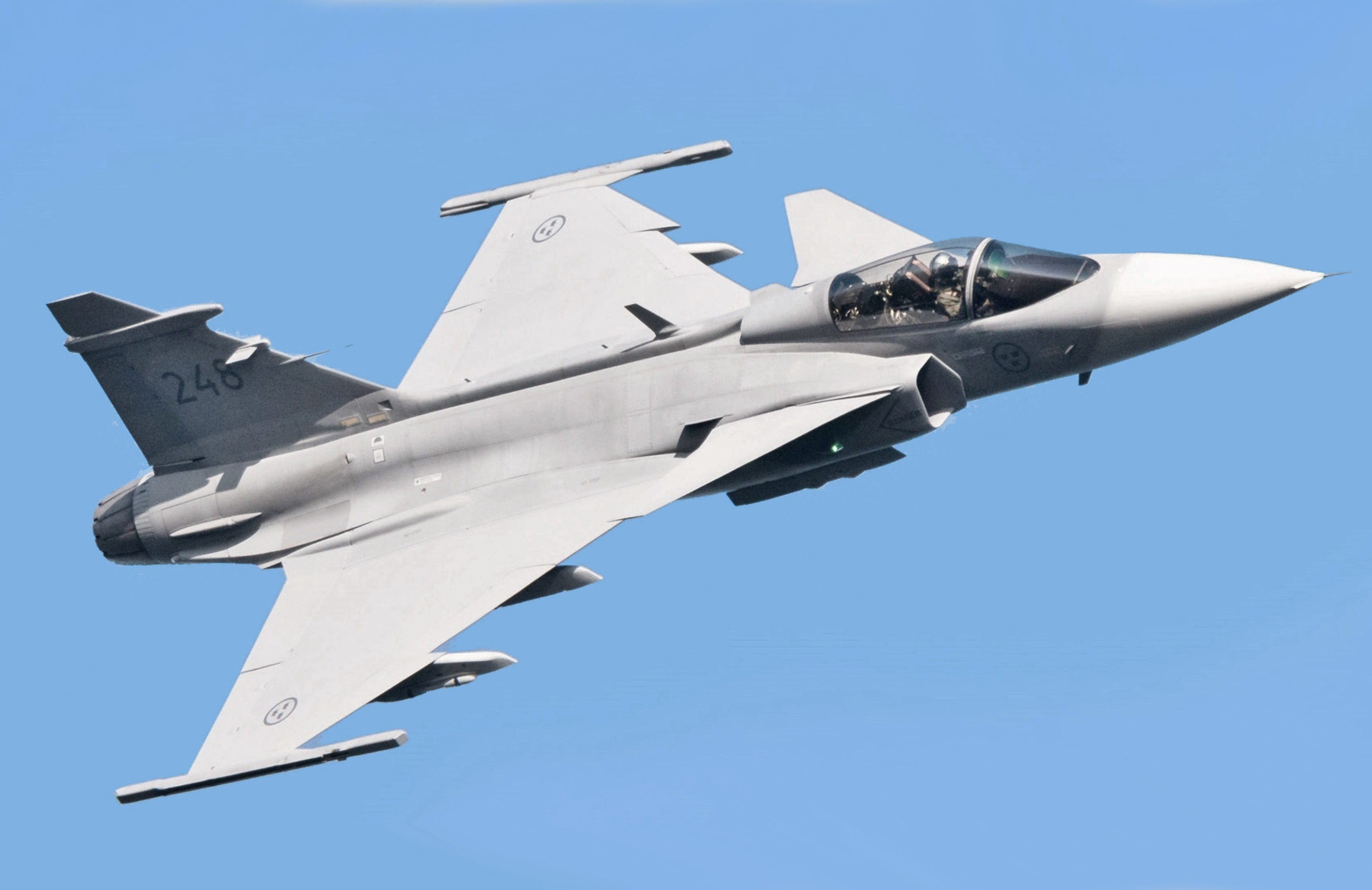
Saab JAS 39 Gripen
Overview
The Saab JAS 39 Gripen is a lightweight, single-engine multirole fighter aircraft designed around Sweden's unique defense doctrine of decentralized operations from highway strips and austere bases. Its designation 'JAS' represents its tri-role capability: Jakt (fighter), Attack (ground attack), and Spaning (reconnaissance). The Gripen embodies Swedish military philosophy of achieving maximum capability per defense krona, emphasizing cost-effectiveness, ease of maintenance, and rapid turnaround times over raw performance metrics. Strategically, the Gripen serves as Sweden's primary air defense asset and represents a compelling alternative for smaller air forces seeking advanced capabilities without the logistical burden of larger platforms like the F-35 or Eurofighter. Its design prioritizes pilot situational awareness through advanced sensor fusion, datalink capabilities, and an intuitive human-machine interface. The aircraft can be maintained by a crew of six technicians and turned around in under 20 minutes between sorties. In the current threat environment, the Gripen's strength lies in its network-centric warfare capabilities and electronic warfare systems rather than stealth or kinematic performance. The aircraft excels in contested airspace through its ability to share targeting data across platforms and integrate with ground-based air defense systems. Its relatively small radar cross-section and advanced EW suite provide survivability through electronic rather than physical stealth. Compared to its peers, the Gripen trades raw performance for operational flexibility and cost-effectiveness. While it cannot match the F-35's stealth or the Eurofighter's high-altitude performance, it offers superior operational availability rates, lower lifecycle costs, and the ability to operate from damaged or improvised airfields. This makes it particularly attractive to nations prioritizing defensive operations and cost-conscious procurement strategies.
Deployment Map
Home ports from known hull assignments. Operating areas reflect typical AORs — individual deployments will vary.
Timeline
Specifications
Armament
Primary BVR weapon
IR-guided WVR missile
Alternative WVR missile
Swedish anti-ship missile
Long-range precision strike
120 rounds
160 countermeasures
Operational Patterns
Typical Deployment
Primary air defense fighter operating from dispersed bases, emphasis on rapid reaction and highway operations
Deployment Length
6 months
Typical Task Group
Operates in 2-4 aircraft sections, often integrated with ground-based air defense and AEW&C platforms
Readiness
High availability rates (70%+) due to simplified maintenance requirements, but limited by small fleet sizes in export countries
Key Operating Areas
Peer Comparison Matrix
Gripen offers superior operational flexibility and lower costs, F-16 provides greater payload and combat radius. Both compete heavily in export markets.
Video angle: David vs Goliath - how Swedish engineering philosophy challenges American design dominance
Typhoon superior in air-to-air performance and altitude capability, Gripen wins on cost-effectiveness and multirole flexibility. Different approaches to European air power.
Video angle: European fighter philosophy - performance vs practicality comparison
Rafale offers carrier capability and greater weapons capacity, Gripen provides lower acquisition and operating costs. Both target same export market segment.
Video angle: Export fighter showdown - French luxury vs Swedish efficiency
FA-50 is light attack trainer-derived, Gripen is purpose-built multirole fighter. Similar costs but Gripen offers significantly greater capability.
Video angle: Light fighter comparison - trainer derivative vs purpose-built design
JF-17 much lower cost but significantly inferior in avionics, sensors, and weapons integration. Different market segments but some overlap.
Video angle: Low-cost fighter analysis - Chinese quantity vs Swedish quality
Combat History
Swedish Gripen C aircraft conducted reconnaissance missions over Libya, marking the type's first combat deployment. Eight aircraft deployed to Sigonella, Sicily.
Demonstrated Gripen's expeditionary capability and NATO interoperability in contested airspace
Swedish, Czech, and Hungarian Gripens have conducted NATO Baltic Air Policing missions, intercepting Russian aircraft over Baltic states.
Proved Gripen's effectiveness in air policing role against modern Russian aircraft including Su-27 and Su-30
Multiple Gripen operators have committed to training Ukrainian pilots and potentially transferring aircraft, though no transfers completed as of 2024.
Highlights Gripen's role as a bridge platform for nations transitioning from Soviet-era equipment
Known Vulnerabilities
Single-engine reliability
Unlike twin-engine competitors, Gripen has no engine redundancy, creating vulnerability over water or hostile territory.
Context: Critical weakness for expeditionary operations or long-range missions over contested areas
Mitigation: Extremely reliable RM12 engine and comprehensive maintenance program, but fundamental limitation remains
Weapons payload capacity
Limited to 5,300kg external payload compared to 8,000+ kg for competitors like F-16 Block 70 or Eurofighter.
Context: Restricts capability in high-intensity conflicts requiring sustained weapons delivery
Mitigation: Gripen E increases capacity but still limited compared to larger platforms
Radar power and range
PS-05/A mechanically-scanned radar has limited range compared to larger AESA systems on F-35 or F/A-18E/F.
Context: Disadvantage in beyond-visual-range engagements against peer adversaries
Mitigation: ES-05 Raven AESA in Gripen E addresses this but older variants remain limited
Industrial base dependency
Heavy reliance on international suppliers (US engines, missiles) creates potential supply chain vulnerabilities.
Context: Could limit export potential and operational flexibility during conflicts involving supplier nations
Mitigation: Sweden developing indigenous alternatives but timeline uncertain
Variants
| Variant | Designation | Years | Count | Status | Key Changes |
|---|---|---|---|---|---|
| Gripen A | JAS 39A | 1996-2013 | 204 | retired | Initial single-seat production variant with PS-05/A radar, basic multirole capability |
| Gripen B | JAS 39B | 1996-2013 | 28 | retired | Two-seat trainer variant, reduced fuel capacity, retained combat capability |
| Gripen C | JAS 39C | 2003-present | 204 | active | Upgraded avionics, NATO compatibility, air-to-air refueling capability, improved radar |
| Gripen D | JAS 39D | 2005-present | 28 | active | Two-seat version of Gripen C with same capabilities |
| Gripen E | JAS 39E | 2019-present | 7 | active | Lengthened fuselage, ES-05 Raven AESA radar, increased fuel capacity, improved EW suite, GE F414 engine |
Fleet Roster (6)
| Hull | Name | Variant | Commissioned | Home Port | Status |
|---|---|---|---|---|---|
| Various | Swedish Air Force | C/D/E | 1996-present | Multiple Swedish bases | active - 94 C/D, 60 E on order |
| Various | South African Air Force | C/D | 2008 | AFB Makhado, AFB Overberg | active - 26 aircraft |
| Various | Czech Air Force | C/D | 2005 | Čáslav Air Base | active - 14 aircraft |
| Various | Hungarian Air Force | C/D | 2006 | Kecskemet Air Base | active - 14 aircraft |
| Various | Thai Air Force | C/D | 2011 | Surat Thani Air Base | active - 12 aircraft |
| Various | Brazilian Air Force | E/F (F-39E/F) | 2021 | Anápolis Air Base | active - 36 aircraft ordered, 5 delivered |
Modernization Programmes
Gripen E/F Development
Next-generation Gripen with AESA radar, increased range, advanced EW suite, and improved weapons capacity. Features 40% greater range and enhanced sensor fusion.
Impact: Transforms Gripen into true 4.5+ generation fighter with significantly enhanced beyond-visual-range capabilities
MS20 Upgrade (Sweden)
Major upgrade to Swedish Gripen C/D fleet including AESA radar retrofit, new EW systems, and improved datalinks.
Impact: Extends service life to 2035+ and maintains capability gap against modern threats
GlobalEye Integration
Integration with Saab's GlobalEye AEW&C platform for enhanced battlespace awareness and targeting.
Impact: Creates network-centric capability allowing Gripen to engage targets beyond radar range using off-board sensors
Images


Frequently Asked
How many Saab JAS 39 Gripen are in service?
271 Saab JAS 39 Gripen are currently in service with Swedish Air Force.
When was the first Saab JAS 39 Gripen commissioned?
The first Saab JAS 39 Gripen entered service in 1996.
Who builds the Saab JAS 39 Gripen?
The Saab JAS 39 Gripen is built by Saab AB.
What variants of the Saab JAS 39 Gripen exist?
Known variants include: Gripen A, Gripen B, Gripen C, Gripen D, Gripen E.
How much does a Saab JAS 39 Gripen cost?
Unit cost is approximately $85M per hull.
Watch Saab JAS 39 Gripen in Action
Iron Command produces in-depth comparison and analysis videos for military equipment.
Watch on YouTube