
Pinaka multiple rocket launcher
Compare with
Overview
The Pinaka is India's indigenous multiple-barrel rocket launcher — a truck-mounted area-fire system named for the bow of the god Shiva, and an increasingly important piece of the Indian Army's long-range fires. Developed by DRDO and produced by Indian private industry, it delivers a rapid, saturating salvo of 214 mm rockets and has matured from an unguided area weapon into a family with guided and extended-range variants. A Pinaka launcher fires twelve rockets in a matter of seconds, blanketing a target area, and a battery can devastate troop concentrations, assembly areas and unprotected positions. The baseline Mk-I reaches around 40 km; the Mk-II/Enhanced and guided variants extend range toward 75–90 km and beyond, with precision guidance kits turning the area weapon into something far more accurate. The system has been combat-relevant on India's western front and is being scaled up significantly. For an analyst, the Pinaka matters as both capability and policy. It gives the Indian Army sovereign, mass-producible long-range rocket artillery to complement towed and self-propelled guns, reduces reliance on imported systems like the Russian Smerch, and has become an export success with Armenia as a launch customer — another marker of India's growing defence-industrial reach in the wider Indo-Pacific and beyond.
Deployment Map
Home ports from known hull assignments. Operating areas reflect typical AORs — individual deployments will vary.
Timeline
Specifications
Armament
Unguided area + guided/ER variants
Doctrine & Employment
Role
Indigenous multiple rocket launcher for massed area and precision long-range fires.
Design Philosophy
Sovereign, mass-producible rocket fires complementing tube artillery.
Employment
Rapid 12-rocket salvos to saturate targets; guided variants for precision shoot-and-scoot.
Threat Context
Long-range fires on India's western and northern fronts; a growing export.
How to Compare
Read against China's PHL-191, the US HIMARS and Russia's Smerch.
Operational Patterns
Typical Deployment
Massed area and precision rocket fire supporting Indian Army operations, mainly on the western and northern fronts.
Typical Task Group
Rocket regiments alongside tube artillery.
Readiness
Scaling up; guided variants entering service.
Key Operating Areas
Peer Comparison Matrix
China's PHL-191 reaches far greater ranges with larger rockets and tactical missiles; the Pinaka is shorter-ranged but indigenous and mass-producible.
Video angle: India and China's rocket artillery compared.
HIMARS fires fewer but longer-range precision rockets/missiles; the Pinaka emphasises salvo mass with growing precision.
Video angle: Mass vs precision in rocket artillery.
India operates the heavier Russian Smerch; the Pinaka is the indigenous complement.
Video angle: India's home-grown rocket artillery.
Combat History
Pinaka saw use during the Kargil conflict in its early form.
Early combat employment of the indigenous system.
Armenia signed deals to import Pinaka systems.
Established Pinaka as an Indian artillery export.
Known Vulnerabilities
Counter-battery exposure
Large signature on firing; vulnerable if static.
Context: Modern radars locate MLRS quickly.
Mitigation: Shoot-and-scoot mobility.
Unguided dispersion (baseline)
The baseline rocket is an area weapon with dispersion.
Context: Less precise than guided systems.
Mitigation: Guided variants now fielding.
Variants
| Variant | Designation | Years | Count | Status | Key Changes |
|---|---|---|---|---|---|
| Pinaka Mk-I | — | 2000– | — | active | Baseline unguided ~40 km MLRS |
| Pinaka Mk-II / ER / Guided | — | 2020s | — | building | Extended range and precision guidance |
Modernization Programmes
Guided & extended-range Pinaka
Guidance kits and longer-range rockets; large Army orders.
Impact: Turns area rocket fire into precision long-range fires.
Images


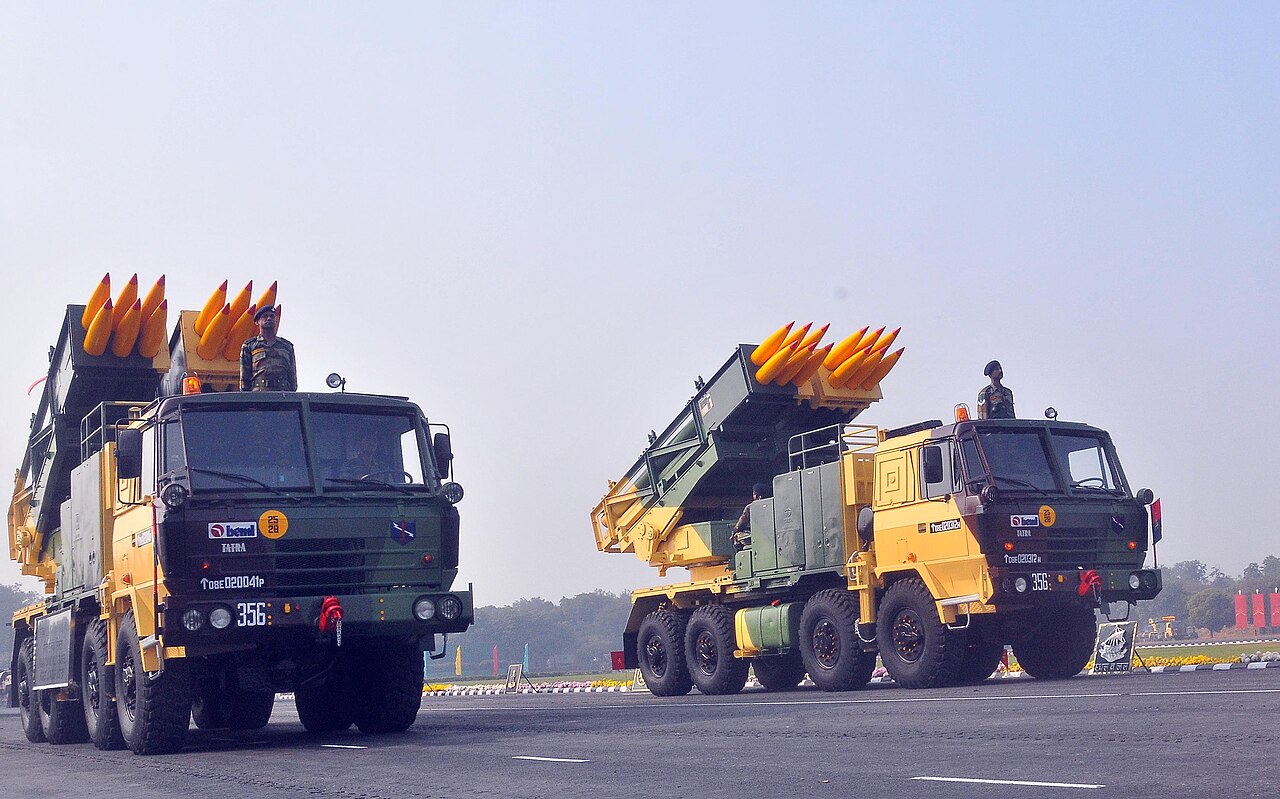


Frequently Asked
When was the first Pinaka multiple rocket launcher commissioned?
The first Pinaka multiple rocket launcher entered service in 2000.
Who builds the Pinaka multiple rocket launcher?
The Pinaka multiple rocket launcher is built by DRDO / Tata, L&T, Solar Industries.
What variants of the Pinaka multiple rocket launcher exist?
Known variants include: Pinaka Mk-I, Pinaka Mk-II / ER / Guided.
Curated Research
recommended
Program context
reference
Variants and range
Watch Pinaka multiple rocket launcher in Action
Iron Command produces in-depth comparison and analysis videos for military equipment.
Watch on YouTube