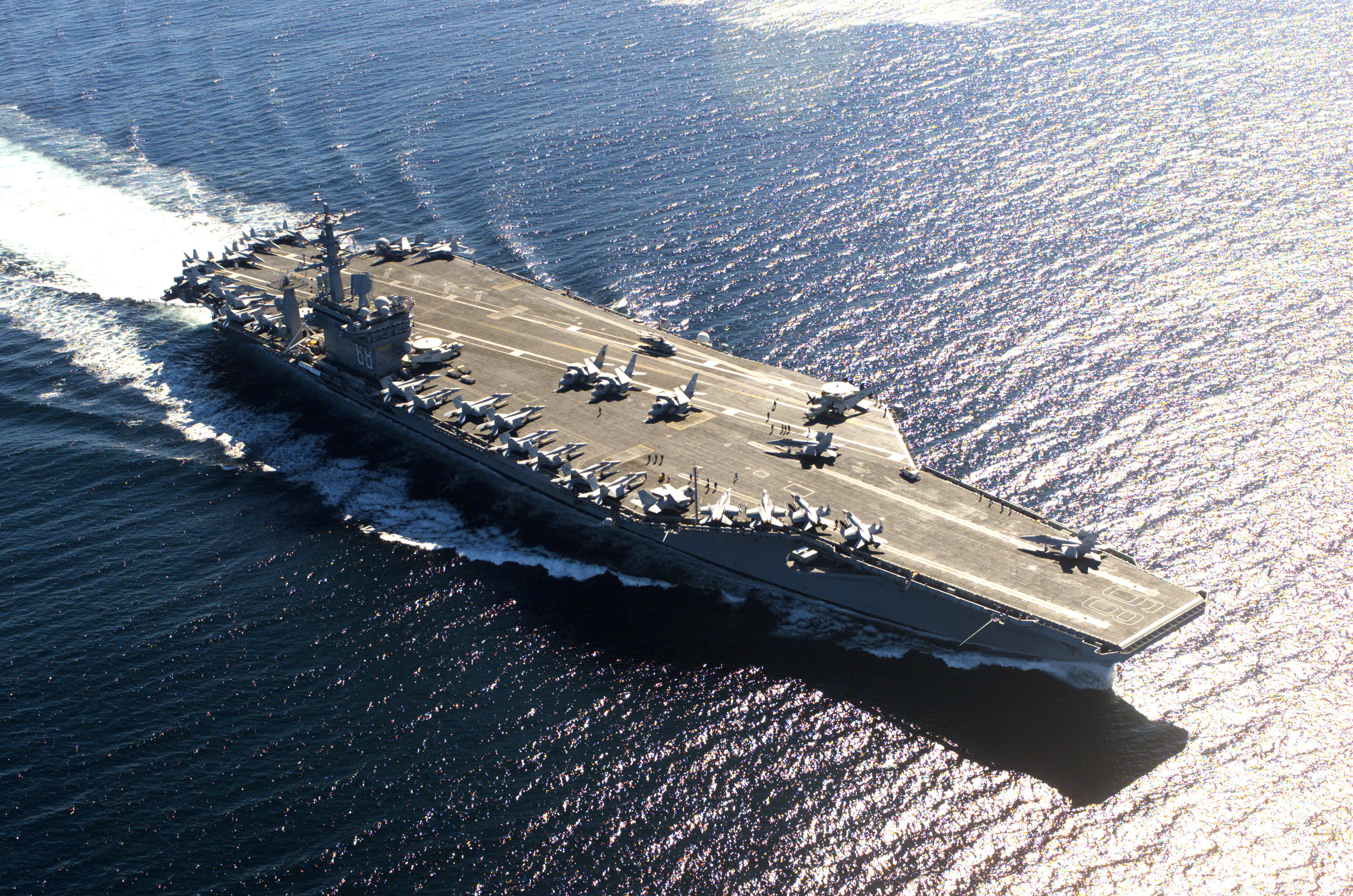
Nimitz-class aircraft carrier
Overview
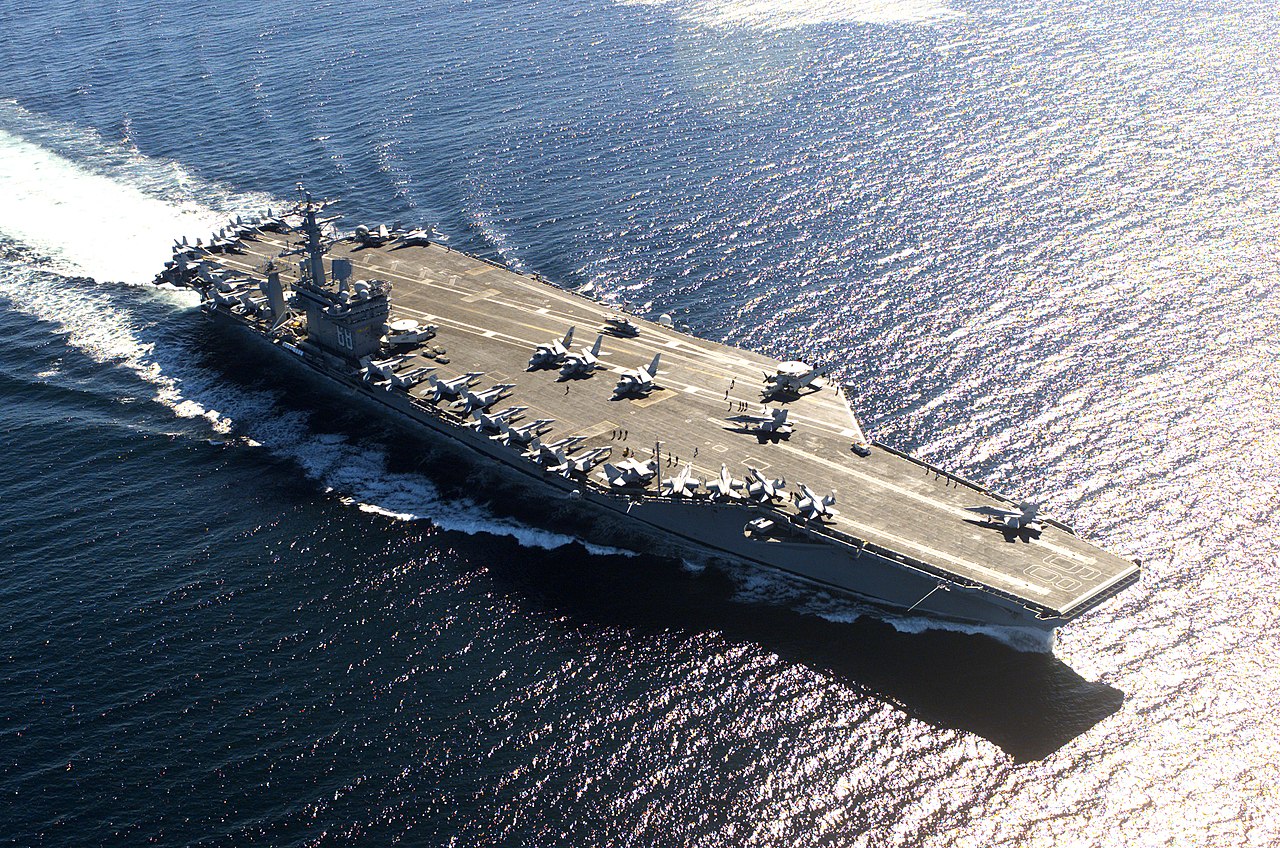
The Nimitz-class aircraft carriers represent the backbone of American naval power projection, serving as floating airbases capable of sustained operations anywhere in the world's oceans. These nuclear-powered supercarriers were designed during the Cold War to counter Soviet naval expansion while providing the United States with unmatched ability to project air power globally. Each carrier operates approximately 60-75 aircraft including F/A-18 Super Hornets, EA-18G Growlers, E-2D Hawkeyes, and various support aircraft. Strategically, Nimitz-class carriers serve as the centerpiece of Carrier Strike Groups (CSGs), providing air superiority, ground attack capabilities, intelligence gathering, and logistics support across vast ocean areas. Their nuclear propulsion allows virtually unlimited range and 20+ years between refueling, making them ideal for extended deployments in contested regions like the Western Pacific and Middle East. The class has been continuously upgraded throughout its service life with improved radar systems, defensive weapons, and aircraft handling capabilities. In today's threat environment, these carriers face increasing challenges from anti-ship ballistic missiles (ASBMs) like China's DF-21D and DF-26, advanced submarines, and swarm attacks using small boats or drones. However, they remain unmatched in their ability to sustain high-tempo air operations far from friendly bases, with each carrier capable of generating 120+ sorties per day during surge operations. Compared to international peers, the Nimitz class significantly outweighs and outguns any competitor. China's Liaoning and Shandong carriers displace roughly half the tonnage and operate smaller air wings, while the UK's Queen Elizabeth class, though modern, lacks catapults and operates only F-35Bs. The Nimitz class remains the gold standard for power projection, though at enormous cost and with growing vulnerability to modern anti-access weapons.
Deployment Map
Home ports from known hull assignments. Operating areas reflect typical AORs — individual deployments will vary.
Timeline
Specifications
Armament
Final layer defense against missiles
Point defense against anti-ship missiles
Passive detection and jamming
Doctrine & Employment
Role
Global power projection through sustained air operations, serving as the centerpiece of carrier strike groups that establish sea control and project American military presence into contested regions beyond the reach of land-based aviation.
Design Philosophy
Prioritized maximum aircraft capacity, nuclear propulsion for unlimited range, and survivability through sheer size and compartmentalization, accepting the trade-offs of enormous cost, massive crew requirements (5,000+ personnel), and high signature that makes concealment impossible. The design sacrificed maneuverability and defensive armament (minimal point defense systems) in favor of relying on escort vessels for protection while maximizing the aviation facilities and fuel capacity needed for sustained high-tempo flight operations.
Employment
Operates as the flagship of a Carrier Strike Group (CSG) typically including 1-2 Arleigh Burke destroyers, 1-2 Ticonderoga cruisers, and 1-2 attack submarines, with the carrier battle group commander (CVBG) coordinating multi-domain operations. Standard deployment cycles involve 6-8 month forward deployments with the carrier conducting flight operations 16-18 hours daily, supporting everything from combat air patrols and strike missions to humanitarian operations and freedom of navigation operations. The air wing's composition varies by theater, with higher fighter-to-attack ratios in contested environments like the Western Pacific versus more strike aircraft for power projection missions in regions like the Persian Gulf.
Threat Context
Originally designed to counter Soviet naval aviation and submarines during blue-water engagements in the Cold War, when the primary threats were Tu-95 Bear bombers, submarine-launched cruise missiles, and surface action groups. The threat environment has evolved to include sophisticated anti-access/area denial (A2/AD) systems featuring long-range precision missiles, advanced submarines, and integrated air defense networks that can potentially target carriers at distances exceeding 1,000nm from hostile coastlines.
How to Compare
Compare primarily on air wing size and composition, sustained sortie generation rates, and operational endurance rather than platform speed or self-defense capabilities—all major carriers achieve similar transit speeds and rely on escorts for protection. The critical differentiators are aircraft capacity (65-85 aircraft), nuclear versus conventional propulsion affecting operational persistence, and the sophistication of command and control systems for managing complex multi-carrier operations.
Operational Patterns
Typical Deployment
Carrier Strike Group centerpiece with 1-2 cruisers, 2-3 destroyers, 1-2 attack submarines, and logistics ship
Deployment Length
9 months
Typical Task Group
Carrier Strike Group (CSG) with guided missile cruiser, destroyers, attack submarine, supply ship
Readiness
Maintenance backlogs affecting availability rates, typically 2-3 carriers deployed at any time with others in maintenance or training cycles
Key Operating Areas
Peer Comparison Matrix
Chinese carriers are significantly smaller (60,000 tons vs 100,000+), use ski-jump launch vs catapults, and operate smaller air wings of J-15 fighters. Limited to regional operations vs global reach.
Video angle: David vs Goliath: How China's carriers stack up against American supercarriers in the Pacific
Modern design but half the displacement, STOVL F-35B only vs varied air wing, no catapults limits aircraft types. Conventional propulsion vs nuclear limits range and deployment duration.
Video angle: Old vs New: Why Britain chose a different path for its new carriers
Nuclear-powered like Nimitz but much smaller (42,000 tons), single carrier limits availability, operates Rafale M fighters. More modern systems but far less capacity.
Video angle: Nuclear carrier club: How France's sole carrier compares to American supercarriers
Similar size to Chinese carriers but plagued by reliability issues, limited air wing, conventional propulsion. More heavily armed with missiles but poor availability record.
Video angle: Paper tiger: Why Russia's only aircraft carrier can't compete with NATO
Next-generation American carrier with electromagnetic catapults, improved radar, smaller crew requirements. More expensive and experiencing technical issues but represents future of US carrier aviation.
Video angle: Old reliable vs new problems: Nimitz vs Ford class growing pains
Combat History
USS Theodore Roosevelt conducted escort operations during Tanker War phase of Iran-Iraq War, providing air cover for reflagged Kuwaiti tankers in Persian Gulf
First major Nimitz-class combat deployment demonstrating sustained operations in contested waters
USS Theodore Roosevelt and USS America launched over 4,800 sorties, USS Saratoga fired Tomahawk missiles. Carriers provided majority of coalition air power
Proved decisive value of carrier aviation in major combat operations far from land bases
Multiple Nimitz-class carriers rotated through Arabian Sea, launching thousands of sorties over Afghanistan. USS Carl Vinson conducted Osama bin Laden burial at sea
Demonstrated sustained power projection capability over two decades of continuous operations
USS George H.W. Bush, USS Carl Vinson, USS Theodore Roosevelt conducted air strikes against ISIS targets in Iraq and Syria, launching over 10,000 sorties
Showcased precision strike capabilities and ability to sustain high-tempo operations
USS Theodore Roosevelt experienced major COVID-19 outbreak in Guam, sidelining carrier for months. Captain Brett Crozier relieved for public letter seeking help for crew
Highlighted vulnerability of large crews to biological threats and readiness implications
USS Dwight D. Eisenhower conducted extended deployment countering Houthi attacks on Red Sea shipping, launching strikes against missile sites in Yemen
Demonstrated continued relevance against asymmetric threats and regional power projection
Known Vulnerabilities
Anti-Ship Ballistic Missiles
Large radar signature and predictable operating areas make carriers vulnerable to DF-21D and DF-26 'carrier killer' missiles with ranges exceeding 1,500km
Context: China's A2/AD strategy specifically targets carrier operations in Western Pacific, potentially pushing carriers beyond effective aircraft range
Mitigation: Distributed operations, improved missile defense, long-range strike weapons, and coordination with allies
Submarine Threats
Limited organic ASW capability beyond embarked helicopters. Reliant on escort ships and submarines for underwater protection in contested waters
Context: Modern diesel-electric and AIP submarines can remain undetected in carrier operating areas, as demonstrated in exercises
Mitigation: Enhanced ASW screening, improved sonobuoy networks, MQ-25 tanker allowing extended CAP ranges
Aging Infrastructure
Oldest ships approaching 50 years service life with increasing maintenance requirements, reduced availability rates, and higher operating costs
Context: Only 10 carriers for global commitments means high operational tempo with limited maintenance windows
Mitigation: RCOH programs extend life, but fundamental hull and systems limitations remain
Crew Fatigue and Manning
Extended deployments (9+ months) and high operational tempo lead to crew fatigue, maintenance backlogs, and recruitment challenges
Context: Competition with civilian sector for technical personnel, especially nuclear-trained sailors
Mitigation: Deployment length limits, improved quality of life programs, retention bonuses
Electronic Warfare Vulnerability
Heavy reliance on GPS, satellite communications, and data links vulnerable to jamming and cyber attacks
Context: Peer adversaries have developed sophisticated EW capabilities specifically targeting carrier operations
Mitigation: Hardened communications, alternative navigation systems, improved EMCON procedures
Variants
| Variant | Designation | Years | Count | Status | Key Changes |
|---|---|---|---|---|---|
| Original Configuration | CVN-68 to CVN-69 | 1975-1981 | 2 | active | Initial design with basic radar and defensive systems |
| Improved Configuration | CVN-70 to CVN-76 | 1982-2003 | 7 | active | Improved radar systems, updated defensive weapons, enhanced damage control |
| Ronald Reagan | CVN-76 | 2003 | 1 | active | Upgraded island design, improved flight deck layout, enhanced communications |
Fleet Roster (10)
| Hull | Name | Variant | Commissioned | Home Port | Status |
|---|---|---|---|---|---|
| CVN-68 | USS Nimitz | Original Configuration | 1975-05-03 | Bremerton, WA | active |
| CVN-69 | USS Dwight D. Eisenhower | Original Configuration | 1977-10-18 | Norfolk, VA | active |
| CVN-70 | USS Carl Vinson | Improved Configuration | 1982-03-13 | San Diego, CA | active |
| CVN-71 | USS Theodore Roosevelt | Improved Configuration | 1986-10-25 | San Diego, CA | active |
| CVN-72 | USS Abraham Lincoln | Improved Configuration | 1989-11-11 | San Diego, CA | active |
| CVN-73 | USS George Washington | Improved Configuration | 1992-07-04 | Yokosuka, Japan | active |
| CVN-74 | USS John C. Stennis | Improved Configuration | 1995-12-09 | Bremerton, WA | active |
| CVN-75 | USS Harry S. Truman | Improved Configuration | 1998-07-25 | Norfolk, VA | active |
| CVN-76 | USS Ronald Reagan | Ronald Reagan | 2003-07-12 | Yokosuka, Japan | active |
| CVN-77 | USS George H.W. Bush | Improved Configuration | 2009-01-10 | Norfolk, VA | active |
Modernization Programmes
Refueling and Complex Overhaul (RCOH)
Mid-life nuclear refueling combined with major systems upgrades, flight deck improvements, defensive systems modernization
Impact: Extends service life by 25 years, modernizes combat systems to current standards
Ship Self Defense System (SSDS) Mk 2
Integrated combat system linking sensors and weapons for automated defense against anti-ship missiles
Impact: Significantly improved defensive capabilities against modern missile threats
Enterprise Air Surveillance Radar (EASR)
Digital radar system replacement for aging AN/SPS-48 and AN/SPS-49 radars during RCOH periods
Impact: Enhanced detection range and tracking capability against low-observable threats
Electromagnetic Aircraft Launch System (EMALS) Retrofit
Potential retrofit of steam catapults with electromagnetic launch systems used on Ford-class
Impact: Would have improved launch efficiency and reduced maintenance, deemed too expensive
Images




Recent News
Frequently Asked
How many Nimitz-class aircraft carrier are in service?
10 Nimitz-class aircraft carrier are currently in service with United States Navy.
When was the first Nimitz-class aircraft carrier commissioned?
The first Nimitz-class aircraft carrier entered service in 1975-05-03.
Who builds the Nimitz-class aircraft carrier?
The Nimitz-class aircraft carrier is built by Newport News Shipbuilding.
What variants of the Nimitz-class aircraft carrier exist?
Known variants include: Original Configuration, Improved Configuration, Ronald Reagan.
How much does a Nimitz-class aircraft carrier cost?
Unit cost is approximately $8.5B per hull.
Curated Research
essential
Norman Friedman's definitive technical and operational history of U.S. carrier development, including detailed analysis of Nimitz-class design decisions and capability evolution.
Congressional Research Service report comparing Ford and Nimitz classes, with extensive discussion of current Nimitz-class operations and limitations driving next-generation requirements.
U.S. Navy's foundational doctrine publication explaining carrier strike group integration, command relationships, and operational employment concepts.
recommended
CSBA analysis examining how Nimitz-class carriers fit into evolving U.S. Navy distributed operations concepts in contested environments.
Former Navy submarine officer and leading analyst on carrier operations, force structure, and adaptation to A2/AD threats in the Western Pacific.
RUSI analysis of global carrier developments and the evolving role of large-deck carriers in modern naval warfare, with specific attention to Nimitz-class vulnerabilities.
U.S. Naval Institute Proceedings articles analyzing air wing evolution, strike package composition, and operational lessons from recent Nimitz-class deployments.
reference
Comprehensive technical specifications, modification history, and deployment records for all ten Nimitz-class carriers with regular updates on refueling and overhaul schedules.
Watch Nimitz in Action
Iron Command produces in-depth comparison and analysis videos for military equipment.
Watch on YouTube