
General Atomics MQ-9 Reaper
Overview
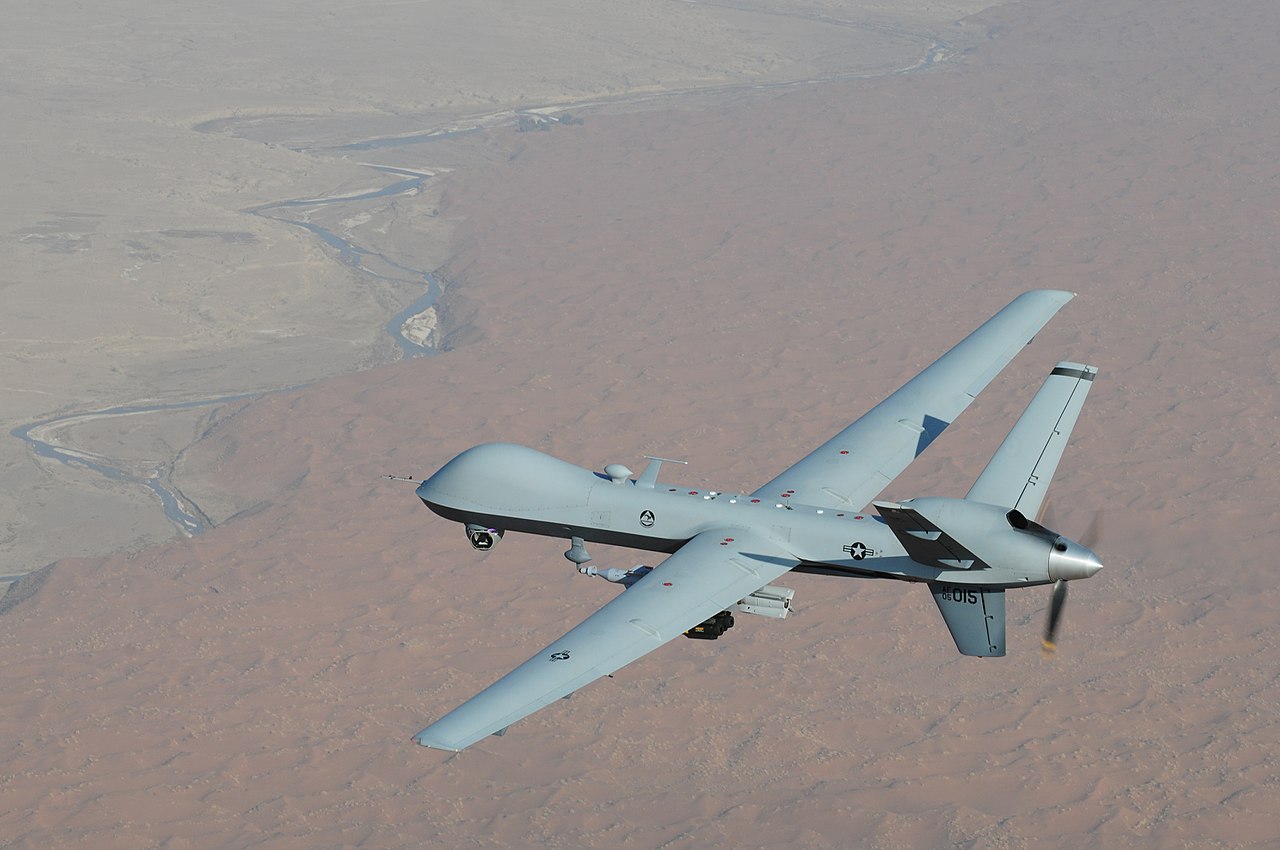
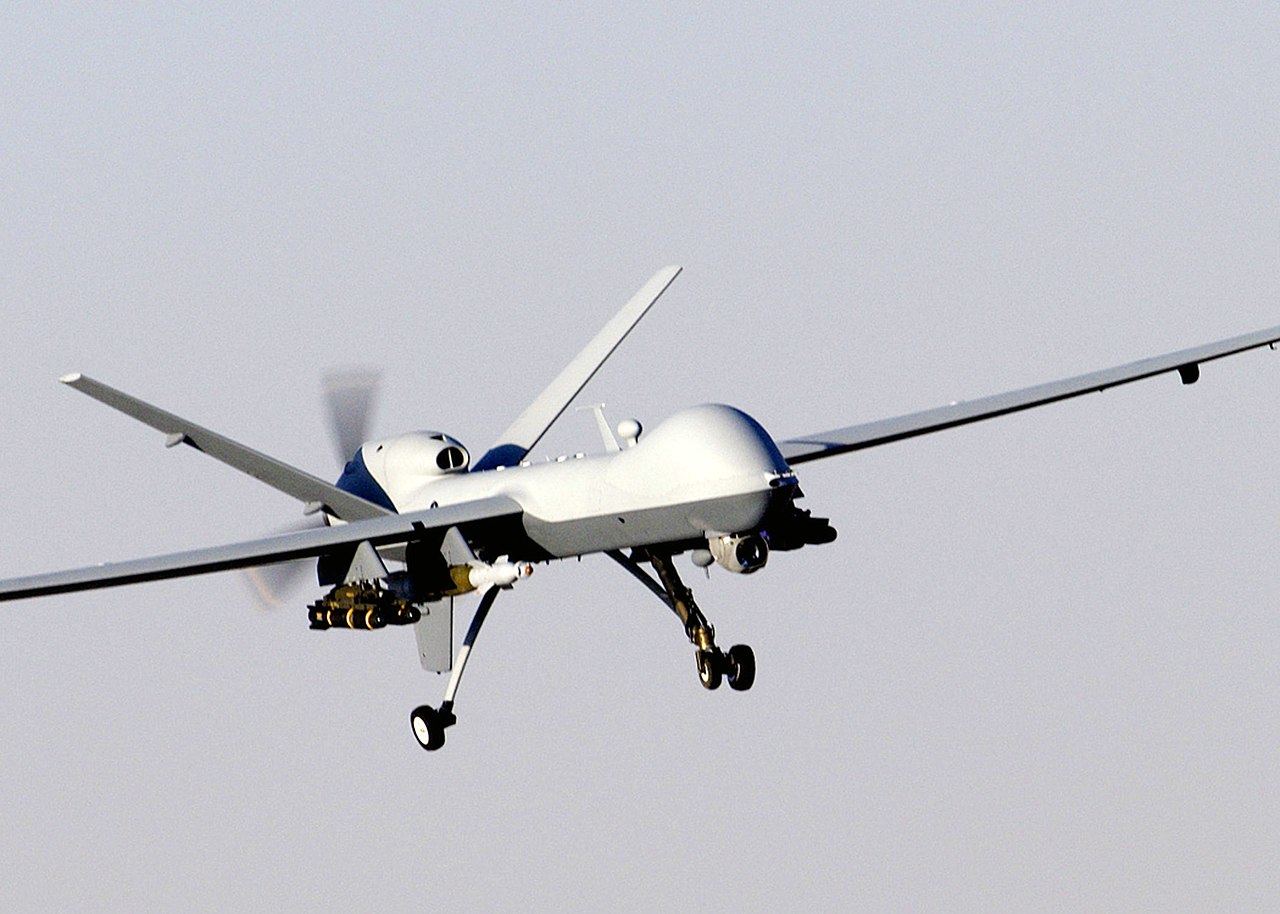
The MQ-9 Reaper is the world's defining medium-altitude, long-endurance (MALE) armed drone — the aircraft that turned the unmanned reconnaissance platform into a persistent hunter-killer. A turboprop-powered, satellite-controlled aircraft far larger than its Predator predecessor, the Reaper combines day-long endurance with a substantial sensor and weapons payload, letting a remote crew watch a target for many hours and then strike it without warning. For two decades it has been the signature instrument of the American way of counter-terrorism. The baseline MQ-9A carries the multi-spectral targeting system (an electro-optical/infrared turret with laser designation) plus radar, and can deliver Hellfire missiles and laser-guided bombs across seven hardpoints. Controlled via satellite datalink from anywhere in the world, it has loitered over Afghanistan, Iraq, Syria, Yemen and the Sahel, and conducted some of the most consequential strikes of the era — including the 2020 killing of Iranian commander Qasem Soleimani. For the Indo-Pacific, the more relevant variant is the MQ-9B SeaGuardian, optimised for maritime wide-area surveillance with a 360-degree maritime radar, automatic identification system tracking, and provision for sonobuoys and anti-submarine sensors. In a theatre defined by vast ocean distances, a single aircraft able to patrol for more than a day and surveil enormous swaths of sea is an enormous force multiplier for maritime domain awareness — which is why Japan operates SeaGuardians and other Indo-Pacific partners are acquiring the type. For an analyst, the Reaper is a study in both the power and the fragility of unmanned airpower. It is unmatched for persistent ISR and strike in permissive airspace, but it is slow, non-stealthy and highly vulnerable to modern air defences and even capable fighters — a limitation made vivid in 2023 when a Russian Su-27 forced down a U.S. Reaper over the Black Sea. Its future in a contested Pacific lies more in surveillance and as a node in crewed-uncrewed teaming than in penetrating defended airspace.
Deployment Map
Home ports from known hull assignments. Operating areas reflect typical AORs — individual deployments will vary.
Timeline
Specifications
Armament
Primary precision strike weapon
Laser- and GPS-guided 500 lb bombs
Maritime patrol and ASW fit
Doctrine & Employment
Role
Medium-altitude long-endurance armed ISR drone; in the Pacific, a long-range maritime surveillance platform.
Design Philosophy
Persistence and payload over speed or stealth — own the time domain in permissive airspace.
Employment
Remote crews fly day-long sorties via satellite for persistent surveillance and precision strike; SeaGuardian patrols vast ocean areas.
Threat Context
Force multiplier for maritime domain awareness across the Indo-Pacific's distances; vulnerable in contested airspace, pushing it toward ISR and teaming roles.
How to Compare
The Western benchmark MALE drone — read against China's Wing Loong, Turkey's TB2 and the Navy's MQ-25.
Operational Patterns
Typical Deployment
Persistent ISR and precision strike in permissive airspace; long-endurance maritime patrol (SeaGuardian) over open ocean.
Typical Task Group
Remote-split operations via satellite; integrated with intelligence and joint fires networks.
Readiness
Mature, widely fielded; maritime and allied variants expanding.
Key Operating Areas
Peer Comparison Matrix
China's MALE strike drone, widely exported as a cheaper Reaper analogue.
Video angle: Reaper vs Wing Loong — the global armed-drone competition.
Smaller, far cheaper combat drone that proved devastating in recent wars; less endurance and payload than the Reaper.
Video angle: Cheap mass vs capability in armed drones.
MQ-25 is a carrier-based unmanned tanker, reflecting the Navy's different unmanned priorities.
Video angle: How the US Navy is going unmanned differently.
Combat History
An MQ-9 Reaper killed Iranian IRGC-Quds Force commander Qasem Soleimani near Baghdad airport.
Among the most strategically significant drone strikes ever conducted.
A Russian Su-27 collided with a U.S. MQ-9 over the Black Sea, forcing the crew to ditch it.
Demonstrated the Reaper's vulnerability in contested airspace near a peer adversary.
MQ-9B SeaGuardian deployed to Kanoya Air Base, Japan, for maritime surveillance.
Showcased the type's Indo-Pacific maritime domain-awareness role.
Known Vulnerabilities
Survivability in contested airspace
Slow, non-stealthy and unable to defend itself against fighters or modern SAMs.
Context: Vivid in the 2023 Black Sea loss to a Russian fighter.
Mitigation: Restricted to permissive airspace or standoff maritime ISR.
Datalink dependence
Relies on a satellite datalink that can be jammed or interdicted.
Context: Peer EW threatens beyond-line-of-sight control.
Mitigation: Hardened/redundant links and autonomy upgrades.
Variants
| Variant | Designation | Years | Count | Status | Key Changes |
|---|---|---|---|---|---|
| MQ-9A Reaper (Block 1/5) | — | 2007– | — | active | Baseline hunter-killer ISR/strike drone |
| MQ-9B SeaGuardian / SkyGuardian | — | 2020– | — | active | Maritime radar, AIS, all-weather/civil-airspace certification, extended endurance |
| MQ-9B Protector RG1 | — | 2023– | — | active | UK Royal Air Force variant |
Modernization Programmes
MQ-9B maritime & teaming
Maritime ISR/ASW fits and integration as a sensor node for crewed-uncrewed teaming.
Impact: Repositions the Reaper from permissive-airspace strike toward Pacific maritime surveillance.
Images




Frequently Asked
How many General Atomics MQ-9 Reaper are in service?
300 General Atomics MQ-9 Reaper are currently in service with U.S. Air Force; U.S. Navy (trials); UK (Protector), Italy, France, others.
When was the first General Atomics MQ-9 Reaper commissioned?
The first General Atomics MQ-9 Reaper entered service in 2007.
Who builds the General Atomics MQ-9 Reaper?
The General Atomics MQ-9 Reaper is built by General Atomics Aeronautical Systems (GA-ASI).
What variants of the General Atomics MQ-9 Reaper exist?
Known variants include: MQ-9A Reaper (Block 1/5), MQ-9B SeaGuardian / SkyGuardian, MQ-9B Protector RG1.
How much does a General Atomics MQ-9 Reaper cost?
Unit cost is approximately $32M per hull.
Curated Research
essential
Official characteristics and role
reference
Specs, variants, operators
Watch General Atomics MQ-9 Reaper in Action
Iron Command produces in-depth comparison and analysis videos for military equipment.
Watch on YouTube