
Mogami-class frigate
Overview
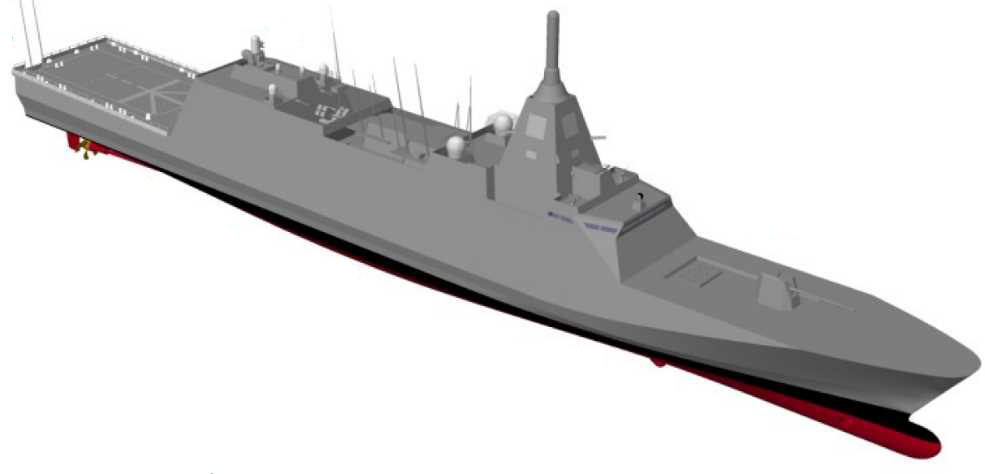
The Mogami-class frigate represents Japan's ambitious attempt to modernize its naval capabilities while managing budget constraints and crew shortages. Designated FFM (Frigate Multi-mission), these vessels are designed as highly automated, multi-role platforms optimized for anti-submarine warfare, air defense, and surface combat in the contested waters of the East China Sea and Western Pacific. Strategically, the Mogami class embodies Japan's shift toward a more proactive defense posture amid rising tensions with China and North Korea. The class prioritizes advanced sensors, networking capabilities, and reduced crew requirements—addressing the JMSDF's chronic manning issues while maintaining operational effectiveness. Each vessel can operate with just 90 crew members, roughly half that of comparable frigates, through extensive automation and simplified maintenance procedures. The design philosophy centers on distributed lethality and interoperability with allied forces, particularly the U.S. Navy. The ships feature the FCS-3A active electronically scanned array (AESA) radar, advanced sonar systems, and Cooperative Engagement Capability (CEC) integration. This allows them to serve as sensor nodes in a broader network-centric warfare environment, extending the reach of larger platforms like the Maya-class destroyers. In the current threat environment, the Mogami class addresses Japan's need for affordable, numerous platforms capable of sustained operations in anti-access/area-denial (A2/AD) scenarios. While not as heavily armed as destroyers, their advanced sensors and networking capabilities make them valuable force multipliers. However, their light armament and limited VLS capacity raise questions about survivability in high-intensity conflicts against peer adversaries like China's expanding navy.
Deployment Map
Home ports from known hull assignments. Operating areas reflect typical AORs — individual deployments will vary.
Timeline
Specifications
Armament
ESSM Block II, Type 07 VL-ASROC
Indigenous anti-ship missile
62-caliber gun
RAM Block 2 missiles
Type 12 torpedoes
Doctrine & Employment
Role
Multi-mission sea control within Japan's expanded defense perimeter, bridging the capability gap between destroyers and patrol vessels while enabling distributed operations across the first island chain.
Design Philosophy
Prioritized automation and multi-mission flexibility over traditional frigate specialization, accepting reduced crew comfort and magazine depth to achieve cost targets under ¥50 billion per hull. Sacrificed dedicated ASW helicopter facilities for modular mission bays, trading proven systems integration for adaptability to evolving threat requirements.
Employment
Typically deployed in small task groups of 2-3 FFMs with ASW helicopter support, conducting extended patrols in the East China Sea and approaches to key straits. Often operates independently or with a single Aegis destroyer for area air defense, leveraging high automation to maintain presence with reduced crew rotations. Integrates into JMSDF's layered ASW screen while providing flexible response to gray-zone operations and maritime intrusions.
Threat Context
Designed primarily for China's expanding submarine fleet and gray-zone operations in the 2010s, but threat evolution toward hypersonic missiles and massed drone attacks has exposed limitations in magazine depth and air defense integration. The platform's modular design provides some adaptation potential, but core architecture reflects pre-2020 threat assumptions.
How to Compare
Compare on automation levels and crew efficiency rather than raw firepower—both Mogami and European equivalents accept reduced VLS capacity for operational sustainability. Focus on ASW sensor integration and helicopter operations, where design philosophies diverge significantly between navies facing different submarine threats.
Operational Patterns
Typical Deployment
Regional patrol and ASW operations, often paired with larger destroyers or submarines
Deployment Length
3 months
Typical Task Group
Operates with destroyer divisions or as part of escort flotillas
Readiness
High automation allows for higher operational tempo but creates dependency on shore-based maintenance support
Key Operating Areas
Peer Comparison Matrix
Chinese frigate has 32 VLS cells vs 16, but Mogami has superior sensors and networking. Type 054A emphasizes quantity over individual capability.
Video angle: David vs Goliath: Japan's tech-heavy approach versus China's numbers game in frigate design
Mogami is more heavily armed and has better sensors, but LCS has greater speed and modularity. Both emphasize automation and reduced crews.
Video angle: Allied approaches to modern frigate design: Japanese integration vs American flexibility
Russian frigate has more VLS cells and longer range missiles, but Mogami has superior radar and electronic systems. Gorshkov emphasizes firepower over sensors.
Video angle: Sensors vs Shooters: Japanese finesse meets Russian firepower in frigate design
FREMM is larger with more weapons but requires larger crew. Mogami prioritizes automation and cost-effectiveness over raw capability.
Video angle: European tradition vs Japanese innovation in modern frigate concepts
Combat History
Multiple Mogami-class vessels have conducted surveillance operations in the East China Sea, monitoring Chinese naval activities and conducting joint exercises with U.S. Navy ships.
Demonstrates operational integration with allied forces and validates sensor networking capabilities in contested waters
Known Vulnerabilities
Light armament
Only 16 VLS cells severely limits sustained combat capability and magazine depth compared to larger destroyers
Context: In high-intensity conflict against Chinese forces, limited missile inventory could be rapidly depleted
Mitigation: Emphasis on networking and coordinated engagement with other platforms to maximize effectiveness
Crew automation dependency
Heavy reliance on automated systems with minimal crew creates single points of failure and damage control limitations
Context: Battle damage could rapidly degrade capability with insufficient crew for manual backup operations
Mitigation: Enhanced damage control systems and redundancy built into critical automated functions
Limited air defense
Lacks long-range SAM capability, relying primarily on ESSM and SeaRAM for air defense
Context: Vulnerable to saturation attacks by Chinese anti-ship missiles and aircraft in contested scenarios
Mitigation: Designed to operate within umbrella of larger destroyers and shore-based air defense
Variants
| Variant | Designation | Years | Count | Status | Key Changes |
|---|---|---|---|---|---|
| Baseline | FFM-1 to FFM-12 | 2022-present | 12 | building | Initial production standard with FCS-3A radar, Type 17 SSM, reduced crew complement |
Fleet Roster (12)
| Hull | Name | Variant | Commissioned | Home Port | Status |
|---|---|---|---|---|---|
| FFM-1 | JS Mogami | Baseline | 2022-03-28 | Maizuru | active |
| FFM-2 | JS Kumano | Baseline | 2022-11-30 | Sasebo | active |
| FFM-3 | JS Noshiro | Baseline | 2023-03-22 | Ominato | active |
| FFM-4 | JS Mikuma | Baseline | 2023-11-29 | Yokosuka | active |
| FFM-5 | JS Yahagi | Baseline | 2024-03-19 | Maizuru | active |
| FFM-6 | JS Agano | Baseline | 2024-11-27 | Sasebo | active |
| FFM-7 | TBD | Baseline | 2025 | TBD | building |
| FFM-8 | TBD | Baseline | 2025 | TBD | building |
| FFM-9 | TBD | Baseline | 2026 | TBD | building |
| FFM-10 | TBD | Baseline | 2026 | TBD | building |
| FFM-11 | TBD | Baseline | 2027 | TBD | building |
| FFM-12 | TBD | Baseline | 2027 | TBD | building |
Modernization Programmes
Enhanced Network Integration
Integration of advanced data links and CEC capabilities to enhance interoperability with U.S. Navy and other JMSDF platforms
Impact: Transforms vessels into networked sensor nodes capable of extending engagement envelopes of other platforms
Hypersonic Missile Integration
Potential integration of Japan's developing hypersonic anti-ship missiles to replace or supplement Type 17 SSMs
Impact: Significantly enhanced anti-ship capability against peer adversaries
Images


Frequently Asked
How many Mogami-class frigate are in service?
6 Mogami-class frigate are currently in service with Japan Maritime Self-Defense Force, with 6 under construction.
When was the first Mogami-class frigate commissioned?
The first Mogami-class frigate entered service in 2022-03-28.
Who builds the Mogami-class frigate?
The Mogami-class frigate is built by Mitsubishi Heavy Industries, Mitsui E&S Shipbuilding.
How much does a Mogami-class frigate cost?
Unit cost is approximately $480M per hull.
Curated Research
essential
Friedman provides essential context on frigate design evolution and the automation trade-offs that define the Mogami class.
CRS report by O'Rourke analyzing JMSDF modernization including detailed Mogami-class procurement and strategic rationale.
recommended
Comprehensive technical specifications and fleet status updates for all JMSDF platforms including Mogami-class variants.
Regular analysis of JMSDF capability development and operational employment patterns in regional context.
Leading open-source analysis on Japanese defense modernization and naval strategy including FFM program assessment.
reference
Authoritative technical analysis and comparison framework for evaluating Mogami against international frigate designs.
Official JMSDF doctrinal publications outlining operational concepts and strategic employment of new frigate capabilities.
Academic analysis of JMSDF doctrinal evolution and how platforms like Mogami fit into broader deterrence strategy.
Watch Mogami in Action
Iron Command produces in-depth comparison and analysis videos for military equipment.
Watch on YouTube