
Mark 48 ADCAP heavyweight torpedo
Overview
The Mark 48 is the U.S. Navy's heavyweight submarine-launched torpedo and the benchmark undersea weapon of the Western world. Designed to kill both fast, deep-diving nuclear submarines and large surface ships, it is the primary armament of every American attack and ballistic-missile submarine, and equips the boats of close allies including Australia, Canada and the Netherlands. More than half a century after its introduction, continuous upgrades have kept it at the leading edge of undersea warfare. The weapon's lethality comes from a combination of speed, range, intelligence and a large warhead. Propelled by a swashplate piston engine burning Otto fuel II and driving a quiet pump-jet, the Mk 48 can run at well over 55 knots to ranges measured in tens of kilometres. It is wire-guided from the launching submarine for most of its run — letting the boat's superior sonar and computers steer the weapon and update the target picture — before its own active/passive sonar seeker takes over for terminal homing. Rather than relying on contact, it detonates its roughly 290 kg warhead beneath a ship's keel, where the gas bubble can break a hull in two. The definitive Mod 7 CBASS (Common Broadband Advanced Sonar System) variant, co-developed with Australia, broadens the sonar's frequency range and sharpens performance in noisy, cluttered littoral waters where future conflicts are likely to be fought. Ongoing guidance-and-control upgrades and a restart of U.S. production reflect renewed great-power competition undersea. For an analyst, the Mk 48 matters because the submarine remains the West's decisive asymmetric advantage in the Pacific, and the torpedo is what makes that advantage lethal. Under AUKUS, Australia's future nuclear-powered submarines will carry it — extending the reach of this weapon deep into the Indo-Pacific and tying allied undersea forces to a common heavyweight torpedo.
Deployment Map
Home ports from known hull assignments. Operating areas reflect typical AORs — individual deployments will vary.
Timeline
Specifications
Doctrine & Employment
Role
Submarine-launched heavyweight torpedo for killing enemy submarines and large surface ships.
Design Philosophy
Maximise the lethality of the West's decisive undersea advantage through speed, range and continuous sensor upgrades.
Employment
Wire-guided from the launching submarine using its superior sensors, then terminal sonar homing and under-keel detonation.
Threat Context
Central to allied undersea dominance in the Pacific; standardised across AUKUS submarine forces.
How to Compare
The Western benchmark — read against Germany's DM2A4, Britain's Spearfish and China's Yu-6.
Operational Patterns
Typical Deployment
Carried by SSNs and SSBNs for anti-submarine and anti-surface engagements; fired from 21-inch tubes.
Typical Task Group
Virginia-, Los Angeles-, Seawolf-class (US) and allied attack submarines.
Readiness
Production restarted; CBASS now the fleet standard.
Key Operating Areas
Peer Comparison Matrix
Fibre-optic guided heavyweight torpedo widely exported with German submarines; comparable role.
Video angle: The two great Western heavyweight torpedoes.
China's wire-guided heavyweight torpedo for its SSN/SSK fleet, reverse-engineered from Western and Russian lineages.
Video angle: US vs Chinese submarine torpedoes — the undersea duel.
Royal Navy heavyweight torpedo with very high speed; upgraded Mod 1 adds insensitive munition and fibre-optic link.
Video angle: AUKUS torpedoes compared.
Combat History
No wartime employment by the U.S. Navy; routinely demonstrated against decommissioned ships in sinking exercises, reliably breaking hulls with under-keel detonation.
Remains the unproven-in-combat but technically dominant Western heavyweight torpedo.
Known Vulnerabilities
Countermeasures
Modern submarines deploy decoys, mobile jammers and evasion tactics against homing torpedoes.
Context: Terminal homing must defeat sophisticated acoustic countermeasures.
Mitigation: CBASS broadband sonar and wire-guided updates improve discrimination.
Wire-guidance constraint
Best performance depends on maintaining the guidance wire, limiting the launching submarine's manoeuvres.
Context: Wire can break, dropping the weapon to autonomous homing earlier.
Mitigation: Capable autonomous seeker as fallback.
Variants
| Variant | Designation | Years | Count | Status | Key Changes |
|---|---|---|---|---|---|
| Mk 48 (baseline) | — | 1972– | — | upgraded | Original anti-submarine/anti-surface heavyweight torpedo |
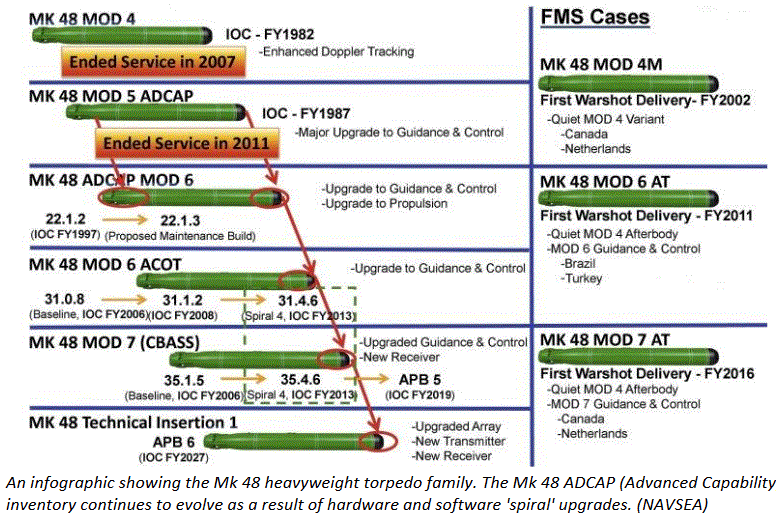
| Mk 48 ADCAP (Mod 4/5) | — | 1988– | — | active | Advanced Capability: new guidance, sonar and propulsion for fast deep-diving subs |
| Mk 48 Mod 6 CBASS / Mod 7 | — | 2006– | — | active | Common Broadband Advanced Sonar (US-Australia); improved littoral and ECCM performance |
Modernization Programmes
Guidance & Control / production restart
Modernised electronics and a restart of new-build Mk 48 production after years of refurbishment-only.
Impact: Replenishes stockpiles for great-power undersea competition.
AUKUS commonality
Arming Australia's future SSN-AUKUS / Virginia-class boats with the Mk 48.
Impact: Standardises allied heavyweight torpedoes across the Indo-Pacific.
Images



Frequently Asked
When was the first Mark 48 ADCAP heavyweight torpedo commissioned?
The first Mark 48 ADCAP heavyweight torpedo entered service in 1972.
Who builds the Mark 48 ADCAP heavyweight torpedo?
The Mark 48 ADCAP heavyweight torpedo is built by Lockheed Martin.
What variants of the Mark 48 ADCAP heavyweight torpedo exist?
Known variants include: Mk 48 (baseline), Mk 48 ADCAP (Mod 4/5), Mk 48 Mod 6 CBASS / Mod 7.
How much does a Mark 48 ADCAP heavyweight torpedo cost?
Unit cost is approximately $4M per hull.
Curated Research
recommended
Official role and characteristics
reference
Specs, variants, CBASS
Watch Mark 48 ADCAP heavyweight torpedo in Action
Iron Command produces in-depth comparison and analysis videos for military equipment.
Watch on YouTube