
M1126 Stryker Infantry Carrier Vehicle
Compare with
Overview
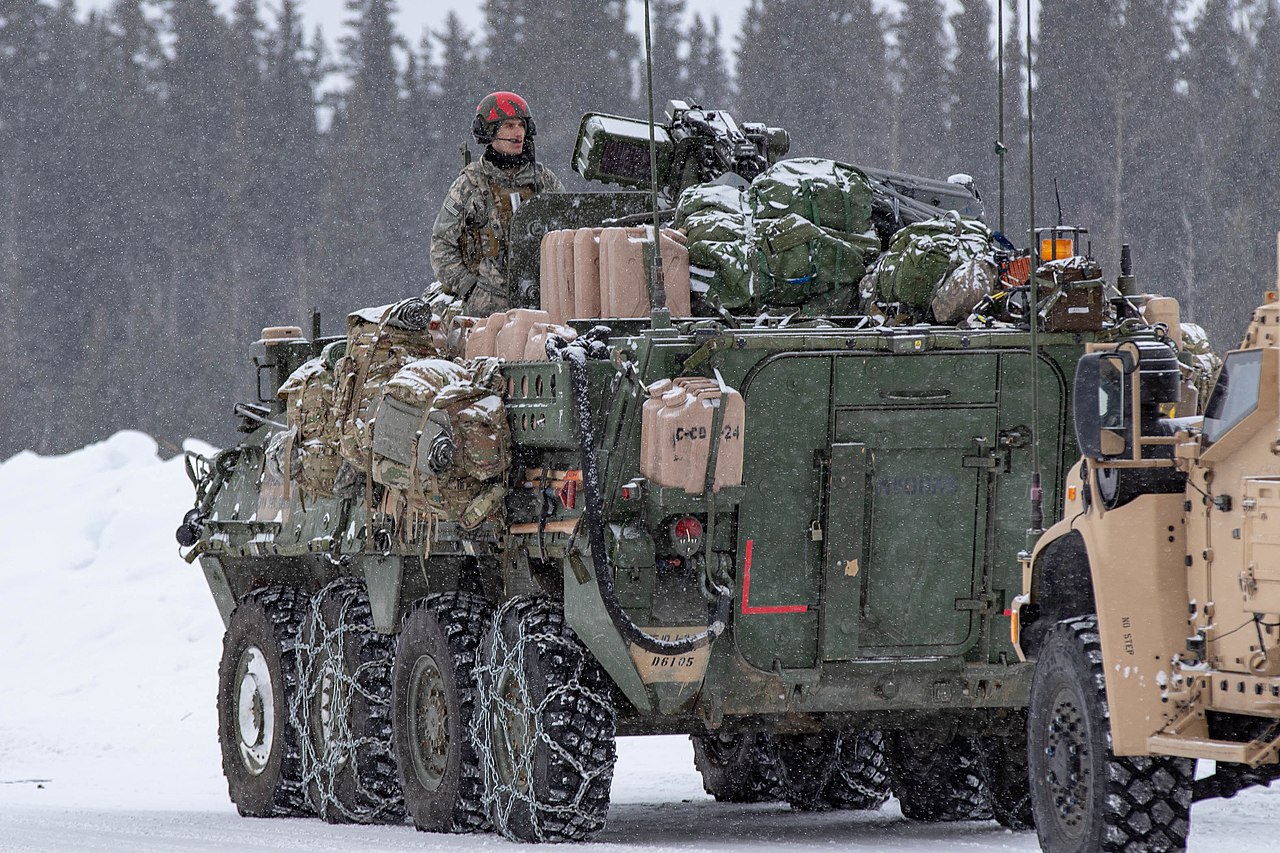
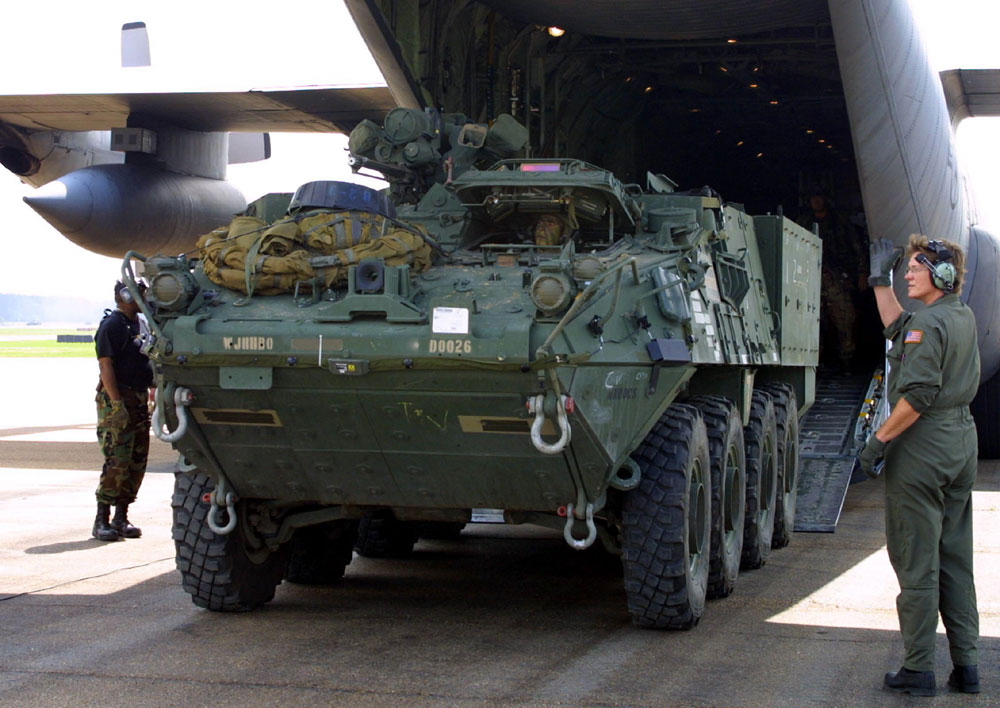
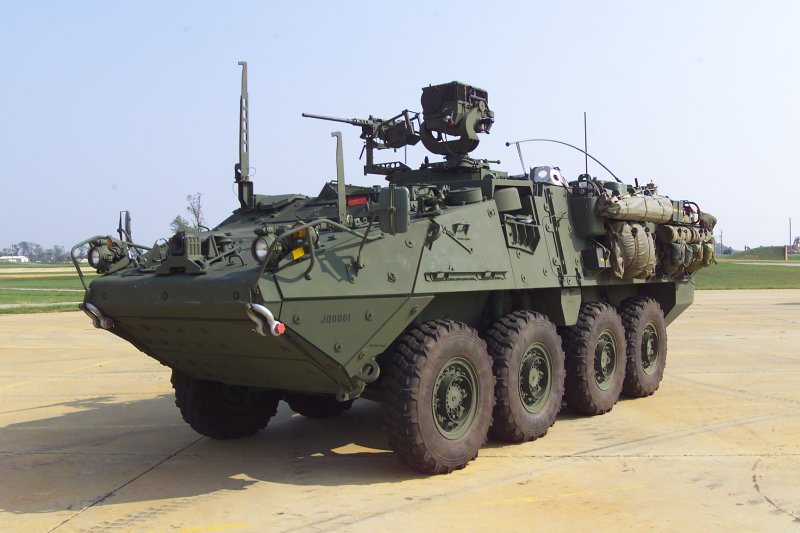
The M1126 Stryker Infantry Carrier Vehicle represents the U.S. Army's attempt to bridge the gap between heavy armored forces and light infantry, embodying the service's vision of rapid-deployment medium-weight brigades. Built on the Canadian LAV III chassis, the Stryker was designed to provide infantry squads with protected mobility while maintaining the strategic deployability that heavy tracked vehicles cannot offer. The platform can carry a nine-man infantry squad plus crew, combining 8x8 wheeled mobility with survivability enhancements including reactive armor and electronic countermeasures. Strategically, the Stryker filled a critical capability gap in the early 2000s when the Army recognized it needed forces that could deploy faster than heavy armor but survive better than unprotected vehicles. The Interim Brigade Combat Team (later Stryker Brigade Combat Team) concept was built around this platform, emphasizing networked operations and combined-arms integration at the company level. Six Stryker Brigade Combat Teams were eventually fielded, each built around approximately 300 Stryker vehicles across multiple variants. In the current threat environment, the Stryker faces significant challenges from advanced anti-tank guided missiles, explosive formed penetrators, and drone-delivered munitions that have proliferated globally. While effective against small arms and artillery fragments, its aluminum hull provides limited protection against modern anti-armor threats. The platform's wheeled configuration, while providing strategic mobility advantages, limits its cross-country performance compared to tracked alternatives and makes it vulnerable to mobility kills from relatively simple improvised explosive devices. Compared to peer platforms like the German Boxer or Finnish Patria AMV, the Stryker offers superior strategic mobility and a mature logistics chain but lags in protection levels and upgrade potential. Its open architecture has enabled continuous modernization, but fundamental limitations in size, weight, and power constrain future growth. The Stryker remains relevant primarily due to its proven reliability, extensive operational history, and the substantial infrastructure investment the Army has made in the platform ecosystem.
Deployment Map
Home ports from known hull assignments. Operating areas reflect typical AORs — individual deployments will vary.
Timeline
Specifications
Armament
Pintle-mounted, commander operated
Optional upgrade, can mount M2 .50 cal or M240B
Firing ports for individual weapons, squad automatic weapons
Operational Patterns
Typical Deployment
Brigade-level deployments as part of rotational forces to Europe, Korea, or contingency operations. Company-level security cooperation missions.
Deployment Length
9 months
Typical Task Group
Operates as integral part of Stryker Brigade Combat Team with organic artillery, engineers, and aviation support
Readiness
High operational tempo has stressed maintenance systems. DVH variants require more frequent tire replacement due to increased weight.
Key Operating Areas
Peer Comparison Matrix
Boxer offers superior protection and modular mission equipment but at significantly higher cost and weight. Better cross-country mobility but reduced strategic deployability compared to Stryker.
Video angle: European vs American approach to medium armor - protection vs deployability trade-offs
Similar 8x8 wheeled configuration but more compact design. Better amphibious capability and easier air transport, but smaller internal volume and less mature electronics integration than Stryker.
Video angle: Nordic engineering vs American systems integration - different solutions to similar requirements
Lower protection levels but amphibious capability and 30mm autocannon as standard. Simpler, more robust design philosophy with lower electronics integration and crew comfort standards.
Video angle: NATO vs Russian doctrine - high-tech networked vs simple robust design philosophies
Stryker is directly derived from LAV III but with extensive US-specific modifications. Canadian LAV 6.0 represents parallel evolution with different upgrade priorities and weapons integration.
Video angle: How two allies evolved the same basic platform differently based on doctrine and threat perceptions
Chinese platform emphasizes amphibious capability and 30mm autocannon as standard equipment. Similar mobility but less sophisticated electronics and force protection systems than modern Strykers.
Video angle: US vs Chinese medium armor development - technology integration vs mass production approaches
Combat History
First combat deployment of 3rd Brigade, 2nd ID in Mosul and surrounding areas. Strykers proved effective for urban patrols and convoy operations but vulnerable to IEDs and RPGs.
Validated basic mobility and communications concepts while revealing critical survivability gaps
Stryker MGS vehicle destroyed by massive IED in Ramadi, killing crew of four. Event highlighted MGS vulnerability and led to tactical employment changes.
Demonstrated limitations of wheeled platform survivability against advanced IED threats
5th Brigade, 2nd ID deployed to Afghanistan's Kandahar province. Terrain and IED threats severely limited mobility, forcing significant tactical adaptations.
Revealed terrain limitations of wheeled platforms in complex environments
2nd Cavalry Regiment Strykers provided fire support and reconnaissance in operations against ISIS in Iraq and Syria, integrating with Iraqi Security Forces.
Demonstrated platform's utility in advisory and fire support roles with allied forces
2nd Cavalry Regiment Strykers conducting deterrence operations along NATO's eastern flank in response to Russian aggression.
Testing platform relevance in potential peer conflict scenarios in European terrain
Known Vulnerabilities
Armor Protection
Aluminum hull provides limited protection against modern anti-tank weapons, large-caliber ammunition, and explosive formed penetrators. Applique armor is modular but constrained by weight limits.
Context: Proliferation of advanced RPGs and ATGMs makes platform vulnerable to most global threats
Mitigation: DVH upgrade, reactive armor tiles, and planned active protection systems partially address threat
Mobility in Complex Terrain
Wheeled configuration limits cross-country performance in soft soil, steep slopes, and heavily vegetated terrain compared to tracked alternatives. Ground pressure and weight distribution issues.
Context: Limits tactical flexibility in many potential operational environments including Eastern Europe
Mitigation: Run-flat tire inserts and traction aids provide marginal improvement but fundamental limitation remains
Logistical Complexity
Multiple variants with different maintenance requirements, parts inventory, and specialized training needs create logistical burden. Tire maintenance and replacement particularly challenging in forward areas.
Context: Sustainability concerns in extended operations or contested logistics environments
Mitigation: Commonality improvements in A1 upgrade and contractor logistics support partially address issues
Network Vulnerability
Heavy reliance on digital communications and blue force tracking makes platform vulnerable to electronic warfare and cyber attacks. Loss of network connectivity significantly degrades effectiveness.
Context: Peer adversaries possess sophisticated EW capabilities that could neutralize key Stryker advantages
Mitigation: Communications security improvements and backup analog systems being integrated
Variants
| Variant | Designation | Years | Count | Status | Key Changes |
|---|---|---|---|---|---|
| Infantry Carrier Vehicle | M1126 | 2002-present | 1567 | active | Base troop transport variant with seating for nine infantry soldiers |
| Reconnaissance Vehicle | M1127 | 2003-present | 339 | active | Enhanced optics suite, additional communications equipment, reduced passenger capacity |
| Mobile Gun System | M1128 | 2007-2022 | 142 | retired | 105mm cannon in automated turret, significant weight increase, crew of 3 |
| Mortar Carrier | M1129 | 2004-present | 256 | active | 120mm mortar system, mortar fire control system, ammunition storage |
| Commander's Vehicle | M1130 | 2003-present | 312 | active | Enhanced communications suite, additional radios and planning equipment |
| Fire Support Vehicle | M1131 | 2004-present | 112 | active | Advanced target acquisition systems, laser designators, fire control equipment |
| Engineer Squad Vehicle | M1132 | 2004-present | 94 | active | Engineering equipment storage, mine detection systems, specialized tools |
| Medical Evacuation Vehicle | M1133 | 2004-present | 142 | active | Medical equipment, stretcher mounts, climate control for patients |
| Anti-Tank Guided Missile Vehicle | M1134 | 2005-present | 56 | active | TOW missile system, targeting optics, missile storage and handling |
| Nuclear, Biological, Chemical Reconnaissance Vehicle | M1135 | 2006-present | 91 | active | Chemical detection sensors, sampling equipment, enhanced NBC protection |
| Double-V Hull | DVH variants | 2009-present | 1295 | active | Enhanced IED protection, increased height and weight, reduced passenger capacity |
Fleet Roster (6)
| Hull | Name | Variant | Commissioned | Home Port | Status |
|---|---|---|---|---|---|
| Multiple | 2nd Stryker Brigade Combat Team, 2nd Infantry Division | Mixed | 2003 | Joint Base Lewis-McChord, WA | active |
| Multiple | 1st Stryker Brigade Combat Team, 25th Infantry Division | Mixed | 2004 | Fort Wainwright, AK | active |
| Multiple | 3rd Stryker Brigade Combat Team, 2nd Infantry Division | Mixed | 2006 | Joint Base Lewis-McChord, WA | active |
| Multiple | 1st Stryker Brigade Combat Team, 4th Infantry Division | Mixed | 2007 | Fort Carson, CO | active |
| Multiple | 2nd Stryker Brigade Combat Team, 4th Infantry Division | Mixed | 2008 | Fort Carson, CO | active |
| Multiple | 2nd Cavalry Regiment | Mixed | 2009 | Vilseck, Germany | active |
Modernization Programmes
Stryker Lethality Improvement Program
Installation of 30mm XM813 cannon in unmanned turret to replace machine gun armament on select ICVs. Provides significant increase in firepower against light armor and fortifications.
Impact: Transforms ICV from pure transport to infantry fighting vehicle with direct fire capability
Double-V Hull Upgrade
Retrofit of flat-bottom hull with V-shaped configuration to deflect IED blasts. Includes additional armor protection and mine-resistant seating.
Impact: Significantly improved crew survivability against IED threats but increased weight and reduced mobility
Stryker A1 Upgrade
Comprehensive modernization including improved power generation, network infrastructure, and integration of next-generation battlefield management systems.
Impact: Extends platform service life through 2040s and improves integration with multi-domain operations
Active Protection System Integration
Installation of Trophy or Iron Fist active protection systems to defeat incoming anti-tank guided missiles and rocket-propelled grenades.
Impact: Would provide critical survivability improvement against modern anti-armor threats
Images





Frequently Asked
How many M1126 Stryker Infantry Carrier Vehicle are in service?
6 M1126 Stryker Infantry Carrier Vehicle are currently in service with U.S. Army.
When was the first M1126 Stryker Infantry Carrier Vehicle commissioned?
The first M1126 Stryker Infantry Carrier Vehicle entered service in 2002.
Who builds the M1126 Stryker Infantry Carrier Vehicle?
The M1126 Stryker Infantry Carrier Vehicle is built by General Dynamics Land Systems.
What variants of the M1126 Stryker Infantry Carrier Vehicle exist?
Known variants include: Infantry Carrier Vehicle, Reconnaissance Vehicle, Mobile Gun System, Mortar Carrier, Commander's Vehicle, Fire Support Vehicle, Engineer Squad Vehicle, Medical Evacuation Vehicle, Anti-Tank Guided Missile Vehicle, Nuclear, Biological, Chemical Reconnaissance Vehicle, Double-V Hull.
How much does a M1126 Stryker Infantry Carrier Vehicle cost?
Unit cost is approximately $5M per hull.
Watch M1126 Stryker Infantry Carrier Vehicle in Action
Iron Command produces in-depth comparison and analysis videos for military equipment.
Watch on YouTube