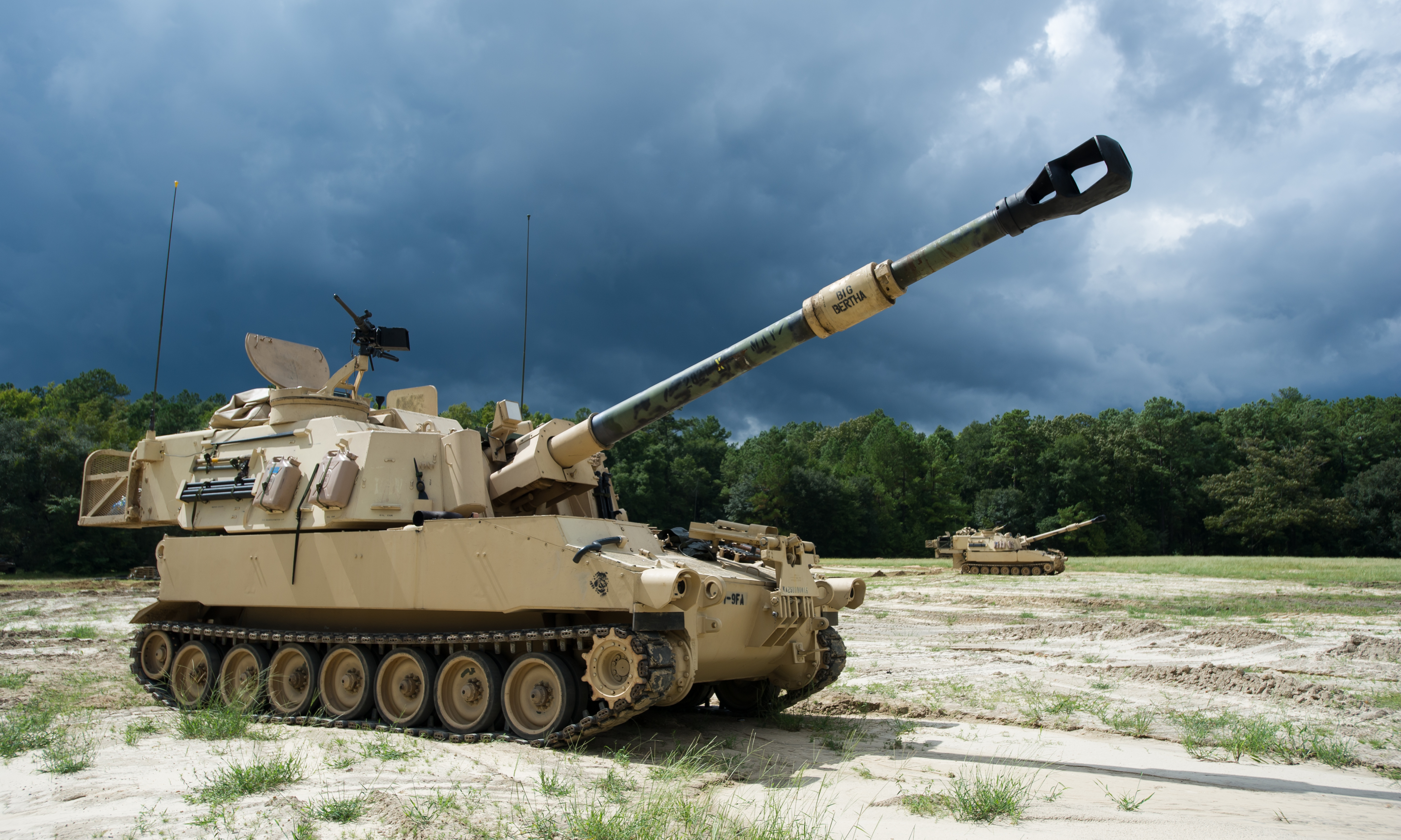
M109A7 Paladin Integrated Management (PIM) Self-Propelled Howitzer
Overview
The M109A7 Paladin Integrated Management (PIM) represents the latest evolution of the world's most widely deployed self-propelled howitzer family, fundamentally rebuilding the platform around modern automotive components and digital fire control systems. Entering service in 2015, the A7 variant addresses critical reliability and logistics issues that plagued earlier M109 variants while providing the U.S. Army's Armored Brigade Combat Teams with enhanced firepower, survivability, and interoperability in high-intensity conflict scenarios. Strategically, the M109A7 serves as the backbone of U.S. Army divisional artillery, designed to provide responsive indirect fire support in both counterinsurgency operations and near-peer conflicts against advanced adversaries like Russia and China. The platform's emphasis on shoot-and-scoot tactics, with rapid displacement capabilities after firing, reflects lessons learned from observing Russian counter-battery radar effectiveness in Ukraine and the need to survive in contested electromagnetic environments. The PIM program philosophy centered on maximum parts commonality with the Bradley Fighting Vehicle family, sharing the same engine, transmission, and suspension components to reduce the Army's logistics footprint. This approach, while controversial due to increased weight and fuel consumption, provides significant advantages in maintenance training, spare parts inventory, and field repair capabilities during sustained operations. In the current threat environment, the M109A7 faces challenges from increasingly sophisticated counter-battery systems, loitering munitions, and the need for extended-range precision fires to compete with Russian and Chinese artillery systems. The platform's integration with the Army's emerging Multi-Domain Operations concept positions it as a key node in networked fires, but questions remain about its survivability against advanced threats and whether traditional tube artillery can maintain relevance against missile-centric adversaries.
Deployment Map
Home ports from known hull assignments. Operating areas reflect typical AORs — individual deployments will vary.
Timeline
Specifications
Armament
Can fire all NATO 155mm ammunition including Excalibur GPS-guided rounds
Commander's weapon, limited ammunition
Operational Patterns
Typical Deployment
Organized in 18-gun battalions supporting Armored Brigade Combat Teams, emphasis on rapid displacement
Deployment Length
9 months
Typical Task Group
Operates with M992A3 ammunition supply vehicles, supported by AN/TPQ-53 counter-fire radars
Readiness
Higher readiness rates than previous variants due to common Bradley components, but still faces parts shortages
Key Operating Areas
Peer Comparison Matrix
Russian system offers longer range (40km+ with RAP rounds) and faster rate of fire, but M109A7 has superior fire control systems and precision ammunition integration
Video angle: NATO vs Russian artillery philosophy - precision vs volume of fire comparison
Chinese system has significantly longer range (50km+) and lighter weight, but M109A7 benefits from proven reliability and extensive logistical support network
Video angle: Pacific artillery competition - range vs reliability in island warfare scenarios
German system has superior rate of fire (10+ rpm burst) and longer barrel, but M109A7 offers better parts commonality and lower operating costs
Video angle: NATO artillery showdown - German engineering vs American logistics philosophy
Korean system is lighter, faster, and has achieved significant export success, while M109A7 relies on mature technology and established supply chains
Video angle: Old guard vs new generation - traditional vs modern artillery design approaches
French wheeled system offers strategic mobility and lower cost but lacks armor protection and sustained fire capability of M109A7
Video angle: Tracked vs wheeled artillery - protection vs mobility trade-offs in modern warfare
Combat History
M109A6/A7 units provided fire support for anti-ISIS operations in Iraq and Syria, conducting precision strikes with Excalibur rounds
Demonstrated precision engagement capabilities and interoperability with coalition forces
18 M109A6 howitzers transferred to Ukraine for combat against Russian forces, reported high effectiveness but maintenance challenges
First major peer conflict employment, validating shoot-and-scoot tactics against advanced counter-battery systems
Known Vulnerabilities
Counter-battery survivability
Large thermal and acoustic signature, limited armor protection against modern counter-battery fires and loitering munitions
Context: Russian Lancet drones and Krasnopol guided artillery have demonstrated effectiveness against similar platforms in Ukraine
Mitigation: Emphasis on rapid displacement, electronic warfare countermeasures, and dispersion tactics
Range disadvantage
30km maximum range significantly shorter than Russian 2S19M2 Msta-S (29km standard, 40km+ with rocket-assisted) and Chinese PLZ-05 (50km+)
Context: Forces U.S. units to operate closer to enemy positions, increasing vulnerability to counter-fires
Mitigation: ERCA program cancelled, relying on rocket artillery and air support for long-range fires
Logistics burden
High fuel consumption (2.8 miles per gallon), complex maintenance requirements, heavy ammunition requirements
Context: Sustainability challenges in extended operations without robust logistics support
Mitigation: Common chassis with Bradley family reduces some maintenance complexity
Electronic warfare vulnerability
Heavy reliance on GPS for navigation and fire control, vulnerable to jamming and spoofing
Context: Russian electronic warfare capabilities demonstrated in Ukraine pose significant threat to precision operations
Mitigation: Development of alternative navigation systems and hardened communications
Variants
| Variant | Designation | Years | Count | Status | Key Changes |
|---|---|---|---|---|---|
| M109A6 Paladin | Previous generation | 1994-2015 | 950 | active | Automated fire control, improved ballistic computer, NBC protection |
| M109A7 Paladin PIM | Current production | 2015-present | 480 | active | Bradley chassis components, improved engine, enhanced electronics, better reliability |
| M992A3 Field Artillery Ammunition Supply Vehicle (FAASV) | Support variant | 2017-present | 145 | active | Ammunition resupply vehicle based on M109A7 chassis |
Fleet Roster (1)
| Hull | Name | Variant | Commissioned | Home Port | Status |
|---|---|---|---|---|---|
| Various | M109A7 Fleet | A7 PIM | 2015-present | Multiple Army bases | Production ongoing, 480 delivered of 580 planned |
Modernization Programmes
Extended Range Cannon Artillery (ERCA)
58-caliber extended barrel for M109A7 to achieve 70km range, cancelled due to technical issues
Impact: Leaves capability gap against Russian and Chinese long-range systems
Armored Multi-Purpose Vehicle (AMPV) Integration
Leveraging common chassis components between M109A7 and AMPV family for logistics efficiency
Impact: Reduces maintenance complexity and spare parts requirements
Precision Strike Suite
Integration of enhanced targeting systems and compatibility with next-generation precision munitions
Impact: Maintains relevance in precision fires competition with guided rocket systems
Images


Frequently Asked
How many M109A7 Paladin Integrated Management (PIM) Self-Propelled Howitzer are in service?
480 M109A7 Paladin Integrated Management (PIM) Self-Propelled Howitzer are currently in service with United States Army.
When was the first M109A7 Paladin Integrated Management (PIM) Self-Propelled Howitzer commissioned?
The first M109A7 Paladin Integrated Management (PIM) Self-Propelled Howitzer entered service in 2015.
Who builds the M109A7 Paladin Integrated Management (PIM) Self-Propelled Howitzer?
The M109A7 Paladin Integrated Management (PIM) Self-Propelled Howitzer is built by BAE Systems.
What variants of the M109A7 Paladin Integrated Management (PIM) Self-Propelled Howitzer exist?
Known variants include: M109A6 Paladin, M109A7 Paladin PIM, M992A3 Field Artillery Ammunition Supply Vehicle (FAASV).
How much does a M109A7 Paladin Integrated Management (PIM) Self-Propelled Howitzer cost?
Unit cost is approximately $4M per hull.
Watch M109A7 Paladin Integrated Management (PIM) Self-Propelled Howitzer in Action
Iron Command produces in-depth comparison and analysis videos for military equipment.
Watch on YouTube