
Lewis B. Puller-class expeditionary sea base
Compare with
Overview
The Lewis B. Puller-class expeditionary sea base (ESB) represents the U.S. Navy's innovative approach to forward-deployed logistics and special operations support in contested maritime environments. These massive auxiliary vessels, designated ESB-3 through ESB-6, serve as floating bases that can sustain special operations forces, support mine countermeasure operations, and provide aviation facilities for rotorcraft and unmanned systems far from traditional shore bases. Strategically, the ESB class fills a critical gap in the Navy's ability to project power and sustain operations in areas where traditional port access is unavailable or contested. The platform's modular design philosophy allows it to reconfigure mission packages rapidly, supporting everything from Navy SEAL insertion operations to humanitarian assistance and disaster relief. This flexibility is essential in the current strategic environment where great power competition demands sustained presence operations across vast ocean areas. The ESB design is based on the proven Alaska-class crude oil tanker hull, modified extensively for military operations. This commercial heritage provides exceptional seakeeping abilities and endurance while keeping costs manageable compared to purpose-built military vessels. The large flight deck can accommodate multiple MH-53 Sea Dragon helicopters simultaneously, while the mission deck below provides 25,000 square feet of reconfigurable space for mission modules, small craft, or vehicle storage. In the current threat environment, ESBs provide commanders with a unique capability to establish temporary forward operating bases in international waters, supporting distributed maritime operations concepts. Unlike traditional amphibious ships tied to Marine Expeditionary Units, ESBs can operate independently or with small surface action groups, providing persistent presence and rapid response capabilities. However, their limited self-defense systems and large signatures make them vulnerable in contested environments, requiring escort protection when operating near peer adversaries.
Deployment Map
Home ports from known hull assignments. Operating areas reflect typical AORs — individual deployments will vary.
Timeline
Specifications
Armament
20mm Gatling gun for missile defense
Small boat defense
Doctrine & Employment
Role
Forward logistics enablement and distributed operations support to extend special operations and mine warfare capabilities beyond traditional shore-based limitations in contested maritime environments.
Design Philosophy
Designers prioritized maximum deck space, fuel/stores capacity, and small craft handling over speed and survivability, accepting merchant-hull vulnerability to gain enormous logistics capacity. The platform sacrifices traditional naval damage control standards and self-defense capabilities to maximize aviation facilities and cargo handling, reflecting the assumption of permissive or lightly contested operational environments.
Employment
ESBs typically operate as semi-independent logistics nodes supporting Maritime Expeditionary Security Force (MESF) operations, special operations task units, and mine countermeasure groups. They provide mothership capabilities for small craft, helicopter operations, and unmanned systems while maintaining sufficient distance from high-threat areas to preserve logistics sustainability. Command relationships typically fall under numbered fleet commanders with operational control delegated to task force commanders based on mission requirements.
Threat Context
Originally designed for counter-piracy, partner capacity building, and uncontested logistics missions, the ESB now faces increasingly sophisticated anti-ship missile threats and submarine warfare challenges. The threat evolution toward long-range precision strike capabilities has forced reconsideration of ESB operating distances and defensive postures in peer competition scenarios.
How to Compare
Compare ESBs on logistics capacity, small craft handling capability, and aviation facilities rather than traditional naval metrics like speed or weapons systems. The key analytical dimensions are cargo throughput, operational endurance, and flexibility to support diverse mission sets—conventional naval performance metrics are largely irrelevant for this platform type.
Operational Patterns
Typical Deployment
Forward-deployed as independent sea base or with special operations task groups
Deployment Length
12 months
Typical Task Group
Independent operations or with destroyer/frigate escort and special operations units
Readiness
High operational tempo with extended deployments, some maintenance challenges due to commercial systems integration
Key Operating Areas
Peer Comparison Matrix
Chinese vessel focused on fleet replenishment vs. ESB's special operations support role. Type 901 has better self-defense but less aviation capability.
Video angle: Compare different approaches to forward logistics - Chinese fleet support vs. US special operations enabler
Smaller Danish ships pioneered modular mission concept but with full warship capabilities. ESB trades combat power for size and endurance.
Video angle: Evolution of modular warship concept from Danish innovation to US sea base application
Spanish LHD provides similar aviation platform but with amphibious assault focus and better self-defense. ESB offers more flexible mission space.
Video angle: Different NATO approaches to expeditionary operations - assault vs. support focus
Combat History
USNS Lewis B. Puller deployed to Persian Gulf providing base for special operations and surveillance assets during Iranian tanker attacks
First operational deployment demonstrated ESB capability to provide forward presence in contested waters
USNS Hershel 'Woody' Williams conducted sustained operations off West Africa, supporting counter-piracy and maritime security cooperation
Proved ESB concept for sustained forward presence operations, maintaining 18-month deployment
USNS Miguel Keith supported special operations exercises in Pacific, hosting MH-60 and unmanned systems operations
Validated multi-domain operations concept with manned-unmanned teaming from sea base platform
Known Vulnerabilities
Self-defense capabilities
Minimal defensive armament limited to Phalanx CIWS and small arms, no area air defense or anti-ship missile capability
Context: Large, slow signature makes attractive target for anti-ship missiles, requires escort protection in contested waters
Mitigation: Planned SeaRAM installation and reliance on escort vessels or shore-based air cover
Signature management
Large radar and thermal signature due to commercial hull origins, easily detectable by surveillance systems
Context: In era of proliferating ISR capabilities, difficult to conceal from adversary detection
Mitigation: Limited options due to hull size, relies on operating in permissive environments or with protective screen
Damage control
Commercial-standard damage control systems and crew training compared to warship standards
Context: Reduced survivability if attacked compared to purpose-built combatants
Mitigation: Enhanced damage control training and some military-standard systems retrofit
Variants
| Variant | Designation | Years | Count | Status | Key Changes |
|---|---|---|---|---|---|
| ESB-3/4 Initial | ESB-3 to ESB-4 | 2015-2018 | 2 | active | Original configuration based on Alaska-class tanker hull with basic aviation and mission deck facilities |
| ESB-5/6 Enhanced | ESB-5 to ESB-6 | 2020-2023 | 2 | active | Improved C4ISR systems, enhanced self-defense capabilities, upgraded mission module interfaces |
Fleet Roster (4)
| Hull | Name | Variant | Commissioned | Home Port | Status |
|---|---|---|---|---|---|
| ESB-3 | USNS Lewis B. Puller | Initial | 2015-08-17 | Norfolk, VA | active |
| ESB-4 | USNS Hershel 'Woody' Williams | Initial | 2020-03-07 | Souda Bay, Greece | active |
| ESB-5 | USNS Miguel Keith | Enhanced | 2021-09-18 | San Diego, CA | active |
| ESB-6 | USNS John Lewis | Enhanced | 2023-03-18 | Norfolk, VA | active |
Modernization Programmes
ESB Mission Module Standardization
Standardizing mission module interfaces across all ESBs to support counter-mine, special operations, and humanitarian assistance packages
Impact: Increases operational flexibility and reduces logistics burden for forward deployments
Enhanced Self-Defense Suite
Addition of SeaRAM point defense systems and improved electronic warfare capabilities
Impact: Reduces vulnerability in contested environments, allows operations closer to threat areas
Images
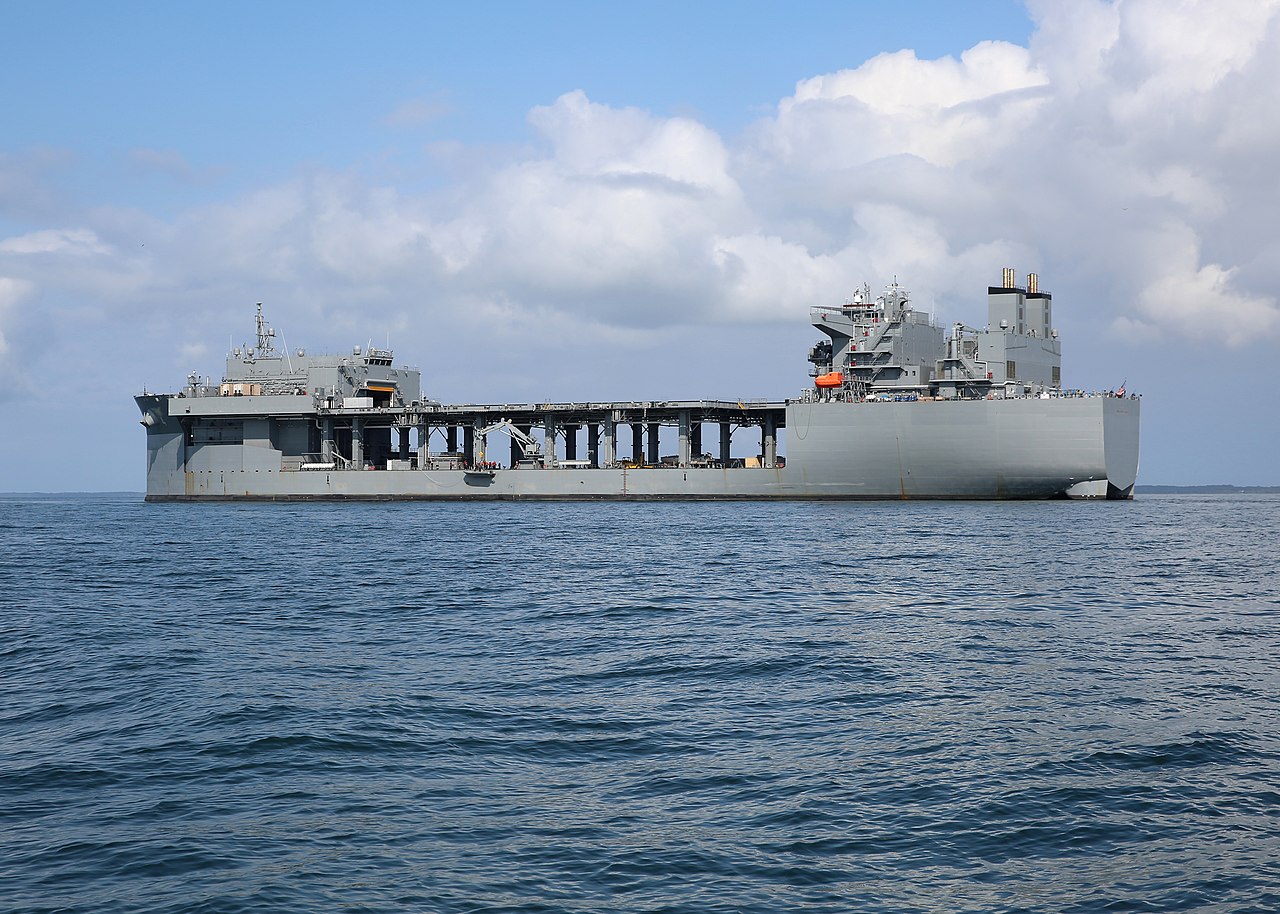


Frequently Asked
How many Lewis B. Puller-class expeditionary sea base are in service?
4 Lewis B. Puller-class expeditionary sea base are currently in service with United States Navy.
When was the first Lewis B. Puller-class expeditionary sea base commissioned?
The first Lewis B. Puller-class expeditionary sea base entered service in 2015-08-17.
Who builds the Lewis B. Puller-class expeditionary sea base?
The Lewis B. Puller-class expeditionary sea base is built by General Dynamics NASSCO.
What variants of the Lewis B. Puller-class expeditionary sea base exist?
Known variants include: ESB-3/4 Initial, ESB-5/6 Enhanced.
How much does a Lewis B. Puller-class expeditionary sea base cost?
Unit cost is approximately $648M per hull.
Curated Research
essential
Provides authoritative technical details and design evolution context for ESB development within broader U.S. Navy auxiliary ship programs.
CRS analysis provides program history, cost analysis, and strategic rationale for ESB procurement decisions.
Official U.S. Navy doctrinal foundation explaining ESB role within naval expeditionary warfare concepts.
recommended
Regular coverage of ESB operations and doctrinal development by serving and retired naval officers provides operational insights.
Strategic context for ESB employment in contested environments and integration with distributed maritime operations concepts.
reference
Comprehensive technical specifications and program details for ESB class characteristics and capabilities.
Regular analysis of ESB operations and future employment concepts by maritime security professionals.
Watch Lewis B. Puller in Action
Iron Command produces in-depth comparison and analysis videos for military equipment.
Watch on YouTubeSources