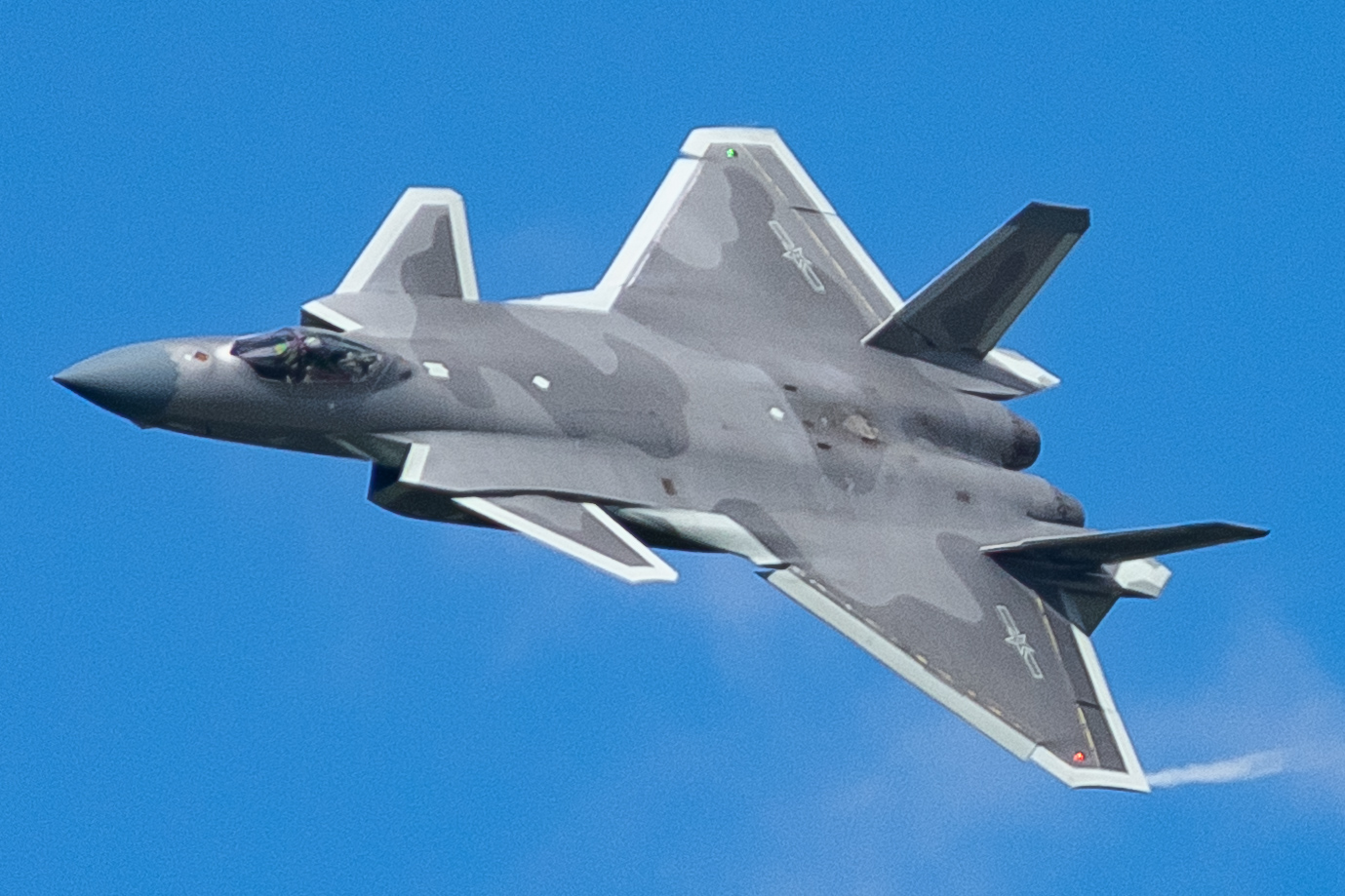
Chengdu J-20 Mighty Dragon
Overview
The Chengdu J-20 Mighty Dragon represents China's entry into the fifth-generation stealth fighter arena, designed specifically to challenge U.S. air dominance in the Western Pacific. This twin-engine, single-seat fighter emphasizes long-range strike capabilities and stealth characteristics, filling the PLAAF's need for a platform capable of operating in contested airspace against advanced air defense systems. The J-20's design philosophy prioritizes forward-hemisphere stealth, extended range, and the ability to engage high-value targets like tankers and AWACS aircraft. Strategically, the J-20 serves as China's primary counter to the F-22 Raptor and F-35 Lightning II, though its role differs significantly from these platforms. Rather than emphasizing air superiority like the F-22, the J-20 appears optimized for long-range interception and strike missions, effectively extending China's anti-access/area-denial (A2/AD) bubble deeper into the Pacific. Its large internal weapons bay can accommodate long-range air-to-air missiles like the PL-15, giving it standoff engagement capability against coalition support aircraft. In the current threat environment, the J-20 represents a paradigm shift for regional air power balance. Its stealth characteristics, while not necessarily matching U.S. fifth-generation fighters, provide sufficient signature reduction to complicate detection and targeting by existing radar systems. The aircraft's operational deployment since 2017 has accelerated, with recent variants featuring indigenous WS-10C engines replacing Russian AL-31 powerplants, reducing foreign dependency and potentially improving performance. Compared to its peers, the J-20 trades some maneuverability for range and payload capacity. While it may not match the F-22's kinematic performance or the F-35's sensor fusion, it offers the PLAAF a credible stealth platform capable of threatening high-value targets at extended ranges, fundamentally altering air campaign planning for any potential Pacific conflict.
Deployment Map
Home ports from known hull assignments. Operating areas reflect typical AORs — individual deployments will vary.
Timeline
Specifications
Armament
Primary beyond visual range missile with AESA seeker
Infrared-guided for close combat
GPS/INS guided glide bomb
Supersonic anti-ship capability (uncertain integration)
Operational Patterns
Typical Deployment
Air defense and long-range interception missions, primarily from mainland China bases
Typical Task Group
Operates with J-16 fighters, KJ-500 AWACS, and tanker support
Readiness
Limited by stealth coating maintenance requirements and specialized support infrastructure
Key Operating Areas
Peer Comparison Matrix
F-22 emphasizes air superiority with superior maneuverability and supercruise, while J-20 prioritizes long-range interception and strike. J-20 has larger weapons bay but less mature stealth technology.
Video angle: David vs Goliath: How China's J-20 plans to counter the world's most advanced air superiority fighter
F-35 offers superior sensor fusion and multirole flexibility, while J-20 provides greater range and payload. Different design philosophies: F-35 as networked multirole platform vs J-20 as long-range interceptor.
Video angle: Quantity vs Quality: J-20's numbers game against F-35's technological edge
Su-57 emphasizes maneuverability with 3D thrust vectoring while J-20 focuses on stealth and range. Both face production and technological challenges but represent different approaches to fifth-generation requirements.
Video angle: Eastern Stealth Showdown: Comparing Russia and China's fifth-generation fighters
F-3 still in development but planned to emphasize advanced sensors and networking to counter J-20's range advantage. Represents Japan's response to growing Chinese air power in the region.
Video angle: Japan's Next Fighter: How the F-3 aims to counter China's J-20 threat
Combat History
J-20 aircraft conducted multiple incursions into Taiwan's Air Defense Identification Zone, demonstrating operational capability and political signaling
First documented operational deployment in contested airspace, showing PLAAF confidence in platform maturity
J-20s reportedly tracked U.S. B-1B bombers during freedom of navigation operations, maintaining standoff distances
Demonstrated long-range interception capability and integration with broader PLAAF air defense network
Known Vulnerabilities
Rear-Aspect Stealth
Stealth characteristics appear optimized for frontal aspect, with less attention to rear-hemisphere signature reduction
Context: Vulnerable to detection by aircraft or ground radars positioned behind the aircraft during egress
Mitigation: Tactical employment emphasizes frontal engagement profiles and rapid egress
Engine Technology Gap
Current WS-10C engines lack supercruise capability and have higher thermal signatures compared to Western counterparts
Context: Limits sustained supersonic operations and increases IR detection range
Mitigation: WS-15 engine development program underway but timeline uncertain
Combat Experience Deficit
No combat experience and limited operational testing against advanced adversary systems
Context: Real-world effectiveness against modern ECM and advanced fighters remains unproven
Mitigation: Increased training exercises and gradual operational deployment expansion
Maintenance and Logistics
Complex stealth coatings and advanced systems require specialized maintenance infrastructure
Context: May limit forward deployment options and sortie generation rates
Mitigation: PLAAF investing in specialized maintenance facilities and training programs
Variants
| Variant | Designation | Years | Count | Status | Key Changes |
|---|---|---|---|---|---|
| J-20A | Initial production variant | 2017-2019 | 50 | active | Initial operational variant with AL-31 engines, basic avionics suite |
| J-20B | Current production variant | 2019-present | 150 | active | WS-10C indigenous engines, improved radar, enhanced stealth coatings, upgraded avionics |
Fleet Roster (1)
| Hull | Name | Variant | Commissioned | Home Port | Status |
|---|---|---|---|---|---|
| Various | PLAAF J-20 Fleet | Mixed A/B variants | 2017-present | Multiple PLAAF bases | active |
Modernization Programmes
WS-15 Engine Integration
Integration of advanced WS-15 turbofan engines to replace current WS-10C powerplants, providing increased thrust and supercruise capability
Impact: Would significantly enhance kinematic performance and reduce thermal signature
Enhanced Sensor Suite
Upgraded IRST systems, improved electronic warfare suite, and enhanced data-link capabilities for network-centric warfare
Impact: Improves situational awareness and interoperability with other PLAAF assets
J-20S Twin-Seat Variant
Development of two-seat variant for training, electronic warfare, and potentially unmanned aircraft control
Impact: Expands mission flexibility and pilot training capability
Images


Frequently Asked
How many Chengdu J-20 Mighty Dragon are in service?
1 Chengdu J-20 Mighty Dragon are currently in service with People's Liberation Army Air Force (PLAAF).
When was the first Chengdu J-20 Mighty Dragon commissioned?
The first Chengdu J-20 Mighty Dragon entered service in 2017-03.
Who builds the Chengdu J-20 Mighty Dragon?
The Chengdu J-20 Mighty Dragon is built by Chengdu Aerospace Corporation (CAC).
What variants of the Chengdu J-20 Mighty Dragon exist?
Known variants include: J-20A, J-20B.
How much does a Chengdu J-20 Mighty Dragon cost?
Unit cost is approximately $110M per hull.
Watch Chengdu J-20 Mighty Dragon in Action
Iron Command produces in-depth comparison and analysis videos for military equipment.
Watch on YouTube