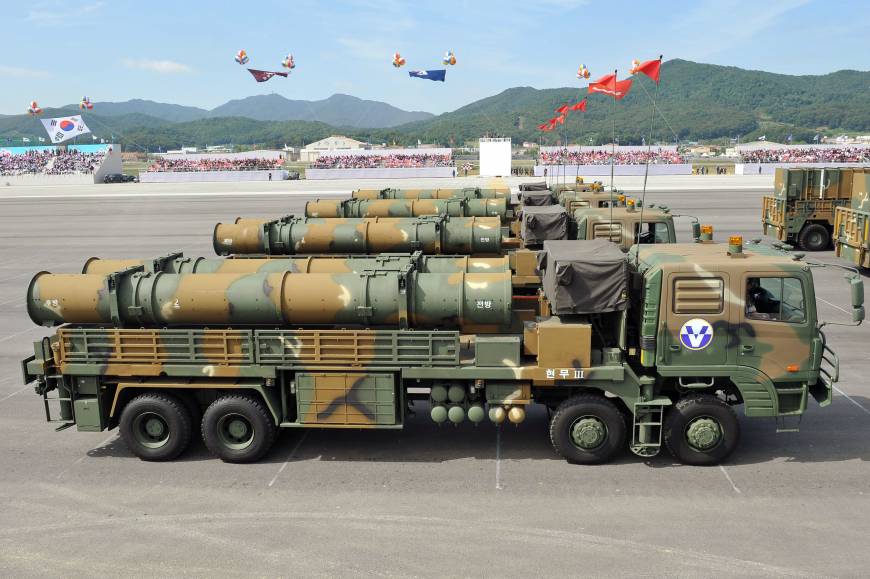
Hyunmoo-3 land-attack cruise missile
Overview
The Hyunmoo-3 is South Korea's long-range land-attack cruise missile — the Tomahawk-class backbone of Seoul's deep-strike capability against North Korea. Named for a mythical guardian, it is a subsonic, terrain-following missile fielded in progressively longer-ranged variants (Hyunmoo-3A/B/C/D) with reach reportedly extending from around 500 km up to 1,500 km, covering the entire North Korean landmass from launchers in the South. It forms the cruise-missile element of South Korea's three-pillar deterrent: the "Kill Chain" pre-emptive strike system, Korea Air and Missile Defense, and the Korea Massive Punishment and Retaliation concept. Guided by inertial navigation with GPS and terrain-contour matching, the Hyunmoo-3 is designed to strike hardened command bunkers, missile sites and leadership targets with precision. For an analyst, the Hyunmoo family illustrates how a U.S. ally has built a sophisticated indigenous strike arsenal under the shadow of a nuclear-armed neighbour. The cruise-missile Hyunmoo-3 is now complemented by the very large Hyunmoo-5 ballistic "bunker-buster," giving South Korea one of the most capable conventional strike forces in Asia — a hedge that shapes deterrence on the peninsula and signals growing regional missile competition.
Deployment Map
Home ports from known hull assignments. Operating areas reflect typical AORs — individual deployments will vary.
Timeline
Specifications
Doctrine & Employment
Role
Long-range land-attack cruise missile for precision deep strike against North Korean targets.
Design Philosophy
Indigenous Tomahawk-class reach to cover the entire peninsula.
Employment
Terrain-following precision strikes on command, missile and leadership sites within Kill Chain/KMPR.
Threat Context
Core of South Korea's conventional deterrent against a nuclear-armed North.
How to Compare
Read against the Tomahawk, China's CJ-10 and North Korea's ballistic missiles.
Operational Patterns
Typical Deployment
Precision strikes on North Korean command, missile and leadership targets across the peninsula.
Typical Task Group
ROK strike units within the Kill Chain / KMPR framework.
Readiness
Mature and fielded; range-extended variants in development.
Key Operating Areas
Peer Comparison Matrix
Hyunmoo-3 is South Korea's indigenous Tomahawk-class land-attack missile.
Video angle: Korea's home-grown Tomahawk.
Comparable subsonic land-attack cruise missile in China's arsenal.
Video angle: East Asia's cruise-missile arsenals compared.
The North Korean missile threat the Hyunmoo force is built to deter and pre-empt.
Video angle: The missile race on the Korean Peninsula.
Combat History
No combat use; central to South Korea's 'Kill Chain' and KMPR deterrent concepts.
Capability assessed from policy and testing.
Known Vulnerabilities
Subsonic speed
Vulnerable to layered air defence.
Context: Effectiveness depends on saturation and routing.
Mitigation: Terrain masking and salvo tactics.
Hardened-target limits
Cruise-missile warheads have limited penetration against deep bunkers.
Context: Drove the heavy Hyunmoo-5 ballistic program.
Mitigation: Pairing with ballistic bunker-busters.
Variants
| Variant | Designation | Years | Count | Status | Key Changes |
|---|---|---|---|---|---|
| Hyunmoo-3A/B/C | — | 2008– | — | active | Progressive range growth (~500 to ~1,500 km) |
| Hyunmoo-3D / submarine-launched | — | 2020s | — | building | Extended range and SLCM development |
Modernization Programmes
Range extension & sea-basing
Longer-range and submarine-launched variants alongside the new Hyunmoo-5 ballistic missile.
Impact: Deepens South Korea's conventional deep-strike options.
Images


Frequently Asked
When was the first Hyunmoo-3 land-attack cruise missile commissioned?
The first Hyunmoo-3 land-attack cruise missile entered service in 2008.
Who builds the Hyunmoo-3 land-attack cruise missile?
The Hyunmoo-3 land-attack cruise missile is built by LIG Nex1 / Agency for Defense Development (ADD).
What variants of the Hyunmoo-3 land-attack cruise missile exist?
Known variants include: Hyunmoo-3A/B/C, Hyunmoo-3D / submarine-launched.
Curated Research
recommended
Arsenal overview
reference
Variants and range
Watch Hyunmoo-3 land-attack cruise missile in Action
Iron Command produces in-depth comparison and analysis videos for military equipment.
Watch on YouTube