
HAL Tejas
Overview
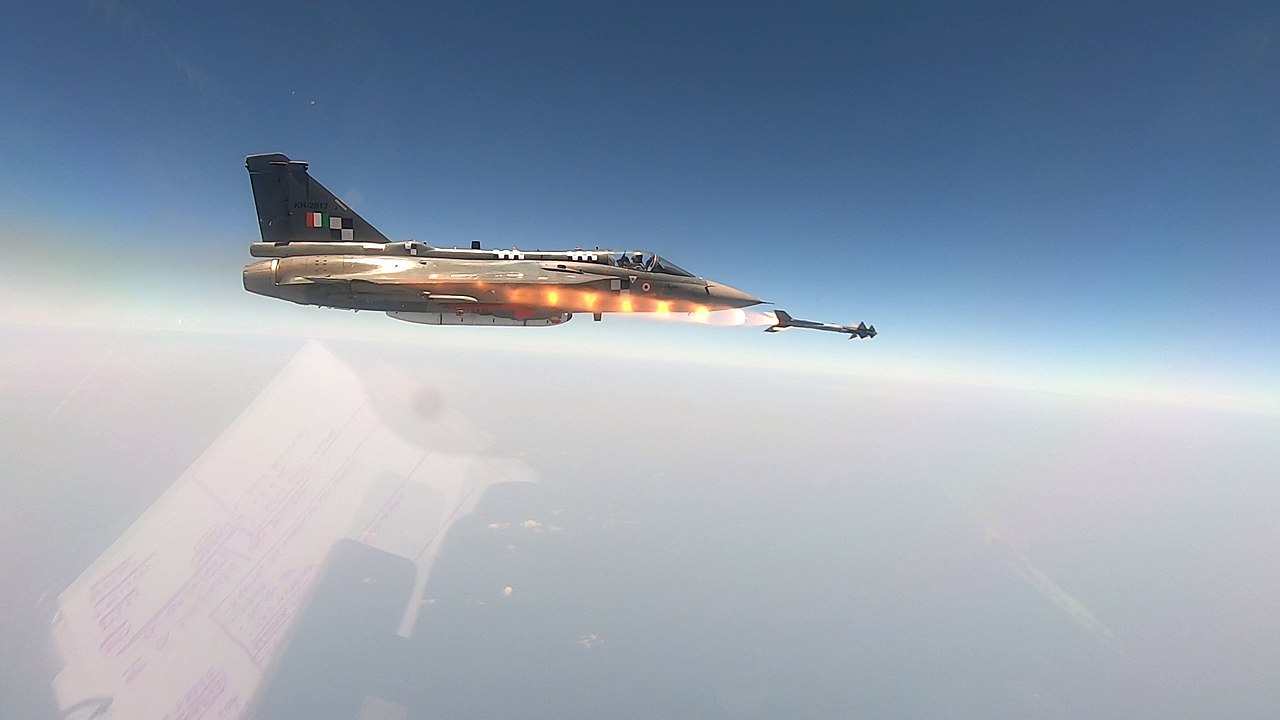
The HAL Tejas is India's indigenous light combat aircraft — a single-engine, tailless delta-wing fighter that, after a famously long development, has become the symbol of India's drive for self-reliance in defence. Designed to replace the ageing MiG-21, it is a lightweight multirole fighter built largely from composites, with relaxed static stability and fly-by-wire controls. The programme's value lies less in any single performance figure than in the industrial capability it represents. The baseline Tejas Mk1 entered IAF service from 2016, and the substantially improved Tejas Mk1A — with an AESA radar, electronic-warfare suite, beyond-visual-range missiles and easier maintenance — is now in series production under large IAF orders. A more powerful Tejas Mk2 (Medium Weight Fighter) with a bigger F414 engine and canards is in development to take on heavier roles. For an analyst, the Tejas is India's bid to build a sovereign fighter pipeline rather than depend on imports — and a potential export product for the Global South, with interest from several countries. It will not out-fight a J-20, and the programme has been slow, but a maturing Tejas line gives India numbers, jobs and industrial depth, and underpins the more ambitious AMCA fifth-generation fighter to follow.
Deployment Map
Home ports from known hull assignments. Operating areas reflect typical AORs — individual deployments will vary.
Timeline
Specifications
Armament
Indigenous Astra on Mk1A
Multirole strike
Internal
Doctrine & Employment
Role
Indigenous light multirole fighter for point air defence and self-reliant fighter production.
Design Philosophy
Sovereign capability and industrial depth over peak performance.
Employment
Fly-by-wire delta for agile air defence and light strike, replacing the MiG-21.
Threat Context
Gives India numbers and a domestic fighter pipeline underpinning the future AMCA.
How to Compare
Read against the JF-17, Gripen and FA-50.
Operational Patterns
Typical Deployment
Point air defence and light multirole across Indian airspace, replacing the MiG-21.
Typical Task Group
Complements Su-30MKI and Rafale in the IAF.
Readiness
Mk1A entering production; Mk2 developing.
Key Operating Areas
Peer Comparison Matrix
The JF-17 is the Sino-Pakistani light fighter the Tejas competes with on capability and export markets.
Video angle: Tejas vs JF-17 — South Asia's light fighters.
The Gripen is a more mature single-engine light fighter the Tejas aspires to match.
Video angle: How the Tejas measures up to the Gripen.
Both are light fighters chasing Global-South export orders.
Video angle: The light-fighter export race.
Combat History
No combat use; inducted into IAF squadrons replacing the MiG-21.
Milestone for indigenous Indian fighter production.
Known Vulnerabilities
Light, short-legged
Limited range and payload versus heavier fighters.
Context: A point-defence/light-multirole aircraft, not a long-range striker.
Mitigation: Mk2 adds range and payload.
Programme pace & supply
Slow development and engine-import dependence (GE).
Context: Production ramp has lagged demand.
Mitigation: Indigenous content rising; orders placed.
Variants
| Variant | Designation | Years | Count | Status | Key Changes |
|---|---|---|---|---|---|
| Tejas Mk1 | — | 2016– | — | active | Initial operational LCA |
| Tejas Mk1A | — | 2024– | — | building | AESA radar, EW suite, BVR, maintainability |
| Tejas Mk2 (MWF) | — | in development | — | planned | F414 engine, canards, heavier multirole |
Modernization Programmes
Mk1A series production & Mk2
Large Mk1A orders and development of the more capable Mk2.
Impact: Builds a sovereign fighter pipeline and squadron numbers.
Images




Frequently Asked
How many HAL Tejas are in service?
40 HAL Tejas are currently in service with Indian Air Force (and Indian Navy trials).
When was the first HAL Tejas commissioned?
The first HAL Tejas entered service in 2016.
Who builds the HAL Tejas?
The HAL Tejas is built by Hindustan Aeronautics Limited (HAL).
What variants of the HAL Tejas exist?
Known variants include: Tejas Mk1, Tejas Mk1A, Tejas Mk2 (MWF).
How much does a HAL Tejas cost?
Unit cost is approximately $45M per hull.
Curated Research
recommended
Program and orders
reference
Variants and development
Watch HAL Tejas in Action
Iron Command produces in-depth comparison and analysis videos for military equipment.
Watch on YouTube