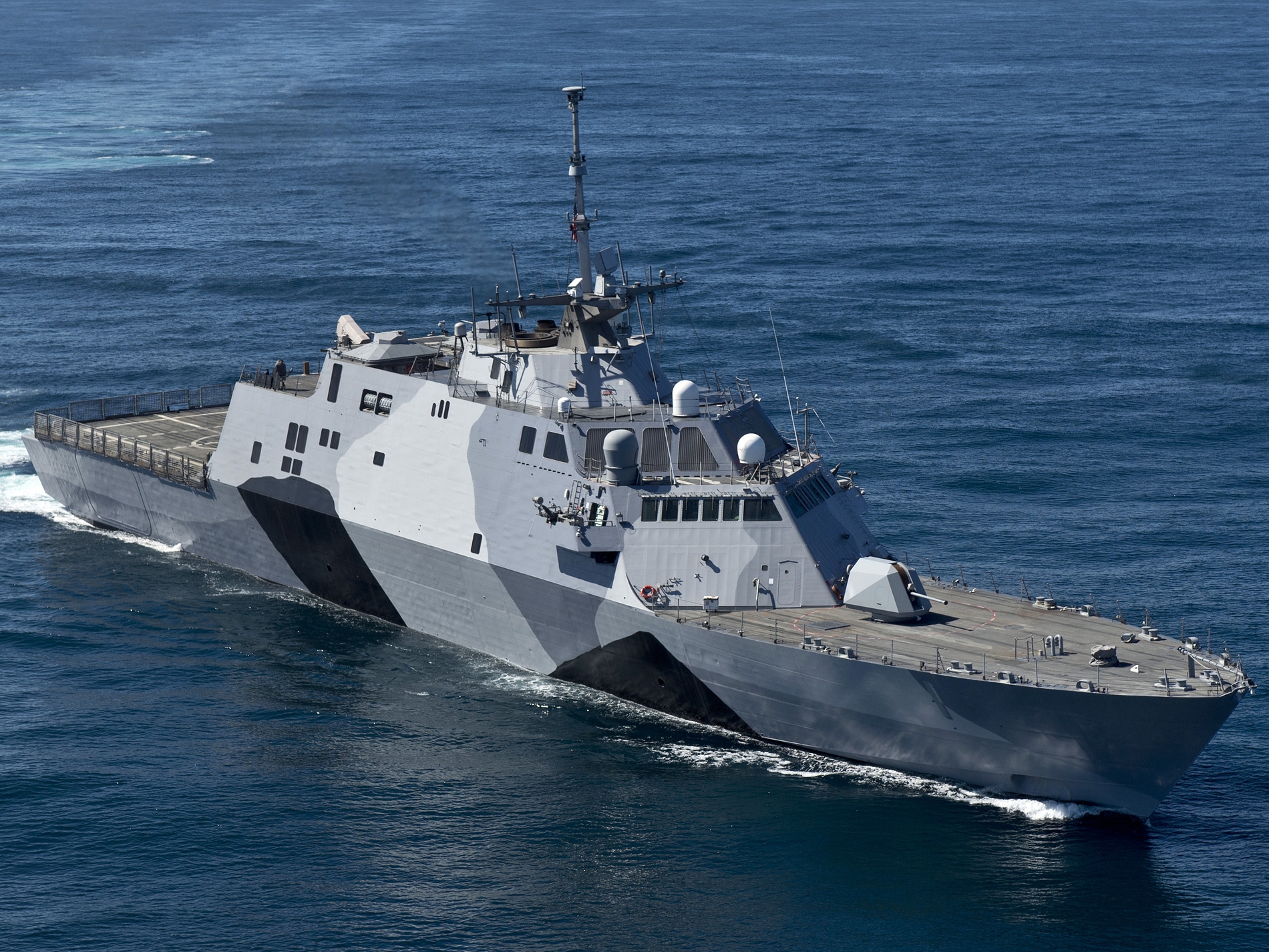
Freedom-class Littoral Combat Ship
Compare with
Overview
The Freedom-class Littoral Combat Ship represents the U.S. Navy's controversial attempt to create a fast, reconfigurable warship optimized for operations in coastal waters and contested littorals. Designed around a modular mission package concept, the Freedom-class was intended to counter asymmetric threats like small boats, mines, and diesel submarines while maintaining the speed and agility to operate in shallow waters where traditional destroyers and cruisers cannot venture. Built by Lockheed Martin at Marinette Marine, the Freedom-class emphasizes speed (45+ knots), shallow draft operations, and mission modularity over traditional naval firepower. The ship's semi-planing monohull design and combined diesel-electric and gas turbine propulsion system enable rapid transit and efficient loitering, theoretically allowing single hulls to cover vast areas of ocean. However, this design philosophy has proven deeply problematic in practice. The Freedom-class has become emblematic of the challenges facing modern naval acquisition programs. Originally projected to cost $220 million per hull, actual costs ballooned to over $670 million each. More critically, the modular mission packages that justified the design have proven unreliable, while the ships themselves suffer from chronic mechanical failures, particularly with their combining gear systems. The Navy has been forced to retire several hulls after less than a decade of service. In the current threat environment dominated by peer competitors with sophisticated anti-ship missiles and long-range precision weapons, the Freedom-class appears increasingly obsolete. Its minimal armament and defensive systems make it vulnerable to even modest threats, while its high operating costs and maintenance requirements strain fleet resources. The Navy has effectively abandoned the LCS concept, replacing it with the more conventional Constellation-class frigate program.
Deployment Map
Home ports from known hull assignments. Operating areas reflect typical AORs — individual deployments will vary.
Timeline
Specifications
Armament
BAE Systems Bofors gun, primary armament
Rolling Airframe Missile for close-in defense
Last-line defense against missiles
AGM-114L with surface warfare module
Small boat defense
Doctrine & Employment
Role
Gap-filling presence operations and asymmetric threat response in contested littorals where traditional blue-water combatants are either too valuable to risk or physically cannot operate effectively.
Design Philosophy
Prioritized speed, shallow draft, and modular reconfigurability over traditional survivability and firepower. Designers sacrificed armor protection, redundant systems, and heavy weaponry for a 40+ knot top speed and the ability to operate in waters as shallow as 12 feet. The aluminum hull construction further traded durability for weight savings and speed.
Employment
Typically deployed as part of surface action groups or independently for counter-piracy, counter-narcotics, and freedom of navigation operations. The modular mission package concept allows for rapid reconfiguration between anti-surface warfare, mine countermeasures, and anti-submarine warfare roles. Often operates with minimal escort due to speed reliance for survivability, though this has proven problematic in practice. Command relationships remain flexible, supporting both fleet operations and regional combatant commander taskings.
Threat Context
Originally designed for post-9/11 asymmetric threats including small boat swarms, coastal mines, and quiet diesel submarines in littoral environments. The threat environment has since evolved toward near-peer competition with China and Russia, exposing the platform's vulnerability to anti-ship cruise missiles and long-range precision fires that its speed-based survivability concept cannot adequately counter.
How to Compare
Compare primarily on operational availability, mission package effectiveness, and cost per presence day rather than traditional firepower metrics. Speed and shallow water capability are table stakes for this class, so focus on reliability, maintenance burden, and actual mission accomplishment versus theoretical capabilities when evaluating against international corvette designs.
Operational Patterns
Typical Deployment
Rotational deployments to Western Pacific, Caribbean counter-narcotics, and partnership missions
Deployment Length
10 months
Typical Task Group
Independent operations or small surface action groups
Readiness
Chronic maintenance issues limit operational availability to approximately 50% fleet-wide
Key Operating Areas
Peer Comparison Matrix
Trimaran hull design vs monohull, similar problems with different engineering solutions. Both classes suffer from cost overruns and reliability issues.
Video angle: LCS shootout - which failed experiment was worse?
Much cheaper (~$100M vs $670M), more traditional armament, better reliability. Chinese emphasis on quantity over modularity has proven more successful.
Video angle: Quantity vs Quality: Why China's simple corvette beats America's high-tech LCS
Smaller, stealthier design with proven anti-ship missiles. Swedish focus on specific mission vs American modularity. Much more cost-effective.
Video angle: How Sweden built the stealth corvette America should have made
Heavily armed with advanced defensive systems, proven in combat. Israeli design prioritizes survivability and firepower over speed and modularity.
Video angle: Battle-tested vs High-tech: Israel's practical corvette vs America's LCS experiment
Similar size but conventional design with reliable systems. German emphasis on proven technology over revolutionary concepts has yielded better results.
Video angle: German engineering vs American innovation: why boring wins
Combat History
USS Freedom conducted multiple FONOPS in South China Sea, challenged Chinese territorial claims around artificial islands
First operational deployment demonstrated basic capability but also highlighted maintenance challenges in high-tempo operations
USS Detroit and USS Billings conducted drug interdiction missions in Caribbean, seized multiple vessels and thousands of pounds of cocaine
Showed effectiveness in low-threat constabulary missions, which became primary operational role
Multiple LCS hulls participated in humanitarian and partnership missions across Pacific region
Demonstrated utility for presence operations but limited combat relevance
Known Vulnerabilities
Mechanical Reliability
Chronic failures of combining gear systems, propulsion casualties, and mission system breakdowns plague the class
Context: Multiple hulls have suffered propulsion failures requiring towing, undermining operational availability
Mitigation: Navy implementing enhanced maintenance protocols but considering early retirement for most hulls
Survivability
Minimal armor protection, limited damage control capabilities, and small crew size create vulnerability to even minor weapon hits
Context: Against peer competitors with anti-ship missiles, LCS lacks defensive systems and damage tolerance of traditional warships
Mitigation: Navy acknowledged this as insurmountable design flaw, leading to Constellation-class development
Mission System Effectiveness
Mission modules have proven unreliable with poor performance in testing and evaluation
Context: Core concept of reconfigurable warship has failed, leaving ships with minimal combat capability
Mitigation: Navy has largely abandoned mission module concept
Cost Effectiveness
Operating costs exceed those of much more capable destroyers while providing minimal combat capability
Context: In budget-constrained environment, LCS consumes resources that could fund more effective platforms
Mitigation: Early retirement program to free up resources for Constellation-class frigates
Variants
| Variant | Designation | Years | Count | Status | Key Changes |
|---|---|---|---|---|---|
| Flight 0 | LCS-1, LCS-3 | 2008-2010 | 2 | retired | Initial production variant with basic systems |
| Flight 0+ | LCS-5 to LCS-25 | 2012-2021 | 11 | active | Improved survivability, upgraded combat systems, enhanced crew facilities, structural reinforcement |
Fleet Roster (13)
| Hull | Name | Variant | Commissioned | Home Port | Status |
|---|---|---|---|---|---|
| LCS-1 | USS Freedom | Flight 0 | 2008-11-08 | Decommissioned | retired |
| LCS-3 | USS Fort Worth | Flight 0 | 2012-09-22 | Decommissioned | retired |
| LCS-5 | USS Milwaukee | Flight 0+ | 2015-12-21 | Mayport, FL | active |
| LCS-7 | USS Detroit | Flight 0+ | 2016-10-22 | Mayport, FL | active |
| LCS-9 | USS Little Rock | Flight 0+ | 2017-12-16 | Mayport, FL | active |
| LCS-11 | USS Sioux City | Flight 0+ | 2018-11-17 | Mayport, FL | active |
| LCS-13 | USS Wichita | Flight 0+ | 2019-01-12 | Mayport, FL | active |
| LCS-15 | USS Billings | Flight 0+ | 2019-08-03 | Mayport, FL | active |
| LCS-17 | USS Indianapolis | Flight 0+ | 2019-10-26 | Mayport, FL | active |
| LCS-19 | USS St. Louis | Flight 0+ | 2020-08-08 | Mayport, FL | active |
| LCS-21 | USS Minneapolis-Saint Paul | Flight 0+ | 2021-05-21 | Mayport, FL | active |
| LCS-23 | USS Cooperstown | Flight 0+ | 2022-02-05 | Mayport, FL | active |
| LCS-25 | USS Marinette | Flight 0+ | 2023-06-24 | Mayport, FL | active |
Modernization Programmes
Frigate Conversion Study
Navy studied converting existing LCS hulls to more capable frigates with enhanced weapons and sensors
Impact: Ultimately abandoned as cost-prohibitive, leading to separate Constellation-class program
LCS Mission Module Integration
Development of Anti-Submarine Warfare, Surface Warfare, and Mine Countermeasures mission packages
Impact: Chronic failures and delays led to effective abandonment of modular concept
Service Life Extension
Navy cancelled planned service life extensions, opting for early retirement instead
Impact: Confirmed end of LCS program viability
Images


Frequently Asked
How many Freedom-class Littoral Combat Ship are in service?
11 Freedom-class Littoral Combat Ship are currently in service with United States Navy.
When was the first Freedom-class Littoral Combat Ship commissioned?
The first Freedom-class Littoral Combat Ship entered service in 2008-11-08.
Who builds the Freedom-class Littoral Combat Ship?
The Freedom-class Littoral Combat Ship is built by Lockheed Martin (Marinette Marine).
What variants of the Freedom-class Littoral Combat Ship exist?
Known variants include: Flight 0, Flight 0+.
How much does a Freedom-class Littoral Combat Ship cost?
Unit cost is approximately $670M per hull.
Curated Research
essential
Comprehensive analysis of LCS program development, costs, and congressional oversight issues by the leading naval analyst.
Most detailed technical and operational analysis of LCS design decisions and performance by the premier U.S. naval historian.
Independent cost-effectiveness analysis comparing LCS approaches and alternatives for congressional decision-making.
recommended
Examines how LCS fits into current Navy distributed operations concept despite original design assumptions.
Critical assessment of LCS role in future fleet architecture and recommendations for platform employment.
Independent oversight analysis of LCS operational availability and maintenance challenges affecting doctrine implementation.
reference
Comprehensive technical specifications and operational history tracking for Freedom-class vessels.
Academic military analysis of LCS operational concepts and lessons learned from early deployments.
Watch Freedom in Action
Iron Command produces in-depth comparison and analysis videos for military equipment.
Watch on YouTube