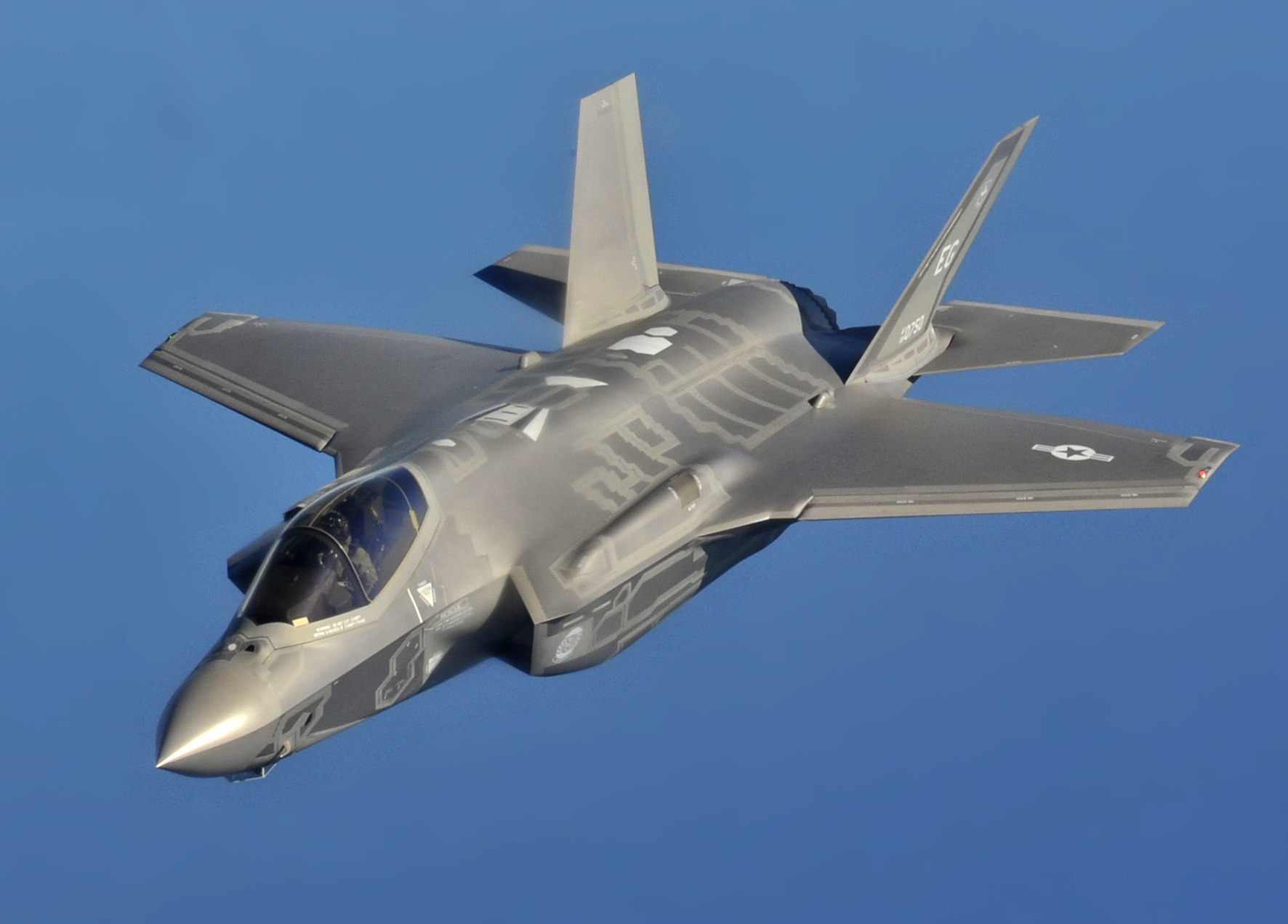
F-35B Lightning II
Compare with
Overview
The F-35B Lightning II represents the world's first operational supersonic short takeoff/vertical landing (STOVL) stealth fighter, fundamentally transforming expeditionary airpower projection. Developed as part of the Joint Strike Fighter program, the F-35B enables the US Marine Corps and allied forces to operate fifth-generation stealth fighters from amphibious assault ships, austere forward bases, and damaged runways where conventional fighters cannot operate. The F-35B's revolutionary Pratt & Whitney F135 engine features a lift fan system that enables vertical landing while maintaining supersonic capability and stealth characteristics. This unique combination of STOVL capability, sensor fusion, and stealth creates unprecedented operational flexibility for expeditionary forces. The aircraft can launch from LHA/LHD decks, conduct combat missions with full stealth and sensor superiority, then return to ships or forward operating bases that would be unusable by conventional fighters. In the current threat environment, the F-35B addresses critical capability gaps in contested littoral regions, particularly in the Indo-Pacific where runway access may be limited by anti-access/area-denial (A2/AD) systems. Its ability to operate from distributed bases complicates enemy targeting while projecting fifth-generation capabilities forward. The platform's sensor fusion and networking capabilities make it a critical node in multi-domain operations, serving as both a strike platform and an intelligence gatherer. Compared to peers, no other operational aircraft combines stealth, supersonic speed, and STOVL capability. The Harrier family provided STOVL capability without stealth or advanced sensors, while advanced fighters like the F-22 lack STOVL capability entirely. Russia's claimed Su-75 and China's various stealth programs do not include STOVL variants, leaving the F-35B in a unique operational niche that fundamentally changes expeditionary warfare calculations.
Deployment Map
Home ports from known hull assignments. Operating areas reflect typical AORs — individual deployments will vary.
Timeline
Specifications
Armament
Primary BVR missile
Short-range dogfight missile
Standoff precision strike
Primary precision strike weapon
External gun pod, 180 rounds
SEAD/DEAD missions
Operational Patterns
Typical Deployment
Embarked on LHA/LHD amphibious assault ships or forward deployed to expeditionary airfields
Deployment Length
6 months
Typical Task Group
Marine Expeditionary Unit (MEU) or Expeditionary Strike Group (ESG)
Readiness
Mission capable rates around 65-70%, below desired 80% due to maintenance complexity and parts availability
Key Operating Areas
Peer Comparison Matrix
F-35B adds supersonic speed, stealth, and advanced sensors but with higher cost and maintenance complexity compared to the proven but obsolete Harrier platform.
Video angle: Evolution of STOVL fighters: what was gained and lost in the Harrier to F-35B transition
Super Hornet offers proven reliability, larger weapons capacity, and lower costs but lacks stealth and STOVL capability, requiring full-size carriers for naval operations.
Video angle: Stealth vs. payload: comparing expeditionary strike capabilities
Soviet supersonic STOVL fighter that never entered service. Similar concept but lacked stealth design and modern sensors, cancelled due to cost and complexity.
Video angle: What if the Yak-141 had succeeded: comparing Soviet and American approaches to STOVL fighters
India's indigenous fighter lacks STOVL capability and stealth features but offers lower costs and full domestic control, representing different approach to air power development.
Video angle: Indigenous vs. international: different paths to advanced fighter capabilities
Combat History
First operational deployment aboard USS Essex (LHD-2) with 13th MEU to Indo-Pacific region
Demonstrated STOVL stealth fighter operations from amphibious platforms
UK RAF F-35Bs conducted first combat strikes from HMS Queen Elizabeth against ISIS targets in Iraq and Syria
First combat use of F-35B, validating carrier strike operations
F-35B ZA470 crashed during recovery operations in Mediterranean, pilot ejected safely
Highlighted challenges of STOVL operations and classified data security concerns
USMC F-35Bs achieved 20:1 kill ratios in air-to-air combat scenarios during advanced training
Demonstrated sensor fusion and stealth advantages in contested environments
Known Vulnerabilities
Software stability and reliability
Persistent software bugs in mission systems causing false alarms, display failures, and weapon release malfunctions. Block 4 TR-3 upgrade delayed multiple times.
Context: Software issues directly impact mission effectiveness and pilot confidence in combat scenarios
Mitigation: Ongoing software patches and TR-3 hardware upgrade to address processing limitations
Maintenance complexity and cost
Stealth coating maintenance requires specialized facilities and techniques. STOVL system adds complexity with lift fan, roll posts, and three-bearing swivel nozzle.
Context: Forward deployed operations may be limited by maintenance requirements, reducing operational availability
Mitigation: Improved maintenance procedures and mobile maintenance capabilities being developed
Limited weapons bay capacity
Internal weapons bays can only carry 2 x 2000lb weapons or equivalent, requiring external carriage that compromises stealth for larger payloads.
Context: In high-threat environments, stealth is essential but limits strike capability compared to conventional fighters
Mitigation: Block 4 adds new weapons options but doesn't address fundamental bay size limitations
Logistics footprint
ALIS/ODIN logistics system creates dependencies on contractor support and complex supply chains. Unique spare parts not shared with F-35A/C variants.
Context: Expeditionary operations may be constrained by logistics requirements, limiting the theoretical advantage of STOVL capability
Mitigation: ODIN system aims to reduce contractor dependence, but remains complex
Variants
| Variant | Designation | Years | Count | Status | Key Changes |
|---|---|---|---|---|---|
| F-35B Block 3F | BF-01 to BF-22 (LRIP) | 2015-2019 | 145 | active | Initial operational capability with basic weapons suite, TR-2 software |
| F-35B Block 4 | Production lots 12+ | 2021-ongoing | 50 | building | TR-3 hardware upgrade, enhanced sensors, expanded weapons integration including SiAW, Meteor |
Fleet Roster (2)
| Hull | Name | Variant | Commissioned | Home Port | Status |
|---|---|---|---|---|---|
| 168301 | BF-01 | Block 3F | 2015-07-31 | MCAS Beaufort, SC | active |
| 169163 | ZZ701 | Block 3F | 2018-12-10 | RAF Marham, UK (809 NAS) | active |
Modernization Programmes
Block 4 Capability Release
TR-3 hardware upgrade with new core processor, Block 4 software with enhanced sensors, new weapons integration including Meteor, SiAW, and advanced electronic warfare capabilities
Impact: Significantly enhances sensor range, processing power, and weapons flexibility
Engine Core Upgrade (ECU)
F135 engine upgrade providing 6-10% more thrust and improved thermal management for Block 4 power requirements
Impact: Addresses power and thermal limitations limiting Block 4 capabilities
Adaptive Engine Transition Program (AETP)
Development of adaptive cycle engines (XA100/XA101) to replace F135 with 25% better fuel efficiency and 10% more thrust
Impact: Would have significantly improved range and performance but cancelled due to cost concerns
Images


Frequently Asked
How many F-35B Lightning II are in service?
2 F-35B Lightning II are currently in service with United States Marine Corps.
When was the first F-35B Lightning II commissioned?
The first F-35B Lightning II entered service in 2015-07-31.
Who builds the F-35B Lightning II?
The F-35B Lightning II is built by Lockheed Martin.
What variants of the F-35B Lightning II exist?
Known variants include: F-35B Block 3F, F-35B Block 4.
How much does a F-35B Lightning II cost?
Unit cost is approximately $116M per hull.
Watch F-35B Lightning II in Action
Iron Command produces in-depth comparison and analysis videos for military equipment.
Watch on YouTube