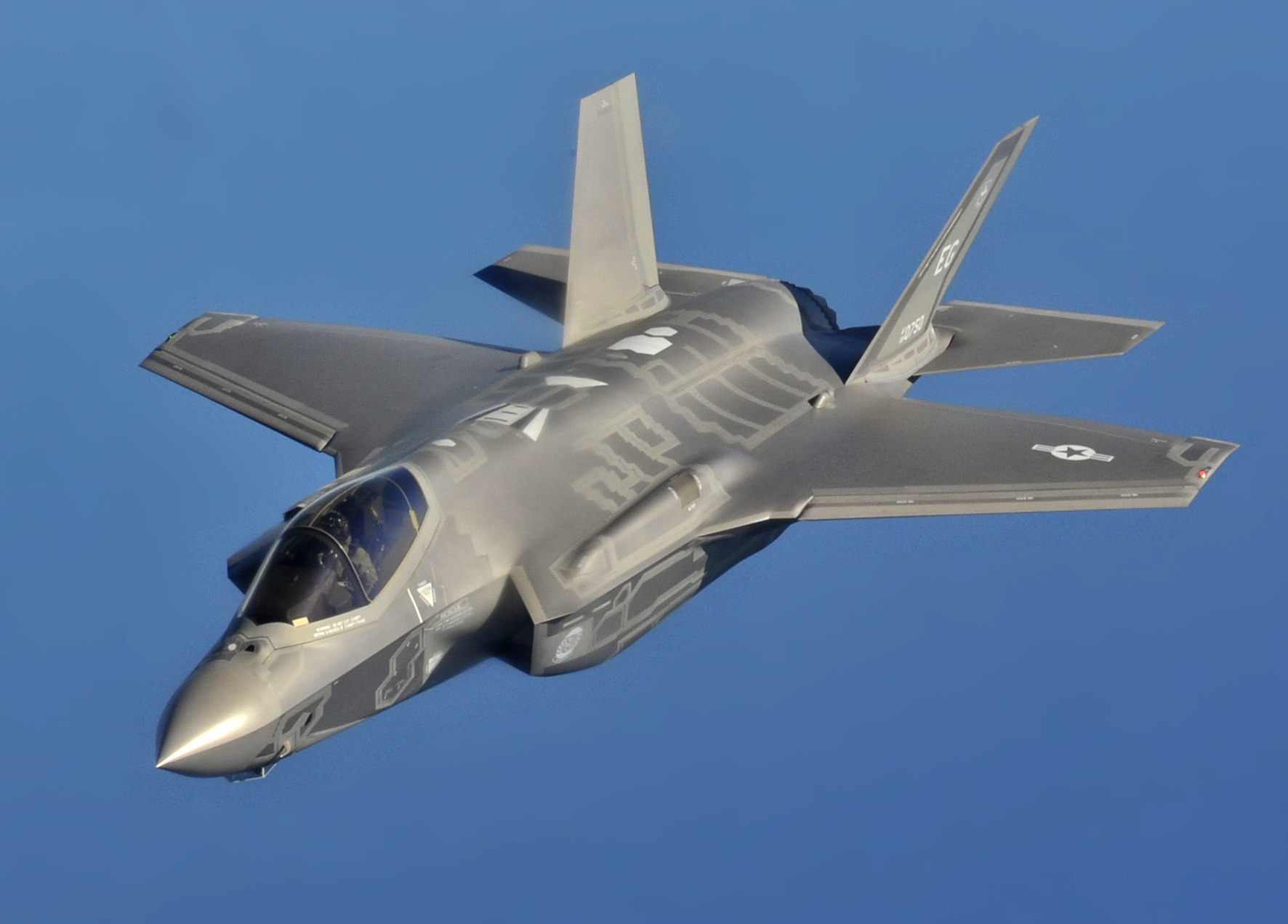
F-35A Lightning II Multirole Fighter
Overview
The F-35A Lightning II represents the conventional takeoff and landing variant of the Joint Strike Fighter program, designed as a fifth-generation multirole stealth fighter to replace aging F-16s and A-10s in USAF service. Built around stealth, sensor fusion, and networked warfare capabilities, the F-35A prioritizes information dominance and precision strike over traditional air superiority metrics like speed or maneuverability. Strategically, the F-35A serves as the cornerstone of NATO and allied air power projection, with its distributed aperture system, AN/APG-81 AESA radar, and advanced electronic warfare suite designed to penetrate advanced integrated air defense systems. The aircraft's ability to share targeting data in real-time across joint and coalition forces represents a fundamental shift toward network-centric warfare, making it as much an intelligence platform as a strike fighter. In the current threat environment, the F-35A's stealth and sensor capabilities provide critical advantages against peer adversaries operating S-400, S-500, and similar long-range SAM systems. However, its single-engine design, limited internal weapons bay capacity, and software complexity have generated ongoing debates about cost-effectiveness and operational readiness rates compared to legacy platforms. Compared to contemporaries like the Eurofighter Typhoon or F/A-18E/F Super Hornet, the F-35A sacrifices kinematic performance for stealth and sensor fusion. Against near-peer competitors like the J-20 or Su-57, it represents a fundamentally different design philosophy—emphasizing network warfare and strike capabilities over traditional air-to-air combat metrics.
Deployment Map
Home ports from known hull assignments. Operating areas reflect typical AORs — individual deployments will vary.
Timeline
Specifications
Armament
Primary BVR weapon
Short-range dogfight missile
Stealth cruise missile
Primary precision munition
Allows multiple target engagement
Internal mount, limited ammunition
Operational Patterns
Typical Deployment
Forward presence deployments, theater air defense, precision strike missions, integrated with coalition forces
Deployment Length
6 months
Typical Task Group
Operates in 12-24 aircraft squadrons, integrated with AWACS, tanker support, and coalition fighters
Readiness
Mission capable rates averaging 65-70%, below program objectives. Parts availability and maintenance complexity remain persistent challenges.
Key Operating Areas
Peer Comparison Matrix
J-20 emphasizes air superiority with longer range and larger weapons bay, while F-35A prioritizes multirole capability and sensor fusion. Different stealth design philosophies with J-20 optimized for frontal RCS reduction.
Video angle: Stealth vs stealth: how two different approaches to fifth-generation design would perform in air-to-air combat
Su-57 emphasizes supermaneuverability and kinematic performance over stealth, with questionable low-observable characteristics. F-35A sacrifices dogfighting capability for stealth and sensors.
Video angle: Traditional air superiority philosophy vs network-centric warfare: which approach wins in modern air combat
Typhoon superior in air-to-air combat with better kinematics and twin-engine reliability, but lacks stealth and advanced sensor fusion. Complementary rather than competing roles in NATO.
Video angle: Why NATO needs both: stealth penetrator vs air superiority specialist in integrated air operations
Rafale offers similar multirole capability without stealth but with proven combat record and lower operating costs. Better naval integration and nuclear delivery capability.
Video angle: Stealth vs proven: examining France's decision to skip fifth-generation for evolved fourth-generation design
F-16 vastly superior in cost-effectiveness and maintainability with proven reliability, but completely outmatched against modern IADS. F-35A designed specifically for high-threat environments where F-16 cannot survive.
Video angle: The $80 million question: when does advanced capability justify 4x the cost of proven legacy platforms
Combat History
First F-35A combat sortie flown by 388th Fighter Wing against ISIS targets in Iraq. Strike missions using precision-guided munitions.
Marked operational debut of the platform in combat, validating basic strike capabilities
F-35As from Al Dhafra Air Base conducted multiple strikes against ISIS remnants, demonstrating sensor fusion and targeting pod integration.
Showed maturation of combat systems and pilot training pipeline
F-35As participated in strikes against Houthi targets in Yemen, operating alongside legacy fighters and naval assets.
First operations against near-peer air defense systems, validating stealth capabilities
Known Vulnerabilities
Maintenance Complexity
Mission capable rates consistently below 70%, with lengthy depot maintenance cycles and complex supply chain for stealth coatings and specialized components.
Context: Impacts sortie generation rates in sustained operations, critical for deterrence scenarios in Pacific theater
Mitigation: Autonomic Logistics Information System (ALIS) replacement with ODIN, improved contractor logistics support
Single Engine Vulnerability
F135 engine represents single point of failure over long-range Pacific missions with limited divert options. Engine fire or failure results in total aircraft loss.
Context: Particularly concerning for penetrating strikes against Chinese mainland targets where recovery options are limited
Mitigation: Enhanced engine monitoring systems, but fundamental design limitation remains
Limited Internal Weapons Capacity
Only four internal weapons stations severely limits simultaneous target engagement or mixed air-to-air/air-to-surface loadouts while maintaining stealth profile.
Context: Against Chinese IADS with multiple target sets, may require multiple sorties or stealth compromise with external weapons
Mitigation: SDB integration maximizes target engagement, but fundamental capacity remains limited
Electronic Warfare Dependence
Heavy reliance on electronic systems and data links creates vulnerability to advanced jamming and cyber attacks. Loss of sensor fusion significantly degrades capability.
Context: Chinese and Russian EW capabilities specifically target F-35 mission systems architecture
Mitigation: Enhanced EW hardening in Block 4, but represents ongoing cat-and-mouse technological competition
Variants
| Variant | Designation | Years | Count | Status | Key Changes |
|---|---|---|---|---|---|
| F-35A Block 3F | AF-1 to AF-175 | 2016-2019 | 175 | active | Initial operational capability software, basic weapons integration, limited mission systems functionality |
| F-35A Block 4 | AF-176 onwards | 2019-present | 275 | building | Enhanced mission systems, additional weapons integration (JASSM, JSOW), improved electronic warfare capabilities, Technology Refresh 3 hardware |
Fleet Roster (1)
| Hull | Name | Variant | Commissioned | Home Port | Status |
|---|---|---|---|---|---|
| Various | USAF F-35A Fleet | Block 3F/4 | 2016-present | Multiple bases worldwide | Note: Individual F-35A tracking by tail number exceeds practical scope - 450+ aircraft across 15+ bases |
Modernization Programmes
Block 4 Modernization
Technology Refresh 3 hardware upgrade, enhanced mission systems processor, additional weapons integration including SiAW, LRASM, JSM. Improved electronic warfare and cyber capabilities.
Impact: Significantly expands weapons compatibility and enhances survivability against advanced threats
Continuous Capability Development and Delivery (C2D2)
Agile software development model replacing traditional block upgrades. Rapid integration of new threats, weapons, and capabilities through over-the-air updates.
Impact: Enables faster response to evolving threat environment and technology insertion
Engine Core Upgrade (ECU)
Pratt & Whitney F135 engine upgrade providing 10% more thrust and improved thermal management for Block 4 power requirements.
Impact: Addresses power and thermal limitations constraining advanced mission systems
Images


Frequently Asked
How many F-35A Lightning II Multirole Fighter are in service?
450 F-35A Lightning II Multirole Fighter are currently in service with United States Air Force.
When was the first F-35A Lightning II Multirole Fighter commissioned?
The first F-35A Lightning II Multirole Fighter entered service in 2016-08-02.
Who builds the F-35A Lightning II Multirole Fighter?
The F-35A Lightning II Multirole Fighter is built by Lockheed Martin.
What variants of the F-35A Lightning II Multirole Fighter exist?
Known variants include: F-35A Block 3F, F-35A Block 4.
How much does a F-35A Lightning II Multirole Fighter cost?
Unit cost is approximately $82M per hull.
Watch F-35A Lightning II Multirole Fighter in Action
Iron Command produces in-depth comparison and analysis videos for military equipment.
Watch on YouTube