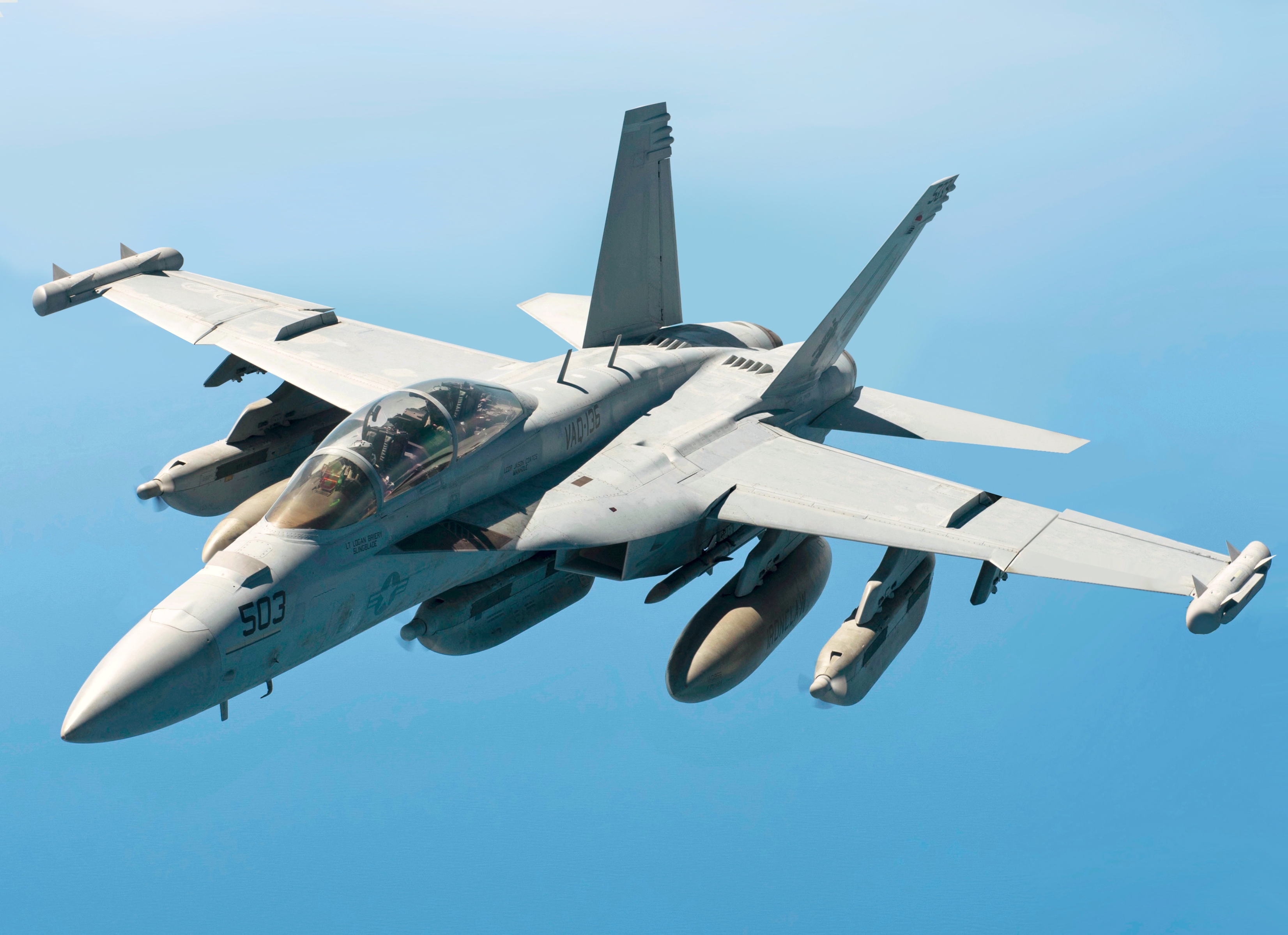
Boeing EA-18G Growler
Compare with
Overview
The EA-18G Growler is the West's premier airborne electronic-attack aircraft — a Super Hornet derivative built to jam enemy radars and communications, suppress and destroy air defences, and protect strike packages in contested airspace. It is included in an Indo-Pacific reference both as a U.S. Navy carrier-air-wing mainstay and because the Royal Australian Air Force is the only operator outside the United States, making it a distinctly allied Indo-Pacific capability. Built on the two-seat F/A-18F airframe, the Growler retains much of the Super Hornet's flight performance while adding a powerful electronic-warfare suite: jamming pods (the legacy ALQ-99 being replaced by the more capable Next Generation Jammer), receivers to locate and characterise enemy emitters, and the AGM-88 HARM/AARGM anti-radiation missile to physically destroy radars. It can blind an integrated air-defence system, deny enemy communications and escort strike aircraft through defended airspace. For an analyst, the Growler is a critical enabler in any high-end fight — the aircraft that makes a modern integrated air-defence system penetrable. Australia's operation of the type gives the U.S.-allied coalition a shared, interoperable electronic-attack capability in the Pacific, and the platform's role only grows as adversary air defences like the HQ-9 and S-400 proliferate. Electronic warfare is often the decisive, invisible layer of air combat, and the Growler is how the West fights it.
Deployment Map
Home ports from known hull assignments. Operating areas reflect typical AORs — individual deployments will vary.
Timeline
Specifications
Armament
Destroys radars (SEAD)
Jams radars and communications
Self-protection
Doctrine & Employment
Role
Airborne electronic-attack aircraft — jam and destroy enemy air defences and protect strike packages.
Design Philosophy
Make integrated air defences penetrable — the invisible enabling layer of air combat.
Employment
Stand-off and escort jamming with HARM/AARGM anti-radiation missiles to blind and kill radars.
Threat Context
Allied (US + RAAF) electronic attack against proliferating HQ-9/S-400-class defences in the Pacific.
How to Compare
Read against China's J-16D, the base Super Hornet and (as its opposite) the KJ-500.
Operational Patterns
Typical Deployment
Electronic attack and SEAD escorting strike packages through contested airspace; carrier and land-based.
Typical Task Group
U.S. carrier air wings; RAAF strike packages with F-35A and Super Hornet.
Readiness
Fielded; NGJ upgrade underway.
Key Operating Areas
Peer Comparison Matrix
China's electronic-attack Flanker variant performs the same jamming/SEAD role for the PLA.
Video angle: The electronic-attack aircraft of the Pacific.
The Growler is the EW-specialised version of the Super Hornet.
Video angle: How the Super Hornet became an EW jet.
The KJ-500 enables (early warning); the Growler disables (jamming) — opposite sides of the EW fight.
Video angle: The invisible air war.
Combat History
Used in U.S. operations (Libya, Iraq/Syria) for electronic attack and SEAD support.
Proven enabler for strike operations against air defences.
Known Vulnerabilities
Non-stealthy
A 4.5-gen airframe with a large signature.
Context: Vulnerable to modern fighters/SAMs if unsupported.
Mitigation: Stand-off jamming and escort.
Finite numbers
Specialised, expensive aircraft in limited numbers.
Context: High demand across theatres.
Mitigation: Allied (RAAF) fleet adds mass.
Variants
| Variant | Designation | Years | Count | Status | Key Changes |
|---|---|---|---|---|---|
| EA-18G Growler | — | 2009– | — | active | Super Hornet-based electronic-attack aircraft |
| EA-18G (NGJ upgrade) | — | 2020s | — | building | Next Generation Jammer replacing ALQ-99 |
Modernization Programmes
Next Generation Jammer
Replacing the legacy ALQ-99 with a far more capable jamming system.
Impact: Sharply improves electronic-attack reach and effectiveness.
Images


Frequently Asked
When was the first Boeing EA-18G Growler commissioned?
The first Boeing EA-18G Growler entered service in 2009.
Who builds the Boeing EA-18G Growler?
The Boeing EA-18G Growler is built by Boeing.
What variants of the Boeing EA-18G Growler exist?
Known variants include: EA-18G Growler, EA-18G (NGJ upgrade).
How much does a Boeing EA-18G Growler cost?
Unit cost is approximately $68M per hull.
Curated Research
recommended
Official characteristics
reference
Specs, EW suite, operators
Watch Boeing EA-18G Growler in Action
Iron Command produces in-depth comparison and analysis videos for military equipment.
Watch on YouTube