
Dreadnought-class submarine
Overview
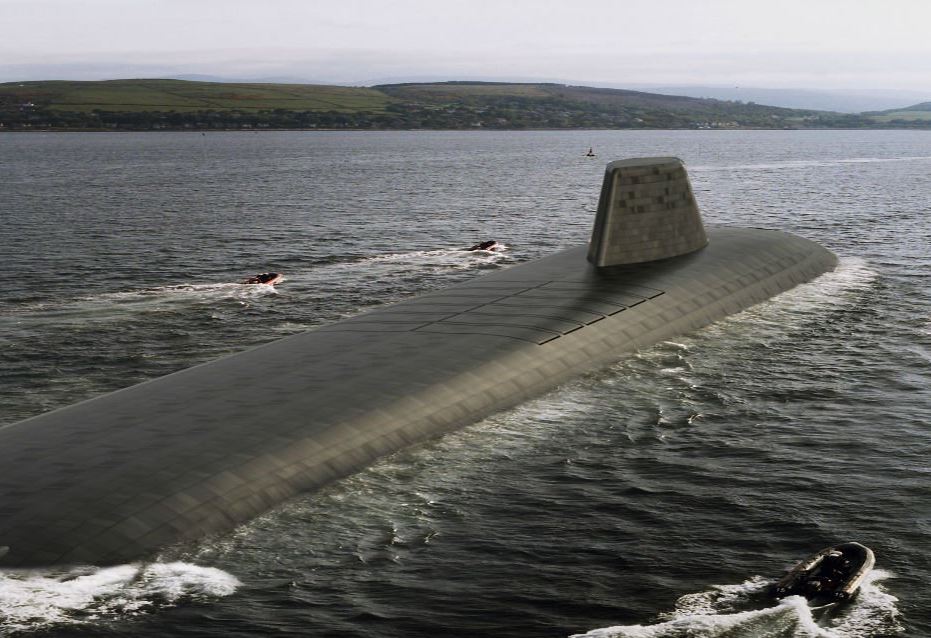
The Dreadnought-class submarine represents the Royal Navy's next-generation nuclear ballistic missile submarine (SSBN), designed to replace the aging Vanguard-class boats that have maintained Britain's Continuous At-Sea Deterrent (CASD) since the 1990s. These submarines will carry the UK's entire nuclear deterrent capability through at least 2060, making them arguably the most strategically critical military platforms in British service. The design philosophy centers on maintaining credible nuclear deterrence while incorporating lessons learned from decades of SSBN operations. The boats feature a new reactor design (PWR3) that will not require refueling during their operational lifetime, significantly reducing through-life costs and maintenance periods. The submarines are being built with modular construction techniques and incorporate advanced stealth technologies to ensure survivability in increasingly contested underwater environments. Strategically, the Dreadnought program represents the UK's commitment to maintaining an independent nuclear deterrent despite spiraling costs—the program is projected to consume roughly 6% of the entire defense budget over its construction period. The boats will initially carry the US-supplied Trident II D5 missile system, later transitioning to the D5LE (Life Extension) variant, maintaining the UK's reliance on American missile technology while preserving independence over targeting and deployment decisions. Compared to international peers, the Dreadnought-class prioritizes stealth and endurance over raw firepower, carrying 12 missile tubes versus 16 on US Columbia-class boats or 16 on French M51-equipped platforms. This reflects Britain's strategic calculus that a smaller but highly survivable deterrent force can provide credible minimum deterrence more cost-effectively than attempting to match superpower arsenals. However, the program's delays and cost overruns have raised questions about the UK's ability to maintain its nuclear deterrent industrial base independently.
Deployment Map
Home ports from known hull assignments. Operating areas reflect typical AORs — individual deployments will vary.
Timeline
Specifications
Armament
US-supplied missiles with UK warheads
Wire-guided with 300kg warhead
Doctrine & Employment
Role
Guarantee the survival of Britain's minimum credible nuclear deterrent through undetectable second-strike capability, ensuring national independence and NATO's extended deterrence architecture remains credible.
Design Philosophy
Prioritised absolute stealth and patrol endurance over speed or conventional warfare capability, accepting reduced torpedo capacity and eliminating non-essential systems that could compromise acoustic signature. Designers emphasised reliability and maintainability over cutting-edge technology to ensure 25+ year service life with minimal risk of mission-critical failures.
Employment
Operates under the Continuous At-Sea Deterrent (CASD) doctrine with one boat always on patrol in classified patrol areas, maintaining 24/7 launch readiness. Command authority flows directly from the Prime Minister through the Chief of Defence Staff, bypassing normal naval command structures. Each patrol typically lasts 2-3 months with complete operational independence, carrying sealed letters of last resort for use if the UK government is destroyed.
Threat Context
Originally designed against Cold War Soviet ASW capabilities, now faces increasingly sophisticated Chinese and Russian submarine detection networks including underwater sensor arrays and AI-enhanced acoustic processing. The threat environment has shifted from predictable bilateral deterrence to complex multipolar scenarios involving cyber warfare against command systems and space-based detection capabilities.
How to Compare
Compare primarily on patrol duration, acoustic signature, and missile capacity rather than speed or multi-role capability—all modern SSBNs achieve adequate submerged performance. The critical metrics are stealth technology generation, reactor service life, and weapons system compatibility with national nuclear doctrine rather than platform versatility.
Operational Patterns
Typical Deployment
Continuous At-Sea Deterrent (CASD) patrol, one boat always at sea
Deployment Length
3 months
Typical Task Group
Solo operations, no escorts to maintain stealth
Readiness
Requires minimum of 3 boats operational to maintain CASD, with fourth in deep maintenance
Key Operating Areas
Peer Comparison Matrix
Columbia-class larger with 16 missile tubes vs 12, shares Common Missile Compartment technology but different reactor design. US boats optimized for Pacific operations while Dreadnought focused on Atlantic/Arctic.
Video angle: Comparing costs and capabilities of allied deterrent forces - why UK chose smaller boats
Jin-class significantly noisier and less capable, carries shorter-range JL-2 missiles requiring forward deployment. Represents growing but still limited Chinese sea-based deterrent.
Video angle: David vs Goliath - how Western submarine technology maintains qualitative edge over Chinese numbers
Borei-class carries 16 Bulava missiles with comparable range, but suffers reliability issues. Russian boats larger but potentially noisier than Dreadnought design.
Video angle: Cold War submarine rivalry enters new generation - comparing British and Russian deterrent modernization
French boats carry indigenous M51 missiles, smaller crew, different operational pattern. Represents independent European approach vs UK reliance on US technology.
Video angle: Brexit implications - comparing independent French deterrent vs UK-US integrated approach
Known Vulnerabilities
Program delays and cost overruns
First boat delivery has slipped multiple times, with costs rising from £31bn to over £41bn program total. Critical skills shortages at Barrow shipyard limiting construction pace
Context: Delays risk gap in continuous deterrent if Vanguard-class boats cannot be life-extended further. Skills crisis reflects decades of reduced submarine construction
Mitigation: Increased investment in apprenticeships, partnerships with US/Australian shipyards under AUKUS framework
Dependence on US missile technology
Complete reliance on US Trident missiles creates potential vulnerability to US policy changes or supply disruptions
Context: Brexit has complicated European defense cooperation, leaving US as only viable partner for strategic missile technology
Mitigation: AUKUS partnership deepens integration with US systems, but increases rather than reduces dependence
Single point of failure infrastructure
All boats will be based at Faslane, all built at Barrow. Single catastrophic event could cripple entire deterrent force
Context: Geographic concentration simplifies logistics but creates strategic vulnerability to targeted attack or accident
Mitigation: Enhanced base security and distributed maintenance capabilities, but fundamental vulnerability remains
Advanced detection technologies
Emerging quantum sensors, AI-enhanced sonar processing, and satellite surveillance technologies may erode traditional submarine stealth advantages
Context: China and Russia investing heavily in anti-submarine warfare technologies specifically designed to counter Western SSBNs
Mitigation: Advanced anechoic coatings and signature management, but technological arms race favors detection over concealment
Variants
| Variant | Designation | Years | Count | Status | Key Changes |
|---|---|---|---|---|---|
| Batch 1 | All 4 boats | 2030-2040 | 4 | building | Initial production standard with PWR3 reactor, CMS-1 combat system, designed for Trident D5LE compatibility |
Fleet Roster (4)
| Hull | Name | Variant | Commissioned | Home Port | Status |
|---|---|---|---|---|---|
| S128 | HMS Dreadnought | Batch 1 | 2030 | HM Naval Base Clyde | building |
| S129 | HMS Valiant | Batch 1 | 2033 | HM Naval Base Clyde | building |
| S130 | HMS Warspite | Batch 1 | 2036 | HM Naval Base Clyde | building |
| S131 | HMS King George VI | Batch 1 | 2040 | HM Naval Base Clyde | building |
Modernization Programmes
PWR3 Reactor Development
Development of new reactor core that will not require refueling during submarine's operational life, incorporating US S9G reactor technology under AUKUS partnership
Impact: Eliminates complex and expensive mid-life refueling, reduces through-life costs by approximately £4 billion
Common Missile Compartment Integration
Integration of US-designed Common Missile Compartment (CMC) shared with Columbia-class, housing 12 Trident missile tubes
Impact: Reduces development costs through shared technology with US Navy, ensures Trident D5LE compatibility
CMS-1 Combat System
New integrated combat management system replacing legacy systems, providing enhanced situational awareness and threat response capabilities
Impact: Modernizes command and control capabilities to handle 21st century threats and multi-domain operations
Images


Frequently Asked
How many Dreadnought-class submarine are in service?
4 Dreadnought-class submarine are currently in service with Royal Navy, with 4 under construction.
When was the first Dreadnought-class submarine commissioned?
The first Dreadnought-class submarine entered service in 2030.
Who builds the Dreadnought-class submarine?
The Dreadnought-class submarine is built by BAE Systems Submarines (Barrow-in-Furness).
How much does a Dreadnought-class submarine cost?
Unit cost is approximately $4.2B per hull.
Curated Research
essential
Provides comprehensive analysis of UK nuclear doctrine evolution and how SSBN requirements derive from political deterrence strategy.
Official UK government justification for Dreadnought programme including threat assessment and capability requirements.
recommended
Leading UK defence think tank providing ongoing analysis of Royal Navy submarine programmes and nuclear deterrent policy.
Friedman's analysis of British submarine design philosophy and operational doctrine provides historical context for modern SSBN development.
Parliamentary analysis of CASD operational requirements and their impact on submarine design specifications.
reference
Comprehensive technical specifications and programme timeline for the Dreadnought-class development.
Milan Vego's doctrinal framework for understanding submarine operational employment and strategic roles.
Detailed specifications database for comparing Dreadnought-class capabilities against international SSBN programs.
Watch Dreadnought in Action
Iron Command produces in-depth comparison and analysis videos for military equipment.
Watch on YouTube