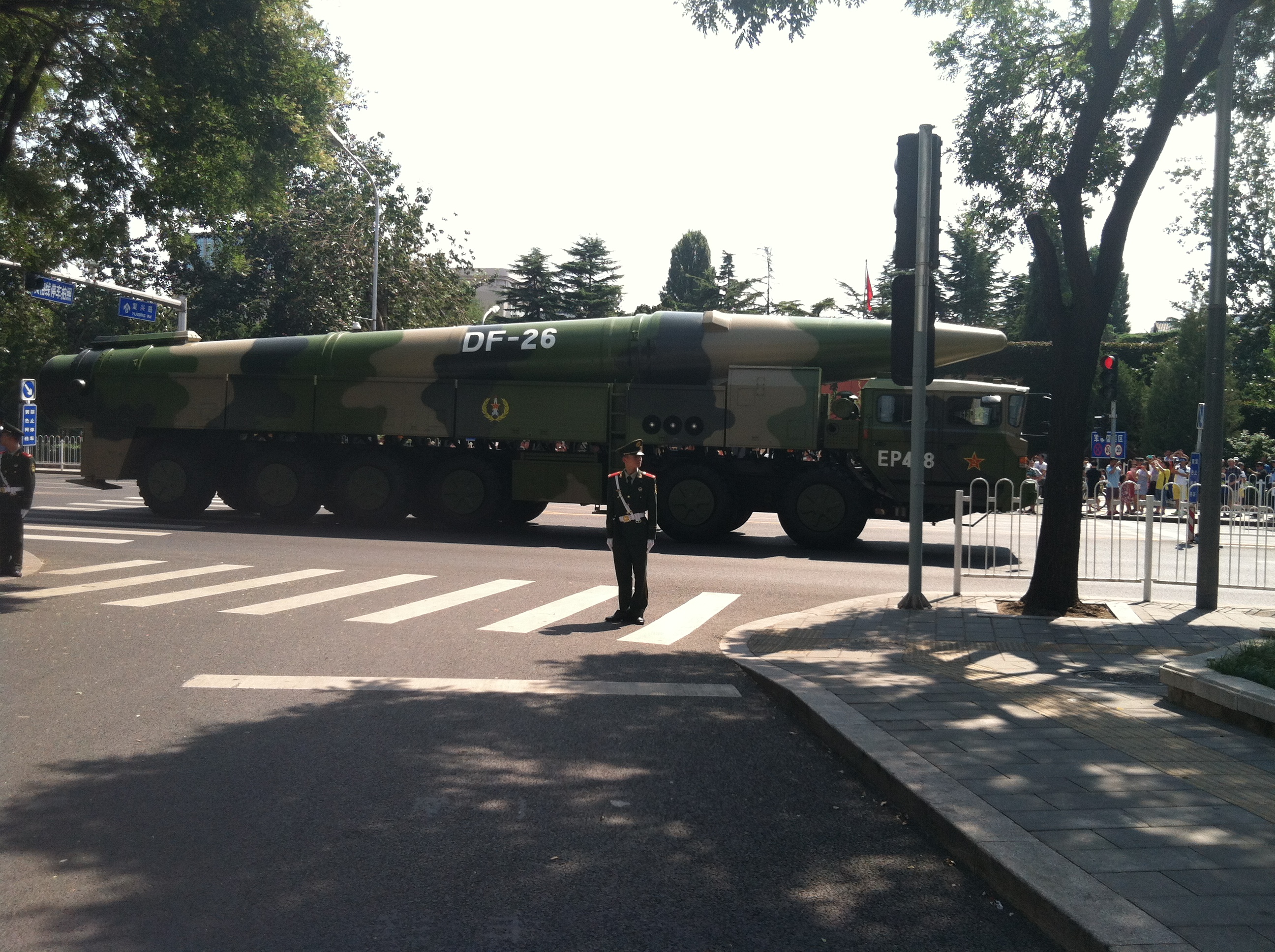
DF-26 intermediate-range ballistic missile
Overview
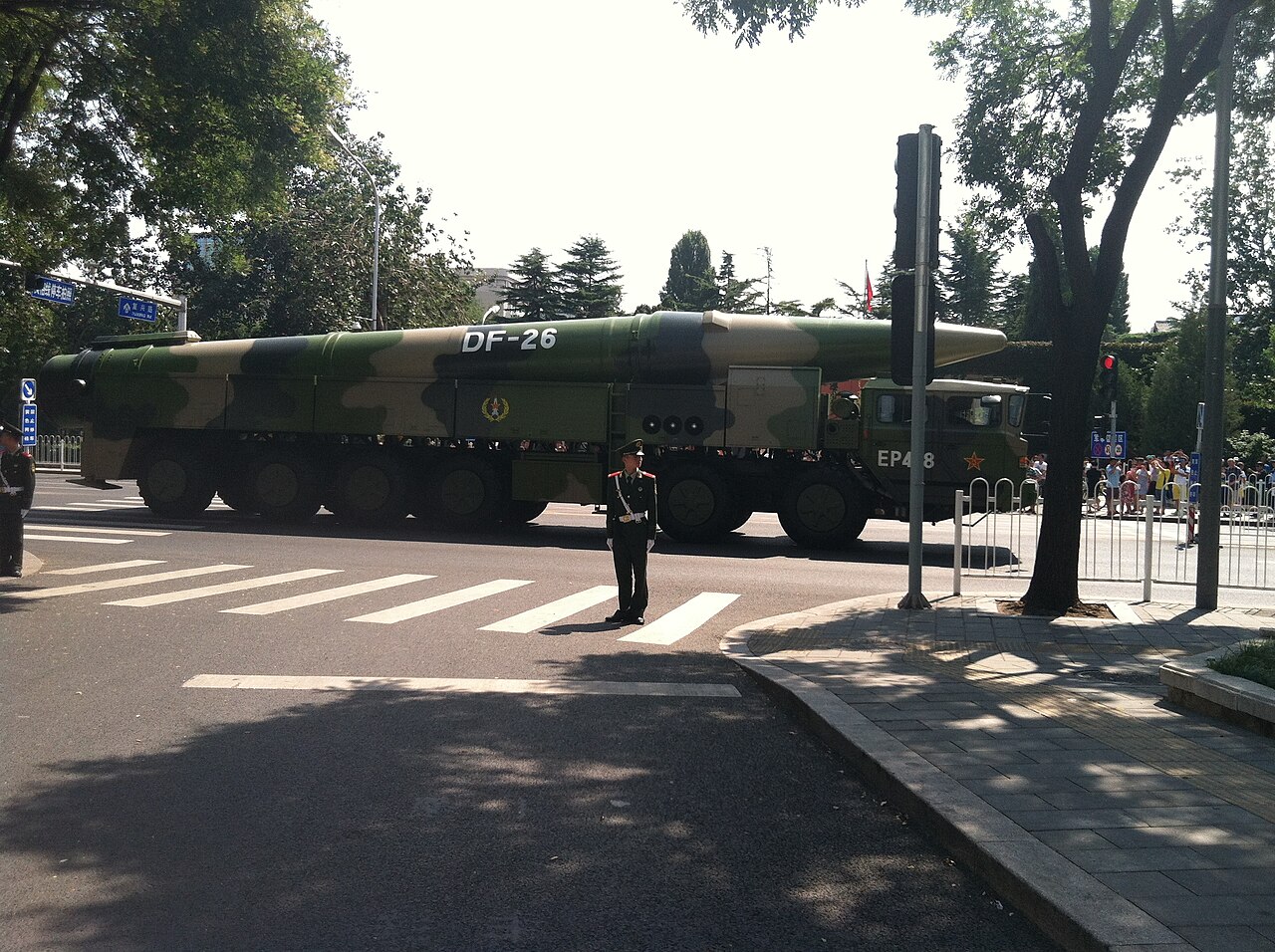
The DF-26 is China's intermediate-range ballistic missile and the longer-ranged sibling of the DF-21D — nicknamed the "Guam killer" because its roughly 4,000 km reach lets it threaten the U.S. territory and its bases from the Chinese mainland. First publicly revealed in the 2015 Beijing parade and fielded from around 2016, it is one of the most flexible weapons in the PLA Rocket Force inventory. Its defining feature is dual capability in two senses. It can carry either a conventional or a nuclear warhead, and reportedly supports rapid "hot-swapping" of warhead packages in the field — a flexibility that complicates an adversary's calculus about whether an incoming DF-26 is a nuclear or conventional strike. It is also dual-role against targets: a precision land-attack weapon and, like the DF-21D, an anti-ship ballistic missile able to manoeuvre against ships at sea with a terminal seeker. For an analyst, the DF-26 extends China's reconnaissance-strike complex from the first island chain out to the second. It pushes the threat envelope to Guam, forces dispersal and hardening of U.S. Pacific basing, and — paired with the DF-21D and DF-17 — creates a layered, mobile, hard-to-counter land-based missile threat that anchors China's anti-access strategy.
Deployment Map
Home ports from known hull assignments. Operating areas reflect typical AORs — individual deployments will vary.
Timeline
Specifications
Doctrine & Employment
Role
Dual conventional/nuclear intermediate-range ballistic missile for land-attack and anti-ship strike out to the second island chain.
Design Philosophy
Reach plus flexibility — range to Guam and swappable conventional/nuclear payloads.
Employment
Dispersed mobile launchers strike fixed targets or manoeuvring ships on satellite/OTH cueing.
Threat Context
Extends China's A2/AD threat to the second island chain and forces dispersal of U.S. Pacific basing.
How to Compare
Read with DF-21D and DF-17 as a layered land-based reconnaissance-strike complex.
Operational Patterns
Typical Deployment
Dispersed road-mobile launchers in interior China; salvo strike on cueing during a regional crisis.
Typical Task Group
Networked with Yaogan ISR satellites and OTH radar; complements DF-21D and DF-17.
Readiness
Fielded in growing numbers across PLARF brigades.
Key Operating Areas
Peer Comparison Matrix
DF-21D is the ~1,500 km 'carrier killer'; DF-26 roughly doubles range to threaten Guam and adds nuclear flexibility.
Video angle: Carrier killer vs Guam killer — China's reconnaissance-strike ladder.
Tomahawk is a subsonic precision cruise missile; the DF-26 is a hypersonic-terminal ballistic weapon with far greater reach and a nuclear option.
Video angle: Ballistic mass vs cruise precision in the Pacific.
DF-17 trades range for an unpredictable hypersonic glide path; DF-26 trades manoeuvre for reach and payload flexibility.
Video angle: Inside China's layered land-based missile force.
Combat History
Fired alongside the DF-21D into the South China Sea during PLA exercises, reportedly striking near a moving target ship.
Demonstrated the long-range anti-ship ballistic missile concept at IRBM range.
Publicly unveiled at the Beijing V-Day parade as the 'Guam killer'.
Confirmed an IRBM able to range U.S. bases in the second island chain.
Known Vulnerabilities
Kill-chain dependency (ASBM mode)
Anti-ship use depends on detecting and continuously tracking a distant moving ship.
Context: Sever the ISR/datalink chain and the maritime threat collapses.
Mitigation: Layered satellite, OTH radar and air/sub sensors.
Warhead ambiguity risk
Conventional/nuclear commonality risks dangerous misinterpretation of a launch.
Context: An adversary may assume the worst, raising escalation risk.
Mitigation: (Strategic management, not technical.)
Variants
| Variant | Designation | Years | Count | Status | Key Changes |
|---|---|---|---|---|---|
| DF-26 (land-attack) | — | 2016– | — | active | Conventional/nuclear precision strike to ~4,000 km |
| DF-26 (anti-ship) | — | 2018– | — | active | Maneuverable RV with terminal seeker for striking ships |
Modernization Programmes
Warhead flexibility & ISR integration
Improved hot-swap warhead handling and tighter satellite/OTH cueing for the anti-ship role.
Impact: Sharpens both deterrent ambiguity and maritime-strike timeliness.
Images




Frequently Asked
When was the first DF-26 intermediate-range ballistic missile commissioned?
The first DF-26 intermediate-range ballistic missile entered service in 2016.
Who builds the DF-26 intermediate-range ballistic missile?
The DF-26 intermediate-range ballistic missile is built by China Aerospace Science and Technology Corp. (CASC).
What variants of the DF-26 intermediate-range ballistic missile exist?
Known variants include: DF-26 (land-attack), DF-26 (anti-ship).
How much does a DF-26 intermediate-range ballistic missile cost?
Unit cost is approximately $20M per hull.
Curated Research
essential
Authoritative profile
reference
Range, roles, dual-capability
Watch DF-26 intermediate-range ballistic missile in Action
Iron Command produces in-depth comparison and analysis videos for military equipment.
Watch on YouTube