
DF-21D anti-ship ballistic missile
Overview
The DF-21D is the world's first operational anti-ship ballistic missile (ASBM) — the weapon that earned the nickname "carrier killer" and, more than any single system, crystallised Western anxiety about China's anti-access/area-denial (A2/AD) strategy. A variant of the road-mobile DF-21 medium-range ballistic missile family, the -D model adds a manoeuvring re-entry vehicle (MaRV) with a terminal seeker, giving a ballistic missile the previously unheard-of ability to hit a moving ship at sea after a hypersonic descent from space. The concept is as much about the kill chain as the missile. To strike a carrier roughly 1,500 km away, the PLA must first detect, identify and track it using over-the-horizon radar, satellites, submarines and aircraft, then pass targeting data to the launcher in near-real time, and finally have the MaRV's seeker reacquire the carrier in its final seconds against decoys and jamming. The missile is only the visible tip of a vast reconnaissance-strike complex; degrade any link in that chain and the threat degrades with it. Strategically, the DF-21D's value is coercive as much as kinetic. Its mere existence forces a U.S. carrier strike group to weigh operating inside the first island chain during a Taiwan or South China Sea crisis, complicating American power projection and buying the PLA time and space. It has since been joined and arguably eclipsed by the longer-range DF-26 "Guam killer" and by hypersonic glide vehicles like the DF-17, but the DF-21D remains the system that opened the era of land-based ballistic threats to ships. For an analyst, the DF-21D is the canonical A2/AD case study: a relatively cheap, mobile, hard-to-counter weapon whose effectiveness is genuinely contested — never tested against a defended carrier under wartime conditions — yet whose deterrent shadow already shapes U.S. and allied operational planning across the Pacific.
Deployment Map
Home ports from known hull assignments. Operating areas reflect typical AORs — individual deployments will vary.
Timeline
Specifications
Doctrine & Employment
Role
Land-based anti-ship ballistic missile to threaten and deter hostile carrier strike groups approaching China's near seas.
Design Philosophy
Impose cost and risk on naval power projection cheaply, exploiting the asymmetry between a missile and a multi-billion-dollar carrier.
Employment
Dispersed mobile launchers fire on satellite/OTH cueing; the MaRV manoeuvres to strike a moving ship in its terminal phase.
Threat Context
The signature weapon of China's A2/AD strategy and the reason U.S. carrier operations inside the first island chain are now contested.
How to Compare
Read alongside the DF-26 and DF-17 as a layered, land-based reconnaissance-strike complex aimed at the sea.
Operational Patterns
Typical Deployment
Road-mobile TEL units dispersed and concealed inland; salvo launch on satellite/OTH cueing during a maritime crisis.
Typical Task Group
Networked with Yaogan ISR satellites, OTH-B radar, submarines and maritime patrol aircraft.
Readiness
Fielded since ~2010; complemented by DF-26 and DF-17.
Key Operating Areas
Peer Comparison Matrix
DF-26 roughly doubles range to ~4,000 km ('Guam killer') with both land-attack and anti-ship roles.
Video angle: Carrier killer vs Guam killer — the reach of China's ASBMs.
Zircon is a sea/air-launched hypersonic cruise missile, not a land-based ballistic weapon.
Video angle: Ballistic vs hypersonic-cruise paths to killing ships.
LRASM is a stealthy subsonic air/ship-launched cruise missile with autonomous targeting — a very different anti-ship philosophy.
Video angle: Mass-and-speed vs stealth-and-autonomy in anti-ship warfare.
Combat History
PLA fired DF-21D and DF-26 missiles into the South China Sea during exercises; U.S. officials reported a missile struck near or on a moving target ship.
First public indication the ASBM concept had been demonstrated against a manoeuvring maritime target.
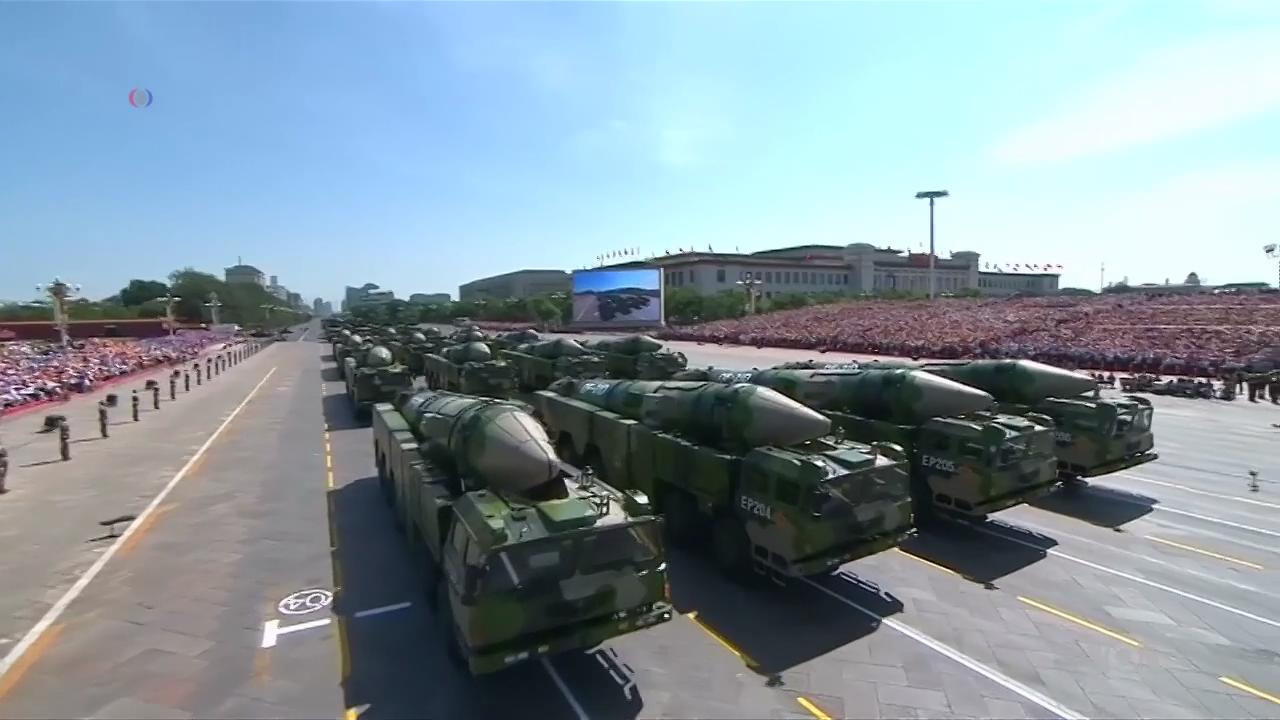
DF-21D publicly paraded in Beijing, officially confirming the anti-ship variant.
Open acknowledgement of a capability long assessed by Western analysts.
Known Vulnerabilities
Kill-chain dependency
Effectiveness hinges on detecting, tracking and continuously cueing a distant moving ship.
Context: Severing ISR or datalinks neutralises the weapon without intercepting it.
Mitigation: Redundant satellite, radar, sub and air sensors.
Terminal seeker vs countermeasures
The MaRV must reacquire the target against decoys, chaff, jamming and manoeuvre.
Context: Carrier groups can spoof or evade in the missile's final seconds.
Mitigation: Improved multi-mode seekers.
Unproven against a defended target
Never tested against a carrier with full Aegis/SM-3/SM-6 defences and EW.
Context: Real-world Pk is genuinely uncertain.
Mitigation: Saturation salvos with DF-26 and cruise missiles.
Variants
| Variant | Designation | Years | Count | Status | Key Changes |
|---|---|---|---|---|---|
| DF-21 (CSS-5) | — | 1991– | — | active | Original land-attack MRBM |
| DF-21C | — | 2006– | — | active | Precision land-attack variant with terminal guidance |
| DF-21D | — | 2010– | — | active | Anti-ship MaRV with terminal seeker — the 'carrier killer' |
Modernization Programmes
Reconnaissance-strike integration
Tighter fusion of OTH radar, Yaogan satellites and UAVs to shorten the targeting cycle.
Impact: Kill-chain timeliness, not the missile itself, is the decisive variable.
Images




Frequently Asked
When was the first DF-21D anti-ship ballistic missile commissioned?
The first DF-21D anti-ship ballistic missile entered service in 2010.
Who builds the DF-21D anti-ship ballistic missile?
The DF-21D anti-ship ballistic missile is built by China Aerospace Science and Technology Corp. (CASC).
What variants of the DF-21D anti-ship ballistic missile exist?
Known variants include: DF-21 (CSS-5), DF-21C, DF-21D.
How much does a DF-21D anti-ship ballistic missile cost?
Unit cost is approximately $11M per hull.
Curated Research
essential
Authoritative range, basing and capability profile
reference
Variants and the ASBM concept
Watch DF-21D anti-ship ballistic missile in Action
Iron Command produces in-depth comparison and analysis videos for military equipment.
Watch on YouTube