
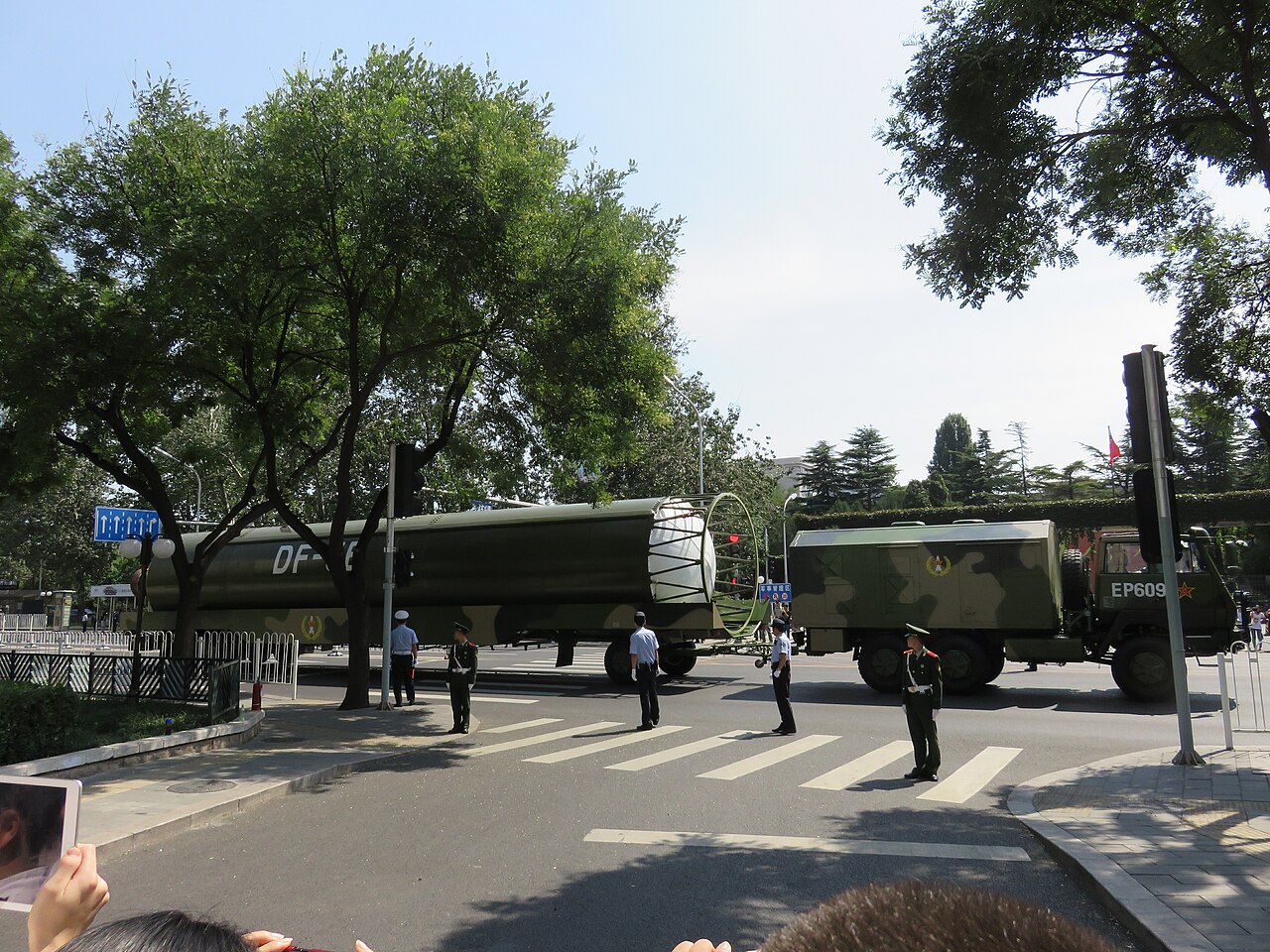
DF-17 hypersonic glide missile
Compare with
Overview
The DF-17 is the world's first operationally fielded hypersonic glide-vehicle missile — a medium-range ballistic booster topped not with a conventional re-entry warhead but with the DF-ZF hypersonic glide vehicle (HGV). Unveiled at the 2019 Beijing parade and assessed operational from around 2020, it represents a genuinely new class of threat that complicates Western missile defence. The distinction matters. A traditional ballistic warhead follows a predictable arcing trajectory after burnout, which is what missile-defence systems are built to track and intercept. The DF-ZF instead releases at high altitude and then glides and manoeuvres within the atmosphere at hypersonic speed (Mach 5–10), flying a flatter, unpredictable path that is far harder to track, predict and engage. Estimated range is on the order of 1,800–2,500 km. For an analyst, the DF-17 is significant less for raw range than for the defensive problem it poses. Its manoeuvring glide degrades the effectiveness of terminal interceptors like THAAD and Patriot and erodes the value of fixed early-warning geometry. It is widely assessed as conventional and precision-capable, and is reported to have an anti-ship application — making it another tool in China's effort to hold both bases and ships at risk inside the Western Pacific.
Deployment Map
Home ports from known hull assignments. Operating areas reflect typical AORs — individual deployments will vary.
Timeline
Specifications
Doctrine & Employment
Role
Conventional hypersonic glide missile to defeat missile defences and strike high-value fixed (and possibly maritime) targets.
Design Philosophy
Defeat the defence — trade pure range for a trajectory that current interceptors struggle to engage.
Employment
Boosts ballistically, then releases a manoeuvring glide vehicle that flies a flat, unpredictable hypersonic path.
Threat Context
Erodes the value of THAAD/Patriot-class terminal defence and fixed early-warning geometry in the Western Pacific.
How to Compare
The glide answer to the hypersonic question — read against Russia's Zircon and U.S. ARRW/LRHW.
Operational Patterns
Typical Deployment
Mobile launchers striking high-value fixed targets (and possibly ships) on a manoeuvring hypersonic glide path.
Typical Task Group
Part of the layered PLARF strike force with DF-21D and DF-26.
Readiness
Operational and expanding since ~2020.
Key Operating Areas
Peer Comparison Matrix
Zircon is a hypersonic cruise missile (air-breathing, powered throughout); the DF-17 is a boost-glide weapon.
Video angle: Glide vs cruise — the two roads to hypersonic strike.
U.S. boost-glide programs lagged the DF-17 into service.
Video angle: Why China fielded hypersonics first.
DF-26 offers far greater range with a conventional/nuclear ballistic RV; DF-17 offers an unpredictable hypersonic glide.
Video angle: Inside the PLARF's mixed missile force.
Combat History
Publicly unveiled at the 70th-anniversary Beijing parade, the first time a hypersonic glide missile was paraded as operational.
Signalled China's lead in fielding hypersonic glide weapons.
Known Vulnerabilities
Technical maturity
Hypersonic glide is demanding — thermal protection, seeker performance and accuracy at glide speed are hard.
Context: Real-world precision and reliability are not publicly verified.
Mitigation: Continued flight testing.
Boost phase
The ballistic boost phase remains detectable and potentially interceptable before glide.
Context: Boost-phase or left-of-launch defences could blunt it.
Mitigation: Mobility and dispersal.
Variants
| Variant | Designation | Years | Count | Status | Key Changes |
|---|---|---|---|---|---|
| DF-17 / DF-ZF | — | 2020– | — | active | Boost-glide MRBM with hypersonic glide vehicle |
Modernization Programmes
Production scaling & anti-ship development
Expanding PLARF inventory and reported maritime-strike applications.
Impact: Broadens the hypersonic threat to both land and sea targets.
Images




Frequently Asked
When was the first DF-17 hypersonic glide missile commissioned?
The first DF-17 hypersonic glide missile entered service in 2020.
Who builds the DF-17 hypersonic glide missile?
The DF-17 hypersonic glide missile is built by China Aerospace Science and Technology Corp. (CASC).
Curated Research
essential
Authoritative profile
reference
HGV concept and range
Watch DF-17 hypersonic glide missile in Action
Iron Command produces in-depth comparison and analysis videos for military equipment.
Watch on YouTube