
Charles de Gaulle
Compare with
Overview
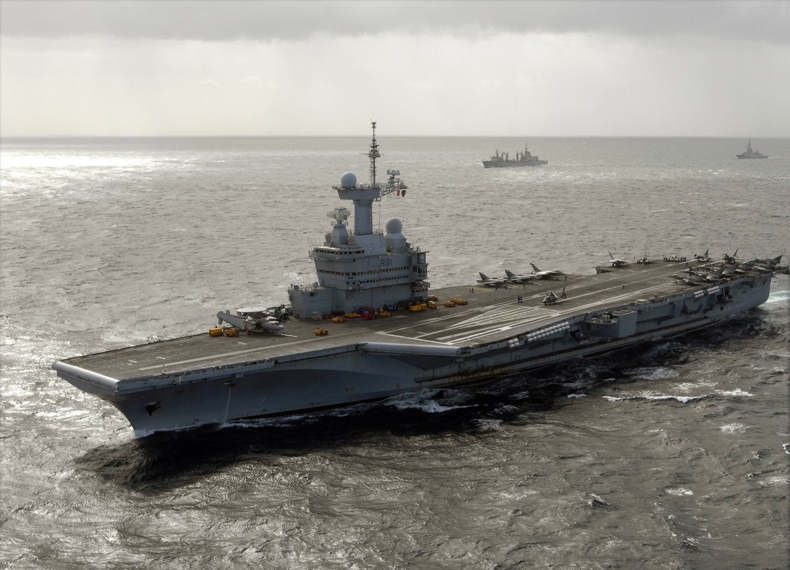
The Charles de Gaulle (R 91) is France's flagship aircraft carrier and the only nuclear-powered aircraft carrier outside of the US Navy fleet. Commissioned in 2001, she represents France's commitment to maintaining independent power projection capabilities and serves as the cornerstone of French naval aviation. With a displacement of 42,500 tonnes, she is significantly smaller than American supercarriers but larger than most other nations' carriers. Strategically, Charles de Gaulle enables France to project air power globally without dependence on foreign bases or alliances, supporting France's foreign policy autonomy. Her nuclear propulsion provides virtually unlimited range and high-speed transit capabilities, though her compact size limits aircraft capacity to around 40 aircraft compared to 75+ on American carriers. The flight deck design accommodates both French Rafale M fighters and various NATO aircraft types. In the current threat environment, Charles de Gaulle provides France with credible power projection against medium-tier threats and supports coalition operations in contested environments. Her integrated air defense systems and nuclear propulsion make her less vulnerable to conventional threats than conventional carriers, though her singular status means France has no carrier capability during her regular 18-month refit cycles. Compared to peers, Charles de Gaulle represents the middle tier of carrier aviation - more capable than STOBAR carriers like India's Vikramaditya or China's early carriers, but significantly smaller and less capable than American Nimitz or Ford-class carriers. Her nuclear propulsion gives her an advantage over conventional carriers like the UK's Queen Elizabeth class in terms of operational endurance and speed.
Deployment Map
Home ports from known hull assignments. Operating areas reflect typical AORs — individual deployments will vary.
Timeline
Specifications
Armament
Point defense against aircraft and missiles
Last-ditch missile defense
Anti-aircraft and small boat defense
Primary strike fighter with air-to-air and air-to-surface capability
Airborne radar and command platform
Doctrine & Employment
Role
Independent power projection and crisis response outside NATO framework, enabling France to conduct autonomous military interventions in Africa, Mediterranean, and Indo-Pacific without relying on allied carrier support.
Design Philosophy
Prioritized nuclear propulsion for strategic autonomy and unlimited range over size and aircraft capacity, accepting a smaller air wing (40 aircraft vs 75+ on US carriers) to achieve this independence. Designed for quality over quantity approach - sophisticated systems and flexible mission capabilities rather than maximum sortie generation rates.
Employment
Operates as flagship of a carrier battle group (Groupe Aéronaval) typically including 2-3 escorts, 1-2 submarines, and a replenishment vessel. Deploys for 4-month rotations supporting operations in Sahel, Levant, or Indo-Pacific, with air wing tailored to specific mission requirements. Commands joint task forces during major interventions, integrating with amphibious forces for expeditionary operations. Maintains nuclear deterrent patrol capability as secondary mission.
Threat Context
Designed during post-Cold War period for expeditionary operations against regional powers and non-state actors, with emphasis on precision strike and air superiority in permissive environments. Current threat evolution toward great power competition and A2/AD environments challenges original assumptions about operating close to contested littorals.
How to Compare
Compare on strategic mobility and operational flexibility rather than raw capacity - nuclear propulsion and deployment frequency matter more than aircraft numbers. Focus on air wing composition versatility and integration with French expeditionary doctrine versus pure sortie generation rates or deck space.
Operational Patterns
Typical Deployment
Task Force 473 operations with escort vessels, power projection missions in Mediterranean, Indian Ocean, or Pacific
Deployment Length
6 months
Typical Task Group
FREMM frigates, Horizon-class destroyers, nuclear attack submarine, replenishment ship
Readiness
18-month refit cycle every 7-8 years creates capability gaps; propulsion issues occasionally limit speed
Key Operating Areas
Peer Comparison Matrix
Queen Elizabeth is larger (65,000 tons) with more aircraft capacity but conventional propulsion and STOBAR operation vs CATOBAR. Nuclear power gives Charles de Gaulle unlimited range and higher sustained speed.
Video angle: Nuclear vs conventional carriers: operational trade-offs and strategic implications
Similar size but STOBAR operation limits aircraft performance. Charles de Gaulle's CATOBAR system and nuclear propulsion provide significantly better power projection capability despite similar displacement.
Video angle: CATOBAR vs STOBAR: why catapults matter for carrier effectiveness
Shandong is larger (70,000 tons) but uses STOBAR operation. Charles de Gaulle's nuclear propulsion and CATOBAR system provide qualitative advantages despite smaller size and aircraft capacity.
Video angle: European vs Chinese carrier development: different approaches to naval aviation
Nimitz carriers are twice the size (100,000+ tons) with nearly double aircraft capacity. Charles de Gaulle represents 'minimum viable' nuclear carrier capability compared to American supercarrier standard.
Video angle: Supercarrier vs medium carrier: cost-effectiveness and strategic utility comparison
Similar vintage but conventional propulsion and reliability issues. Charles de Gaulle has demonstrated consistent operational availability while Kuznetsov has spent years in refit with uncertain status.
Video angle: Tale of two carriers: French success vs Russian struggles in carrier operations
Combat History
First operational deployment supporting operations in Afghanistan. Rafale M conducted combat air patrols and reconnaissance missions over Afghanistan from Arabian Sea.
First combat deployment demonstrated nuclear carrier's expeditionary capabilities and Rafale M combat effectiveness
Led French naval operations during Libya intervention. Aircraft conducted over 840 combat sorties, including precision strikes against Gaddafi forces.
Proved carrier's ability to sustain high-tempo operations and lead coalition naval air power
Deployed to Eastern Mediterranean and Persian Gulf following Paris attacks. Rafale M conducted strikes against ISIS targets in Iraq and Syria.
Demonstrated rapid response capability and sustained strike operations against terrorist targets
Extended deployment supporting anti-ISIS operations, conducting over 350 combat missions from Persian Gulf position.
Showed sustained operational tempo and logistics capability in distant theater
Known Vulnerabilities
Single point of failure
France has no carrier capability when Charles de Gaulle is in refit, creating 18-month gaps in carrier aviation every 7-8 years.
Context: Limits French power projection and makes planning around refit cycles critical for operations
Mitigation: PANG program may include second carrier, but currently no concrete plans for two-carrier fleet
Limited aircraft capacity
40-aircraft capacity significantly smaller than US carriers (75+), limiting strike package size and sustained operations tempo.
Context: Reduces ability to conduct simultaneous air defense, strike, and support missions compared to larger carriers
Mitigation: Efficient aircraft mix and cooperation with land-based air power partially compensates
Propulsion shaft problems
Recurring issues with propeller shaft design have limited maximum speed and required multiple repairs.
Context: Reduces tactical mobility and creates maintenance vulnerabilities during high-tempo operations
Mitigation: Modifications made during refits, but fundamental design issues persist
Limited missile defense
Only 32 VLS cells with Aster 15 provides limited protection against saturation missile attacks compared to escort vessels.
Context: Requires close coordination with escort vessels for protection against modern anti-ship missile threats
Mitigation: Operates within task group with dedicated air defense vessels
Variants
| Variant | Designation | Years | Count | Status | Key Changes |
|---|---|---|---|---|---|
| Initial Configuration | R 91 | 2001-2007 | 1 | upgraded | Original configuration with DRBJ-11B radar, basic SENIT combat system |
| Mid-Life Upgrade | R 91 | 2017-2018 | 1 | active | Upgraded SENIT 8 combat system, improved communications, structural reinforcements |
Fleet Roster (1)
| Hull | Name | Variant | Commissioned | Home Port | Status |
|---|---|---|---|---|---|
| R 91 | Charles de Gaulle | Mid-Life Upgrade | 2001-05-18 | Toulon Naval Base | active |
Modernization Programmes
NAWARS (Naval Airborne Warfare And Reconnaissance System)
Integration of new satellite communications, Link 16 tactical data links, and improved electronic warfare systems.
Impact: Enhanced networking with allied forces and improved electronic warfare capability
Nuclear Reactor Refueling
Major refit including nuclear fuel replacement, reactor maintenance, and systems upgrades during 15-month availability.
Impact: Extends operational life and provides opportunity for major system upgrades
PANG (Porte-Avions de Nouvelle Génération)
Next-generation nuclear aircraft carrier to replace Charles de Gaulle, larger and more capable design.
Impact: Will provide increased aircraft capacity and modernized systems for future decades
Images



Frequently Asked
How many Charles de Gaulle are in service?
1 Charles de Gaulle are currently in service with French Navy (Marine Nationale).
When was the first Charles de Gaulle commissioned?
The first Charles de Gaulle entered service in 2001-05-18.
Who builds the Charles de Gaulle?
The Charles de Gaulle is built by DCN Brest (now Naval Group).
What variants of the Charles de Gaulle exist?
Known variants include: Initial Configuration, Mid-Life Upgrade.
How much does a Charles de Gaulle cost?
Unit cost is approximately $4.2B per hull.
Curated Research
essential
Comprehensive analysis of French carrier aviation doctrine and the strategic rationale behind the Charles de Gaulle design decisions.
RUSI analysis explaining how Charles de Gaulle enables France's independent intervention strategy in Africa and beyond.
Official French naval doctrine explaining the strategic role of the carrier battle group in national defense strategy.
recommended
Provides doctrinal framework for understanding carrier operations in Mediterranean and confined waters where Charles de Gaulle frequently operates.
Leading source for analysis of French military capabilities and European defense industrial issues affecting carrier modernization.
Premier French defense think tank providing insider analysis of carrier operations and future PANG carrier program implications.
reference
Detailed technical specifications and systems overview for understanding platform capabilities and limitations.
Annual assessment of Charles de Gaulle operational status, air wing composition, and comparative analysis with allied carriers.
Watch Charles de Gaulle in Action
Iron Command produces in-depth comparison and analysis videos for military equipment.
Watch on YouTube