Boxer Multi-Role Armoured Vehicle
Compare with
Overview
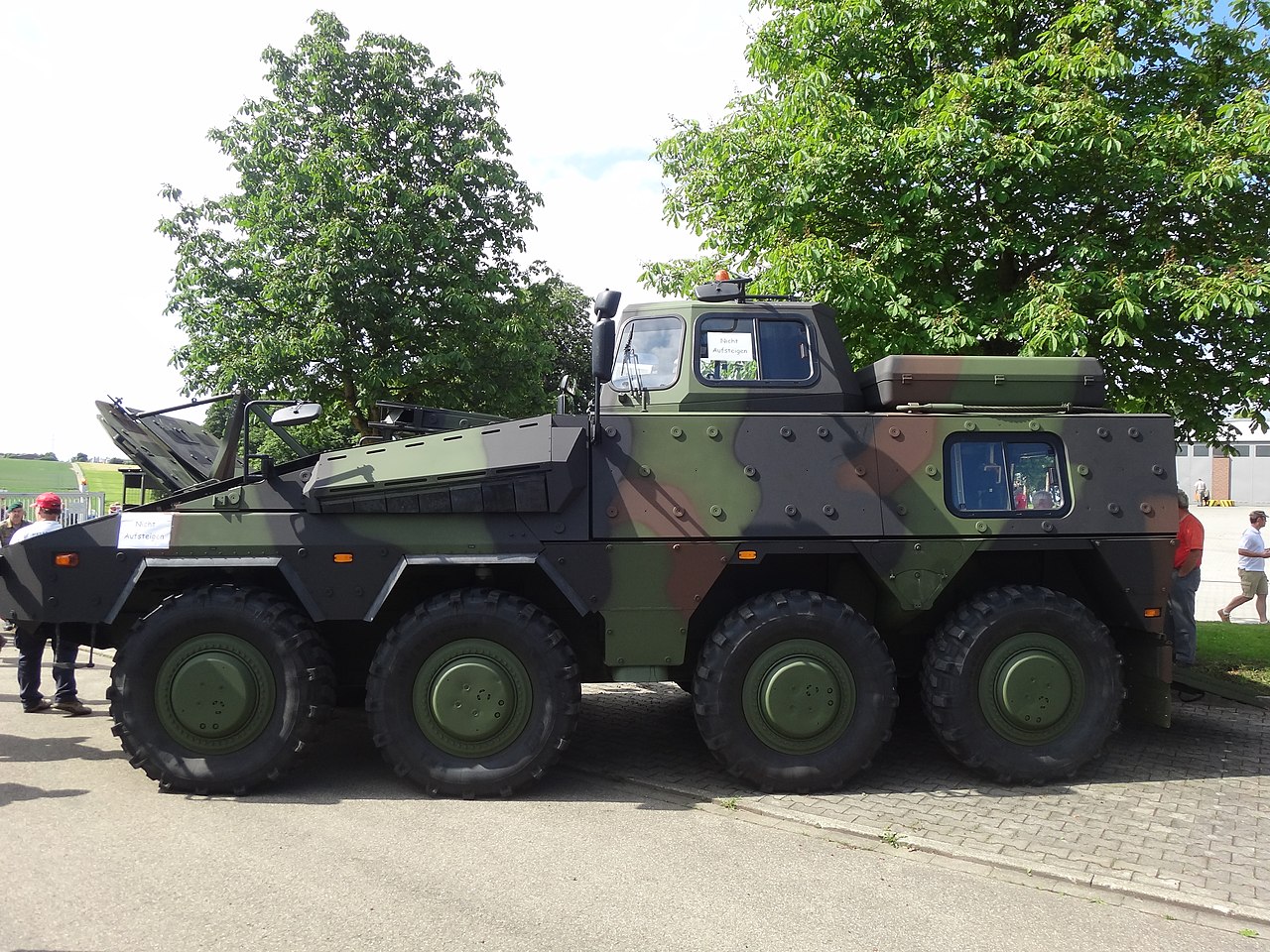
The Boxer Multi-Role Armoured Vehicle represents one of Europe's most successful 8x8 wheeled armoured fighting vehicle programs, developed jointly by Germany and the Netherlands through ARTEC GmbH. The platform's modular mission equipment concept allows rapid role reconfiguration through interchangeable mission modules, making it adaptable to infantry transport, command post, ambulance, engineer, and reconnaissance roles within hours rather than weeks. Strategically, the Boxer fills the critical capability gap between heavy tracked IFVs like the Puma and lighter patrol vehicles, providing high mobility for rapid deployment scenarios while maintaining substantial protection against IEDs, mines, and small arms fire. Its 8x8 configuration offers superior strategic mobility compared to tracked alternatives, crucial for NATO's emphasis on rapid reinforcement of Eastern European allies. The design philosophy prioritizes survivability through a V-shaped hull, advanced armor packages, and comprehensive electronic warfare protection, reflecting lessons learned from Iraq and Afghanistan. The drive module houses the crew in a protected capsule separate from the mission module, significantly improving survival rates if the rear compartment is compromised. In the current threat environment, Boxer's significance lies in its proven adaptability to urban warfare, peacekeeping, and high-intensity conflict scenarios. Unlike many competitors that excel in specific roles, Boxer's true strength is operational flexibility - the same chassis can serve as an APC, command vehicle, or ambulance depending on mission requirements. Against peers like the Finnish Patria AMV or Italian Centauro II, Boxer offers superior protection and modularity, though at significantly higher unit cost.
Deployment Map
Home ports from known hull assignments. Operating areas reflect typical AORs — individual deployments will vary.
Timeline
Specifications
Armament
Optional turret for IFV variant
Mounted on Lance turret
Standard on most variants
Operational Patterns
Typical Deployment
Battalion-level mechanized infantry support, reconnaissance, and command post operations
Deployment Length
6 months
Typical Task Group
Operates in mechanized infantry battalions with 12-14 vehicles per company
Readiness
High availability rates (85%+) but complex mission module changes require specialized maintenance
Key Operating Areas
Peer Comparison Matrix
AMV is lighter (26t vs 38.5t) with better strategic mobility but inferior protection and modularity. Boxer offers superior mine protection and mission flexibility at higher cost.
Video angle: European 8x8 showdown - weight vs protection trade-offs in modern AFV design
Centauro focuses on fire support with 120mm gun vs Boxer's transport/utility focus. Similar mobility but different tactical roles and protection philosophies.
Video angle: Wheels vs tracks debate - examining 8x8 specialization strategies
Stryker is lighter (19t) with lower protection but greater air-transportability. Boxer provides superior survivability and modularity but sacrifices strategic deployment speed.
Video angle: NATO standardization challenges - comparing American vs European 8x8 philosophies
BTR-82A is much lighter (13.6t) and cheaper but significantly inferior in protection, electronics, and crew survivability. Represents quantity vs quality approach.
Video angle: East vs West AFV philosophies - survivability vs cost effectiveness
Combat History
German Boxer vehicles conducted final NATO combat patrols in Afghanistan, demonstrating mine resistance and reliability in harsh terrain
Validated protection systems and mechanical reliability under combat conditions
German and Lithuanian Boxer vehicles regularly participate in Baltic deterrence missions and multinational exercises
Demonstrates interoperability and rapid deployment capabilities for NATO Article 5 scenarios
Multiple IED simulation tests conducted by British Army CRV variants, validating protection upgrades
Confirmed survivability improvements over earlier 8x8 platforms
Known Vulnerabilities
Top-attack munitions
Like all wheeled AFVs, vulnerable to modern top-attack ATGMs, loitering munitions, and artillery-delivered smart submunitions
Context: Critical weakness against Russian Kornet-EM, Javelin, and emerging drone swarm attacks
Mitigation: Trophy APS integration ongoing, but coverage gaps remain for certain attack angles
Urban mobility limitations
Large size (8m length, 3m width) restricts maneuverability in dense urban terrain compared to tracked IFVs
Context: Problematic for urban warfare scenarios like those seen in Ukraine's cities
Mitigation: Training emphasis on combined arms coordination, but fundamental size constraint remains
Wheel vulnerability
Wheels remain vulnerable to small arms fire and fragmentation, potentially immobilizing vehicle
Context: Run-flat inserts help but cannot match tracked vehicle survivability after mobility kills
Mitigation: Improved run-flat technology and rapid repair procedures, but inherent weakness persists
Variants
| Variant | Designation | Years | Count | Status | Key Changes |
|---|---|---|---|---|---|
| GTK (Gepanzertes Transport-Kraftfahrzeug) | A1-A8 configurations | 2009-present | 350 | active | Basic APC configuration with infantry transport module |
| GTFz (Command Post) | Command variants | 2011-present | 50 | active | Extended communications suite, battlefield management systems |
| CRV (Combat Reconnaissance Vehicle) | British Army variant | 2019-present | 523 | active | 40mm CT gun, advanced sensors, UK-specific systems integration |
| LPBV (Land Platform Boxer Vehicle) | Australian variant | 2018-present | 211 | building | Tropicalized systems, Rafael Trophy APS integration planned |
Fleet Roster (4)
| Hull | Name | Variant | Commissioned | Home Port | Status |
|---|---|---|---|---|---|
| N/A | German Army Fleet | Multiple GTK/GTFz variants | 2009-ongoing | Various bases | active - 350+ vehicles |
| N/A | British Army Fleet | CRV | 2019-ongoing | UK bases | active - 200+ delivered, 523 total planned |
| N/A | Australian Army Fleet | LPBV | 2018-ongoing | Australian bases | building - 211 on order |
| N/A | Lithuanian Army Fleet | GTK | 2017-ongoing | Lithuania | active - 91 vehicles |
Modernization Programmes
Trophy Active Protection System
Integration of Rafael Trophy APS on Australian and potential other variants to defeat RPGs and ATGMs
Impact: Significantly enhances survivability against modern anti-tank threats
Digitalization Package
Upgraded IFIS systems, improved C4ISR integration, enhanced battlefield management capabilities
Impact: Better situational awareness and network integration for multi-domain operations
Next-Generation Turret
Development of 35mm turret option with airburst ammunition and improved sensors
Impact: Enhanced lethality against drones, light armor, and infantry in fortified positions
Images



Frequently Asked
How many Boxer Multi-Role Armoured Vehicle are in service?
1100 Boxer Multi-Role Armoured Vehicle are currently in service with German Army.
When was the first Boxer Multi-Role Armoured Vehicle commissioned?
The first Boxer Multi-Role Armoured Vehicle entered service in 2009.
Who builds the Boxer Multi-Role Armoured Vehicle?
The Boxer Multi-Role Armoured Vehicle is built by ARTEC GmbH (Rheinmetall/KMW).
What variants of the Boxer Multi-Role Armoured Vehicle exist?
Known variants include: GTK (Gepanzertes Transport-Kraftfahrzeug), GTFz (Command Post), CRV (Combat Reconnaissance Vehicle), LPBV (Land Platform Boxer Vehicle).
How much does a Boxer Multi-Role Armoured Vehicle cost?
Unit cost is approximately $5M per hull.
Watch Boxer Multi-Role Armoured Vehicle in Action
Iron Command produces in-depth comparison and analysis videos for military equipment.
Watch on YouTubeSources