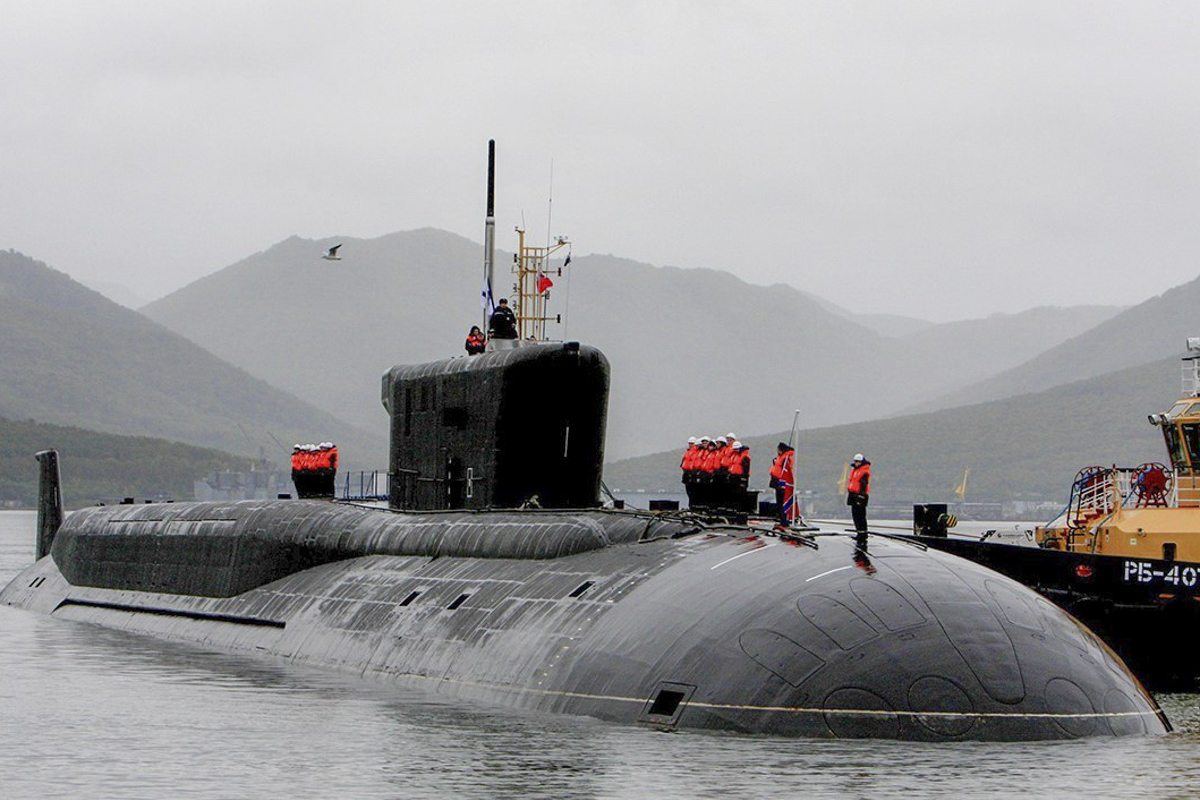
Borei-class submarine
Overview
The Borei-class (Project 955/955A) represents Russia's fourth-generation strategic nuclear submarine, designed to modernize the aging Soviet-era SSBN fleet and maintain credible sea-based nuclear deterrence through the 2050s. These boats form the maritime component of Russia's nuclear triad, carrying up to 16 RSM-56 Bulava submarine-launched ballistic missiles (SLBMs) with multiple independently targetable warheads, providing Moscow with a survivable second-strike capability. The design philosophy prioritizes stealth and survivability over raw firepower, incorporating advanced acoustic dampening, improved reactor technology, and reduced magnetic signatures compared to previous Soviet SSBNs. The class features a pump-jet propulsion system borrowed from Akula-class attack submarines, significantly reducing noise signatures and making detection more difficult for NATO ASW assets. Strategically, the Borei-class enables Russia to maintain nuclear parity with the United States and China while operating from heavily defended bastions in the Barents and Sea of Okhotsk. Unlike the massive Typhoon-class predecessors, the Borei design emphasizes operational flexibility and cost-effectiveness, allowing for sustained patrols and rapid deployment from Northern and Pacific Fleet bases. In the current threat environment, these submarines represent Russia's most survivable nuclear delivery platform, capable of striking targets across North America and Europe from protected Arctic waters. While smaller than US Ohio-class SSBNs in terms of missile capacity, the Borei-class boats are potentially quieter and more maneuverable, designed specifically to counter advanced NATO ASW capabilities developed during the Cold War.
Deployment Map
Home ports from known hull assignments. Operating areas reflect typical AORs — individual deployments will vary.
Timeline
Specifications
Armament
10 MIRV warheads per missile, 150kt yield each
Wake-homing and wire-guided variants
Can be deployed through torpedo tubes
Doctrine & Employment
Role
Ensures survivable nuclear deterrence by maintaining a credible second-strike capability from Russia's most challenging maritime operating areas, particularly the Arctic bastions under protective air and naval umbrellas.
Design Philosophy
Prioritized stealth, survivability, and missile payload over speed and endurance, accepting reduced maximum velocity compared to Soviet predecessors in exchange for dramatically improved acoustic signature and reliability. Designers sacrificed some diving depth and traditional Soviet submarine ruggedness for more sophisticated Western-influenced quieting technologies and improved crew habitability for extended patrols.
Employment
Operates from heavily defended bastions in the Barents and Okhotsk Seas, supported by attack submarines, surface combatants, and land-based aviation. Conducts extended deterrent patrols in ice-covered waters where Western ASW capabilities are degraded. Command flows directly from the General Staff through Northern and Pacific Fleet headquarters, with strategic missile employment requiring National Command Authority authorization.
Threat Context
Designed to counter advanced Western ASW capabilities including Virginia and Astute-class submarines, P-8 maritime patrol aircraft, and integrated underwater surveillance networks. The threat environment has intensified since design inception with improved Allied ASW coordination, expanded NATO presence in the Arctic, and enhanced space-based maritime domain awareness.
How to Compare
Compare primarily on acoustic signature and missile capability rather than speed or diving depth - modern SSBN effectiveness depends on remaining undetected rather than outrunning threats. Missile magazine size, patrol endurance, and operating environment survivability (particularly under-ice capability) are the key discriminators between strategic submarine designs.
Operational Patterns
Typical Deployment
Strategic deterrent patrols from protected bastion areas, primarily Barents Sea and Sea of Okhotsk
Deployment Length
3 months
Typical Task Group
Operates independently with possible Akula-class or Yasen-class escort submarines for protection
Readiness
Maintenance intensive due to complex systems; typically 2-3 boats operationally available at any time from total fleet
Key Operating Areas
Peer Comparison Matrix
Ohio carries 20 Trident missiles vs 16 Bulava, but Borei potentially quieter with pump-jet propulsion. Ohio has proven missile reliability while Bulava remains questionable.
Video angle: David vs Goliath: comparing Russia's modern stealth approach against America's proven firepower advantage
Borei significantly quieter and more capable than Jin-class, with longer-range missiles and better build quality. Jin represents 1990s technology while Borei incorporates 2000s advances.
Video angle: Tale of two nuclear powers: Russia's submarine expertise vs China's rapid naval expansion
Similar size and capability but Vanguard uses proven US Trident missiles. Both emphasize stealth over raw firepower compared to older designs.
Video angle: Stealth vs stealth: comparing British precision engineering with Russian innovation under sanctions
French boats smaller with 16 missiles like Borei, but M51 SLBM more reliable than Bulava. Triomphant designed for Mediterranean operations vs Borei's Arctic focus.
Video angle: National deterrents: France's independent nuclear strategy vs Russia's great power ambitions
Typhoon massive but obsolete with only one operational boat. Borei represents complete design philosophy shift from Cold War gigantism to modern efficiency and stealth.
Video angle: Evolution of Russian sea power: from Soviet overkill to modern strategic thinking
Combat History
K-535 Yuriy Dolgorukiy conducted rare Mediterranean patrol, first Russian SSBN deployment to the region since Cold War
Demonstrated Russia's intent to challenge NATO's Mediterranean dominance and ability to threaten European targets from multiple vectors
K-549 Knyaz Vladimir conducted successful four-missile salvo test of Bulava SLBMs from White Sea
First operational salvo test proving submarine's ability to rapidly deliver multiple warheads, validating survivable second-strike capability
Multiple Borei-class submarines conducted simultaneous patrols in Arctic regions during heightened tensions over Ukraine
Demonstrated Russia's ability to maintain continuous strategic deterrent patrols despite international pressure
At least two Borei-class submarines maintained strategic patrols during initial phase of Ukraine invasion
Provided credible nuclear deterrent against NATO intervention while Russia conducted conventional operations
Known Vulnerabilities
Bulava missile reliability
The RSM-56 Bulava SLBM experienced multiple test failures during development, with success rates below US Trident standards. Early operational reliability remains questionable.
Context: Strategic deterrent credibility depends entirely on Bulava performance, as no backup SLBM system exists for the class
Mitigation: Continued testing and incremental improvements, but fundamental design may limit ultimate reliability
Limited construction capacity
Sevmash can only build 1-2 Borei boats per year, limiting fleet expansion and replacement of aging Delta-class submarines. Economic sanctions further constrain production.
Context: Russia needs rapid SSBN modernization to maintain strategic parity, but industrial limitations prevent accelerated procurement
Mitigation: Extending service life of existing Delta-class boats while slowly building Borei fleet
NATO ASW improvements
Advanced Western sonar systems, P-8 Poseidon aircraft, and improved underwater sensor networks threaten traditional Russian SSBN sanctuary areas in Arctic.
Context: Russian strategic deterrent depends on undetected operations in defended bastions, increasingly challenged by NATO capabilities
Mitigation: Operating deeper into Arctic ice, improved acoustic dampening, and defensive submarine escorts
Crew training and retention
Complex systems require extensive training, but Russian Navy faces recruitment challenges and economic pressures affecting personnel retention.
Context: SSBN operations demand highest skill levels, critical for maintaining deterrent credibility and operational safety
Mitigation: Improved compensation and training facilities, but underlying economic constraints persist
Variants
| Variant | Designation | Years | Count | Status | Key Changes |
|---|---|---|---|---|---|
| Project 955 Borei | K-535 Yuriy Dolgorukiy to K-550 Aleksandr Nevskiy | 2013-2014 | 3 | active | Initial production version with pump-jet propulsion, Bulava SLBM integration, improved reactor design over previous SSBNs |
| Project 955A Borei-A | K-549 Knyaz Vladimir to K-573 Knyaz Pozharskiy | 2020-present | 5 | active | Extended hull by 10m, improved sonar systems, enhanced stealth coating, upgraded combat systems, better crew accommodations |
Fleet Roster (8)
| Hull | Name | Variant | Commissioned | Home Port | Status |
|---|---|---|---|---|---|
| K-535 | Yuriy Dolgorukiy | Project 955 | 2013-01-10 | Gadzhiyevo | active |
| K-550 | Aleksandr Nevskiy | Project 955 | 2013-12-23 | Vilyuchinsk | active |
| K-551 | Vladimir Monomakh | Project 955 | 2014-12-19 | Vilyuchinsk | active |
| K-549 | Knyaz Vladimir | Project 955A | 2020-06-12 | Gadzhiyevo | active |
| K-574 | Knyaz Oleg | Project 955A | 2021-12-28 | Vilyuchinsk | active |
| K-573 | Knyaz Pozharskiy | Project 955A | 2023-12-25 | Gadzhiyevo | active |
| K-329 | Generalissimus Suvorov | Project 955A | 2023-12-25 | Gadzhiyevo | active |
| K-571 | Dmitriy Donskoy | Project 955A | 2024-05-25 | Vilyuchinsk | active |
Modernization Programmes
Improved Borei-A continuation
Construction of additional Project 955A boats to reach planned fleet size of 12 SSBNs. Includes further acoustic improvements and integration of upgraded Bulava variants.
Impact: Will provide Russia with modern SSBN fleet capable of maintaining continuous deterrent patrols through 2050s
Bulava modernization
Development of improved Bulava variants with enhanced penetration aids, updated guidance systems, and potentially hypersonic maneuverable warheads.
Impact: Increases survivability against advanced missile defense systems and maintains strategic parity with US and Chinese capabilities
Sonar system upgrades
Integration of next-generation sonar arrays and acoustic processing systems to counter improving NATO ASW capabilities.
Impact: Maintains stealth advantage and improves self-defense capabilities in contested waters
Images


Recent News
Frequently Asked
How many Borei-class submarine are in service?
8 Borei-class submarine are currently in service with Russian Navy.
When was the first Borei-class submarine commissioned?
The first Borei-class submarine entered service in 2013-01-10.
Who builds the Borei-class submarine?
The Borei-class submarine is built by Sevmash Shipyard.
What variants of the Borei-class submarine exist?
Known variants include: Project 955 Borei, Project 955A Borei-A.
How much does a Borei-class submarine cost?
Unit cost is approximately $1.5B per hull.
Curated Research
essential
Provides comprehensive analysis of Russian strategic nuclear doctrine and the role of sea-based deterrent forces including Borei-class submarines.
IISS assessment covering Russian naval modernization priorities and strategic submarine development within broader military reform context.
Official Russian naval doctrine outlining strategic submarine force missions and operational concepts for sea-based nuclear deterrence.
recommended
RUSI analysis of Russian naval strategy and the strategic submarine force's role in Moscow's maritime doctrine.
Regular Bulletin of Atomic Scientists updates on Russian strategic forces including detailed Borei-class submarine and Bulava missile status.
H.I. Sutton provides detailed technical analysis and satellite imagery assessment of Russian submarine programs including Borei-class construction.
reference
Comprehensive technical specifications and program status updates for Borei-class submarines and associated weapon systems.
UK parliamentary assessment includes comparative analysis of peer strategic submarine capabilities including Russian Borei-class systems.
Watch Borei in Action
Iron Command produces in-depth comparison and analysis videos for military equipment.
Watch on YouTube