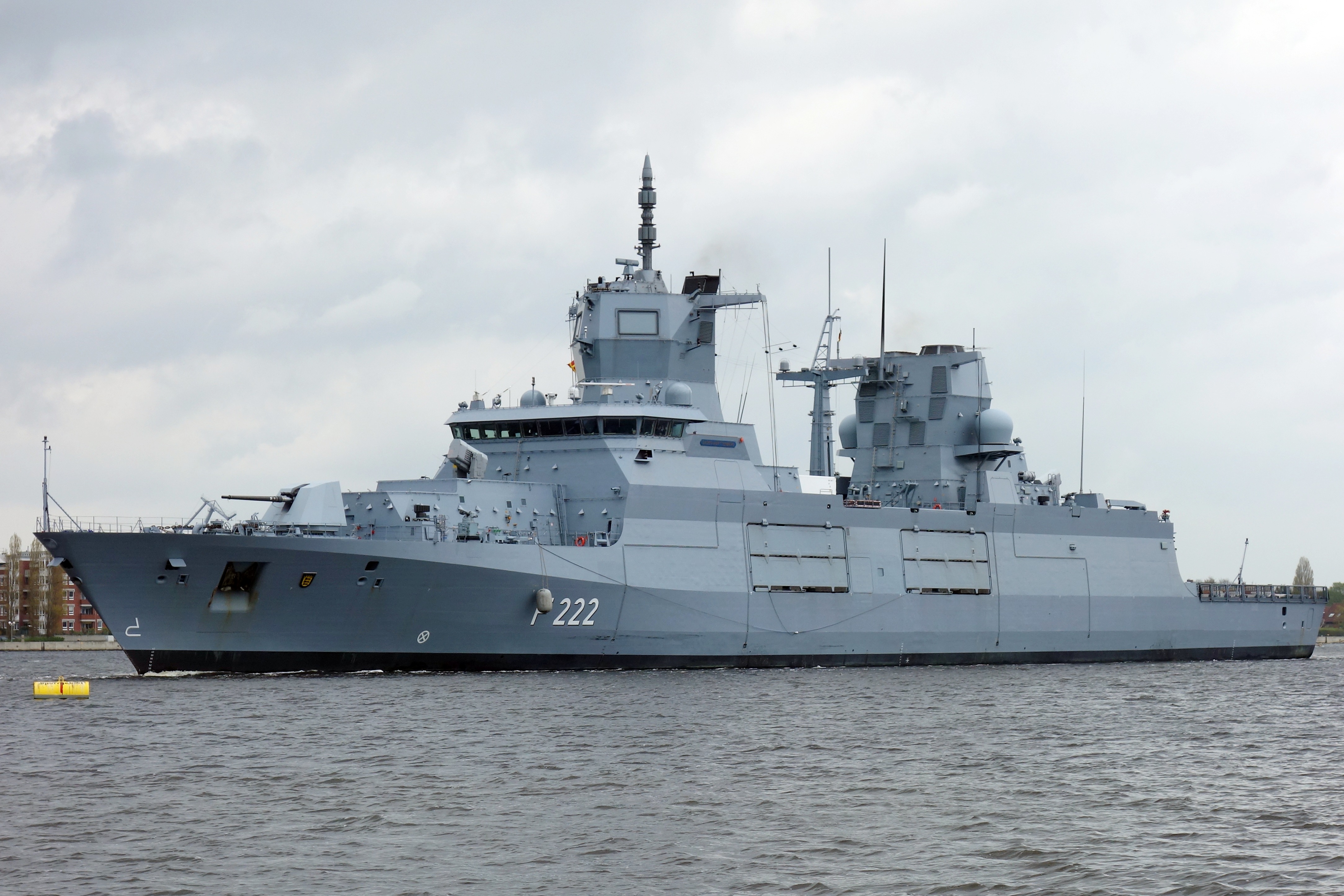
Baden-Württemberg-class frigate
Overview
The Baden-Württemberg-class frigate (F125) represents Germany's controversial attempt to create a "stabilization frigate" optimized for extended low-intensity operations rather than traditional naval warfare. At 7,200 tons, these are among the world's largest frigates, designed around a radical 24-month deployment cycle with crew rotation rather than ship rotation. This ambitious concept aimed to maintain persistent presence in crisis regions while reducing lifecycle costs. The F125's design philosophy prioritizes endurance, modularity, and multi-mission capability over raw firepower. Unlike peer frigates focused on anti-air warfare or ASW, the Baden-Württemberg class emphasizes land-attack capability, maritime security operations, and flexible mission modules. The ships feature extensive automation to operate with reduced crews (126 vs 200+ on comparable frigates) and sophisticated damage control systems for independent operations far from home ports. Development has been plagued by cost overruns (originally €2.9B, final cost ~€3.2B), technical issues, and capability gaps that delayed full operational status until 2023. Most critically, the ships initially lacked meaningful air defense beyond RAM point-defense missiles, making them unsuitable for contested environments. The German Navy's focus on "stabilization operations" reflected post-Cold War strategic assumptions that have proven problematic in today's great power competition era. In the current threat environment, the F125's limitations are stark. While excellent for counter-piracy or humanitarian missions, they lack the air defense, ASW capability, and survivability for high-intensity naval warfare. This has forced Germany to simultaneously develop the more conventional F126 frigate for traditional naval missions, essentially admitting the F125's conceptual limitations. The class represents a fascinating but flawed experiment in naval design philosophy that prioritized presence over lethality.
Deployment Map
Home ports from known hull assignments. Operating areas reflect typical AORs — individual deployments will vary.
Timeline
Specifications
Armament
Swedish anti-ship missile
Only air defense system
Primary gun system for land attack
For asymmetric threats
Limited ASW capability
Doctrine & Employment
Role
Sustained presence and stabilization operations in littoral crisis regions, prioritizing endurance and persistent engagement over high-intensity naval warfare. The F125 exists to project German commitment through continuous deployment cycles rather than episodic naval diplomacy.
Design Philosophy
Prioritized habitability, endurance, and modularity over traditional frigate capabilities, sacrificing magazine depth and high-end sensors for crew comfort and extended deployment capability. The design accepts reduced anti-air and anti-submarine warfare performance in exchange for exceptional seakeeping, comprehensive C4ISR systems, and flexible mission spaces. This represents a fundamental shift from platform-centric to mission-centric naval architecture.
Employment
Deployed individually or in pairs for 24-month rotations with crew swaps every four months, maintaining persistent presence without ship rotation. Typically operates independently in stabilization missions, counter-piracy, or maritime security operations rather than as part of traditional naval task groups. Command structure emphasizes flexibility for extended autonomous operations under national or EU frameworks. The platform serves as a floating base for special operations, humanitarian assistance, and training partnerships with regional navies.
Threat Context
Designed for the post-Cold War security environment emphasizing failed states, piracy, and regional instability rather than peer naval competition. The platform assumed benign air threats and focused on asymmetric challenges, but faces criticism as great power competition returns and Germany's NATO commitments require more traditional naval warfare capabilities.
How to Compare
Compare on deployment endurance, crew rotation capability, and mission flexibility rather than magazine depth or sensor performance - the F125 optimized for persistence over lethality. Evaluate against other nations' approaches to sustained maritime presence: U.S. forward-deployed naval forces, French sovereignty missions, or UK forward presence. Cost-per-day deployed and crew welfare metrics matter more than traditional frigate benchmarks.
Operational Patterns
Typical Deployment
Extended stabilization operations in permissive environments, counter-piracy, maritime security
Deployment Length
24 months
Typical Task Group
Independent operations or with EU/UN task forces
Readiness
Extended deployment cycle limits availability in home waters; complex systems require specialized maintenance
Key Operating Areas
Peer Comparison Matrix
FREMM prioritizes balanced AAW/ASW capability over endurance, conventional deployment cycle, proven design with multiple exports vs F125's experimental approach
Video angle: Traditional vs revolutionary frigate concepts - why Germany's gamble failed
Type 26 emphasizes ASW excellence and modular mission bay but maintains strong combat capability, similar size but different priorities
Video angle: Two approaches to modular frigate design - combat first vs presence first
Russian frigate prioritizes heavy missile armament and air defense over endurance, designed for contested environments vs F125's stabilization focus
Video angle: NATO vs Russian frigate philosophy - presence vs lethality
US frigate based on FREMM design emphasizes combat capability and integration with carrier groups vs F125's independent operations focus
Video angle: Why the US rejected Germany's revolutionary frigate concept
Combat History
Baden-Württemberg deployed to Mediterranean for UN peacekeeping mission off Lebanon coast, demonstrating extended deployment concept
First operational deployment validated 24-month rotation concept but in low-threat environment
Nordrhein-Westfalen conducted counter-piracy operations in Red Sea and Gulf of Aden
Demonstrated capability for maritime security operations but highlighted air defense limitations
Known Vulnerabilities
Air defense
Severely limited air defense with only short-range RAM missiles, making ships vulnerable to aircraft, cruise missiles, and drones
Context: Fatal flaw in contested environments where air superiority cannot be assumed
Mitigation: Planned upgrades under consideration but require major modifications
ASW capability
Minimal anti-submarine warfare capability with basic sonar and limited torpedo armament
Context: Major limitation in Baltic or North Atlantic where submarine threat is significant
Mitigation: Relies on helicopters and other platforms for ASW mission
Over-automation
Heavy reliance on automation with small crew creates vulnerability if systems fail or are compromised
Context: Cyber attacks or battle damage could severely degrade capability
Mitigation: Extensive redundancy built in but crew cannot manually override all systems
Conceptual limitations
Designed for low-intensity operations, fundamentally unsuited for high-end naval warfare
Context: Germany's strategic environment has shifted toward peer competition requiring different capabilities
Mitigation: F126 frigate program addresses these limitations for future vessels
Variants
| Variant | Designation | Years | Count | Status | Key Changes |
|---|---|---|---|---|---|
| F125 Block 1 | F222-F225 | 2019-2023 | 4 | active | Initial production variant with basic air defense suite, modular mission bay, focus on stabilization operations |
Fleet Roster (4)
| Hull | Name | Variant | Commissioned | Home Port | Status |
|---|---|---|---|---|---|
| F222 | Baden-Württemberg | F125 Block 1 | 2019-06-17 | Wilhelmshaven | active |
| F223 | Nordrhein-Westfalen | F125 Block 1 | 2020-05-18 | Wilhelmshaven | active |
| F224 | Sachsen-Anhalt | F125 Block 1 | 2021-12-07 | Wilhelmshaven | active |
| F225 | Rheinland-Pfalz | F125 Block 1 | 2023-06-26 | Wilhelmshaven | active |
Modernization Programmes
Air Defense Upgrade
Potential integration of additional air defense systems beyond RAM, possibly including medium-range SAMs in VLS cells
Impact: Would address critical air defense gap but requires significant modification
Mission Module Development
Development of specialized mission packages for different operations including ASW, MCM, and special forces support
Impact: Enables true multi-mission capability as originally envisioned
Images


Frequently Asked
How many Baden-Württemberg-class frigate are in service?
4 Baden-Württemberg-class frigate are currently in service with German Navy (Deutsche Marine).
When was the first Baden-Württemberg-class frigate commissioned?
The first Baden-Württemberg-class frigate entered service in 2019-06-17.
Who builds the Baden-Württemberg-class frigate?
The Baden-Württemberg-class frigate is built by ThyssenKrupp Marine Systems (TKMS).
How much does a Baden-Württemberg-class frigate cost?
Unit cost is approximately $730M per hull.
Curated Research
essential
Provides comprehensive analysis of modern frigate design philosophies and the trade-offs between traditional naval warfare and stabilization missions.
Critical examination of the F125's controversial design choices and their implications for modern naval warfare doctrine.
recommended
Leading analyst on European naval developments with extensive coverage of F125 program challenges and doctrinal implications.
Analyzes Germany's strategic maritime doctrine and how the F125 fits into broader naval modernization efforts.
Annual assessment of European naval capabilities including critical analysis of Germany's frigate programs.
reference
Comprehensive technical specifications and development timeline for the F125 program.
Official NATO maritime doctrine explaining how stabilization frigates like the F125 integrate with alliance operations.
Watch Baden-Württemberg in Action
Iron Command produces in-depth comparison and analysis videos for military equipment.
Watch on YouTube