
Northrop Grumman B-21 Raider
Overview
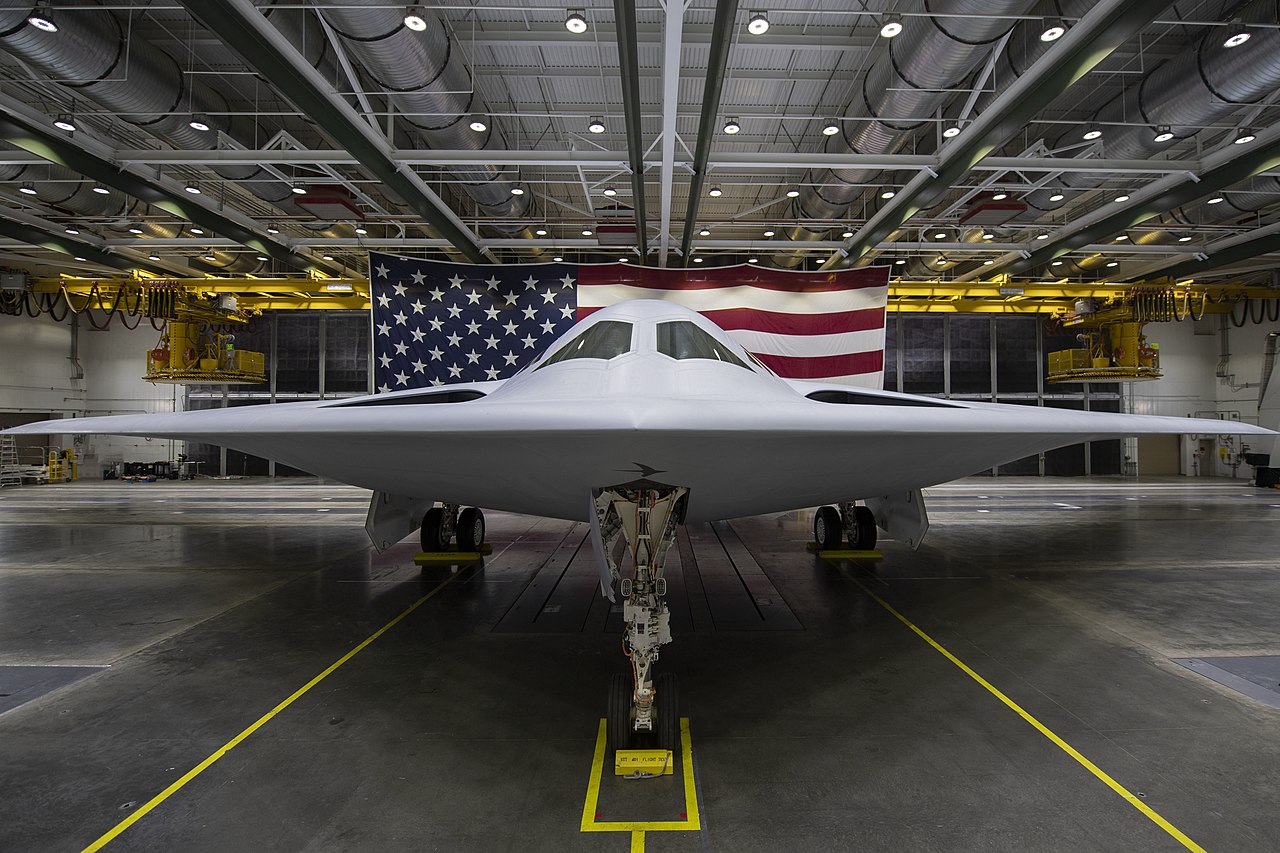
The B-21 Raider represents the United States' next-generation strategic bomber, designed to penetrate advanced air defense networks that have evolved since the B-2 Spirit's development in the 1980s. As the cornerstone of America's future nuclear triad and conventional long-range strike capability, the B-21 incorporates 21st-century stealth technology, open-architecture systems, and advanced manufacturing techniques to maintain air superiority against peer adversaries like China and Russia. The aircraft's design philosophy centers on affordability at scale and technological adaptability—lessons learned from the B-2's $44 billion program cost for just 21 aircraft. Northrop Grumman leveraged existing technologies, digital engineering, and commercial manufacturing practices to create a bomber that can be produced in meaningful quantities while incorporating upgrades throughout its service life. The Air Force plans to procure at least 100 aircraft, with the capability to expand production if strategic requirements demand. In the current threat environment, the B-21 addresses the proliferation of sophisticated integrated air defense systems (IADS) deployed by near-peer competitors. Unlike legacy bombers that rely on standoff weapons or fighter escorts, the Raider is designed to operate unescorted in contested airspace, providing theater commanders with assured access for both nuclear and conventional missions. Its multi-spectral stealth characteristics reportedly exceed the B-2's already formidable signature reduction. Compared to its peers—primarily China's H-20 and Russia's PAK DA—the B-21 benefits from America's substantial investment in stealth technology maturation and operational experience. While specific performance parameters remain classified, the Air Force has indicated the Raider will be capable of global operations without forward basing requirements, addressing the vulnerability of fixed overseas installations in a peer conflict scenario.
Deployment Map
Home ports from known hull assignments. Operating areas reflect typical AORs — individual deployments will vary.
Timeline
Specifications
Armament
Primary nuclear payload
Future nuclear cruise missile
2,000 lb GPS-guided munition
Multi-mode seeker SDB
Stealth cruise missile
Future hypersonic capability
Operational Patterns
Typical Deployment
Strategic deterrence patrols, theater strike missions, ISR operations
Deployment Length
6 months
Typical Task Group
Independent operations or small bomber task force
Readiness
Currently limited by test aircraft availability and pilot training pipeline development
Key Operating Areas
Peer Comparison Matrix
H-20 reportedly optimized for regional operations in Pacific theater with potentially larger payload capacity but less mature stealth technology and global reach capability
Video angle: Next-generation bomber race: comparing stealth philosophies and strategic objectives between superpowers
PAK DA development significantly delayed with unclear stealth capabilities, likely emphasizing standoff weapons over penetrating stealth design
Video angle: Why Russia's next-gen bomber lags behind: resource constraints vs technological ambitions
B-21 incorporates 30 years of stealth technology advancement, designed for affordability and adaptability vs B-2's exquisite but expensive design
Video angle: Evolution of American stealth bombing: what the B-21 learned from B-2's successes and failures
B-52 provides high-capacity standoff strike in permissive environments while B-21 enables penetrating strikes in contested airspace
Video angle: High-low bomber mix: why the Air Force needs both 70-year-old B-52s and cutting-edge B-21s
Combat History
B-21 test aircraft 82-8001 completed maiden flight from Edwards AFB, conducting basic flight envelope testing
Demonstrates program transition from development to flight testing phase, marking major milestone for next-generation bomber capability
Known Vulnerabilities
Production Rate Constraints
Limited to approximately 15 aircraft per year at current production rate, insufficient for rapid force expansion
Context: Peer competitors may achieve numerical superiority in strategic bombers through higher production rates
Mitigation: Air Force exploring production line acceleration and additional manufacturing facilities
Forward Basing Dependence
Despite intercontinental range, extended operations in Pacific theater likely require forward staging from potentially vulnerable bases
Context: China's anti-access capabilities threaten Guam, Japan, and Australia-based operations
Mitigation: Distributed operations concept and hardened facility construction
Multi-Static Radar Detection
Advanced bistatic and multistatic radar networks may degrade stealth effectiveness through cross-section analysis
Context: China and Russia developing networked radar systems specifically designed to counter stealth aircraft
Mitigation: Electronic warfare integration and adaptive stealth materials research
Cyber Attack Surface
Heavy reliance on networked systems and data links creates potential cyber vulnerabilities
Context: Peer adversaries possess sophisticated cyber warfare capabilities targeting military networks
Mitigation: Classified cybersecurity measures and air-gapped critical systems
Variants
| Variant | Designation | Years | Count | Status | Key Changes |
|---|---|---|---|---|---|
| B-21A | B-21A | 2024-present | 2 | building | Initial production variant with baseline avionics suite and stealth configuration |
Fleet Roster (2)
| Hull | Name | Variant | Commissioned | Home Port | Status |
|---|---|---|---|---|---|
| 82-8001 | Spirit of America | B-21A | 2023-12-02 | Edwards AFB, CA | testing |
| 82-8002 | TBD | B-21A | 2024 | Edwards AFB, CA | testing |
Modernization Programmes
Digital Backbone Integration
Integration of Open Mission Systems architecture to enable rapid capability updates and third-party system integration
Impact: Enables continuous capability evolution without major aircraft modifications
Advanced Electronic Warfare Suite
Enhanced EW capabilities to counter emerging threat radar and communication systems
Impact: Maintains stealth advantage against evolving air defense technologies
Hypersonic Weapon Integration
Integration of AGM-183A ARRW and future hypersonic weapons for time-critical targeting
Impact: Provides capability against heavily defended, relocatable targets
Images






Frequently Asked
How many Northrop Grumman B-21 Raider are in service?
2 Northrop Grumman B-21 Raider are currently in service with U.S. Air Force.
When was the first Northrop Grumman B-21 Raider commissioned?
The first Northrop Grumman B-21 Raider entered service in 2024.
Who builds the Northrop Grumman B-21 Raider?
The Northrop Grumman B-21 Raider is built by Northrop Grumman.
How much does a Northrop Grumman B-21 Raider cost?
Unit cost is approximately $2.8B per hull.
Watch Northrop Grumman B-21 Raider in Action
Iron Command produces in-depth comparison and analysis videos for military equipment.
Watch on YouTubeSources