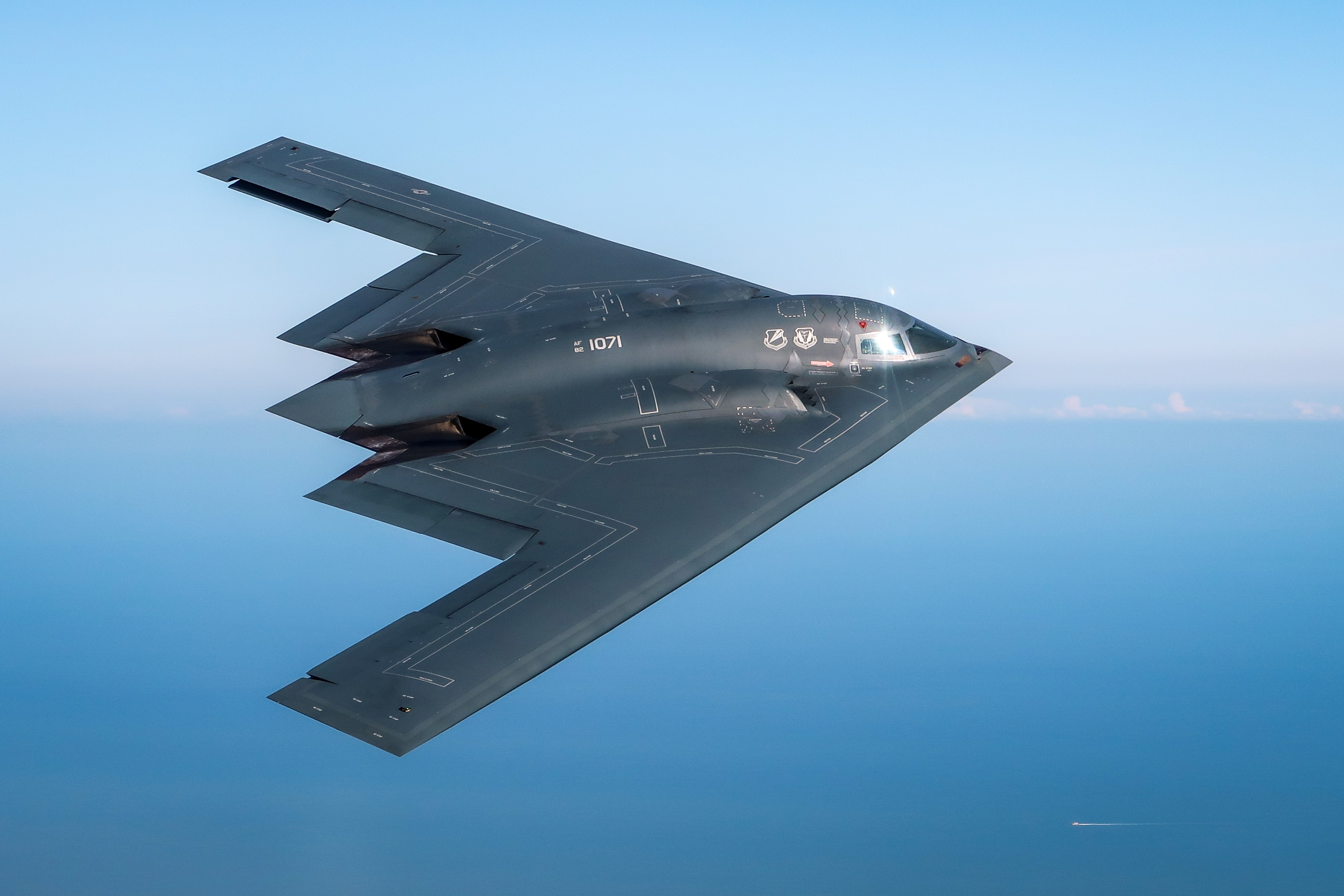
Northrop Grumman B-2 Spirit
Overview
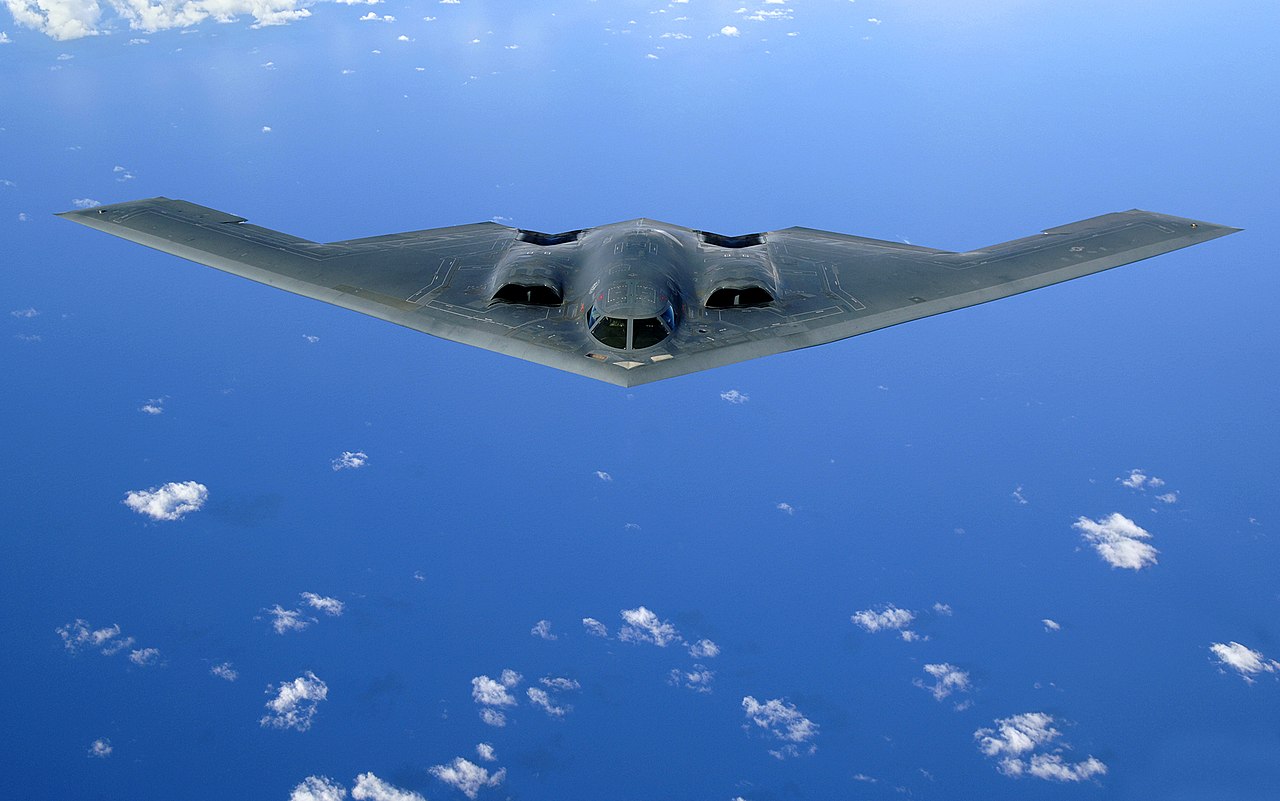
The B-2 Spirit represents the pinnacle of stealth bomber technology, designed during the Cold War to penetrate Soviet air defenses and strike strategic targets with nuclear weapons. Its flying wing design and advanced radar-absorbing materials give it a radar cross-section comparable to a large bird, making it nearly invisible to conventional air defense systems. With only 21 aircraft built due to enormous costs, each B-2 is a strategic asset capable of delivering both conventional and nuclear payloads anywhere in the world. The B-2's strategic role has evolved from nuclear deterrence to global strike missions, demonstrated repeatedly in conflicts from Kosovo to Libya to Afghanistan. Its ability to operate from continental U.S. bases and strike targets globally within hours makes it a unique power projection tool. The aircraft can carry up to 40,000 pounds of ordnance in two internal bays, maintaining stealth characteristics while delivering precision strikes. In the current threat environment, the B-2 faces challenges from advancing air defense systems, particularly low-frequency radars and integrated air defense networks deployed by near-peer adversaries. China's deployment of anti-access/area-denial (A2/AD) systems and Russia's advanced S-400/S-500 SAM networks represent the most serious challenges to B-2 operations since the aircraft's introduction. Compared to peers like Russia's Tu-160 or China's H-20, the B-2 trades raw speed and payload for unmatched stealth and global reach. While the Tu-160 can carry more weapons and fly faster, it lacks stealth capabilities. China's upcoming H-20 appears designed to match B-2 capabilities but remains unproven. The B-2's combination of stealth, range, and precision strike capability remains unique, though the upcoming B-21 Raider will eventually succeed it with more advanced technology and lower operating costs.
Deployment Map
Home ports from known hull assignments. Operating areas reflect typical AORs — individual deployments will vary.
Timeline
Specifications
Armament
Variable yield tactical/strategic nuclear weapons
High-yield strategic nuclear weapons
Retired 2012, nuclear-armed stealth cruise missile
30,000-pound bunker buster bombs
2,000-pound GPS-guided bombs
500-pound GPS-guided bombs
Operational Patterns
Typical Deployment
Global strike missions from Whiteman AFB with forward staging at Guam, Diego Garcia, or allied bases for extended operations
Deployment Length
6 months
Typical Task Group
Usually operates independently or in pairs, supported by KC-135 tanker aircraft for aerial refueling
Readiness
Typically 12-16 aircraft mission-capable at any time due to extensive maintenance requirements. Stealth coating repairs can ground aircraft for weeks.
Key Operating Areas
Peer Comparison Matrix
Tu-160 prioritizes speed (Mach 2.05) and payload (45,000kg) over stealth, uses variable-geometry wings and carries only standoff weapons. B-2 trades speed/payload for stealth and precision.
Video angle: Classic speed vs stealth comparison - which approach better penetrates modern air defenses in 2024?
H-20 appears to copy B-2 flying wing design but likely has less advanced stealth technology and shorter range. Still in development with limited public information available.
Video angle: China's attempt to match B-2 capability - how close can they get to 30-year-old American technology?
B-21 uses more advanced materials and manufacturing for better stealth and lower costs. Smaller payload but more affordable to build and operate in quantity.
Video angle: Old vs new stealth - why the US is replacing the 'irreplaceable' B-2 with a smaller bomber
Completely opposite philosophy - Tu-95 relies on standoff weapons and accepts detection, while B-2 penetrates air defenses. Tu-95 much cheaper but more vulnerable.
Video angle: Penetration vs standoff - two completely different approaches to strategic bombing in the nuclear age
B-1B carries more conventional weapons (84 JDAMs vs 16) and flies faster, but lacks stealth capability. Complementary rather than competing platforms in USAF service.
Video angle: America's bomber duo - when do you send the invisible B-2 vs the weapons truck B-1B?
Combat History
B-2s conducted first combat missions, striking Serbian targets with GPS-guided bombs. Six aircraft flew 49 sorties over 78 days, demonstrating global strike capability with missions flown from Whiteman AFB.
First operational use proved B-2's ability to conduct precision strikes while maintaining stealth, validating the platform's conventional warfare role
B-2s struck Taliban and Al-Qaeda targets in Afghanistan in opening night of war, flying 44-hour round-trip missions from Whiteman AFB with multiple aerial refuelings.
Demonstrated unprecedented global reach and persistence, setting record for longest combat missions in aviation history
B-2s participated in 'shock and awe' campaign, striking Iraqi command and control facilities and strategic targets with precision munitions during opening phase of invasion.
Proved effectiveness against integrated air defense systems and hardened targets in high-threat environment
Three B-2s struck Libyan airfields and aircraft shelters with 2,000-pound bombs in opening strikes against Gaddafi regime, flying from Whiteman AFB.
Demonstrated continued relevance in limited intervention scenarios and ability to rapidly project power globally
B-2s struck ISIS camps in Libya with GBU-38 JDAMs, targeting foreign fighters and terrorist infrastructure in coordinated strikes.
Showed adaptation to counterterrorism missions and precision strike against non-state actors
Spirit of Kansas (82-1071) crashed on takeoff at Andersen AFB, Guam due to moisture in air data sensors. Both crew members ejected safely. Aircraft was total loss.
Only operational loss of B-2, highlighting vulnerability of complex systems to environmental factors and enormous cost of each airframe loss
Known Vulnerabilities
Low-frequency radar detection
B-2's stealth coatings and shaping are optimized against X-band radars. VHF and UHF radars can potentially detect the aircraft at reduced but tactically significant ranges.
Context: China and Russia have deployed long-wavelength radars specifically to counter stealth aircraft, potentially compromising B-2's primary advantage
Mitigation: Route planning to avoid known low-frequency radar sites, electronic warfare support, and development of next-generation B-21 with improved all-aspect stealth
Maintenance complexity and cost
Each B-2 requires 119 hours of maintenance per flight hour, with stealth coating maintenance being particularly demanding. Operating costs exceed $135,000 per flight hour.
Context: High maintenance requirements limit availability and sortie generation rates in sustained operations, while costs restrict training and readiness
Mitigation: Ongoing efforts to reduce maintenance requirements and develop more durable stealth coatings, but fundamental issues remain
Limited quantity and basing
Only 20 operational aircraft concentrated at single base (Whiteman AFB) makes fleet vulnerable to attack or natural disasters. No backup production capability exists.
Context: In peer conflict, losing even one aircraft represents 5% of fleet. Concentration at Whiteman makes entire fleet vulnerable to strike or weather events
Mitigation: Dispersal operations to forward bases, construction of additional hangars, and development of B-21 replacement fleet
Electronic warfare vulnerability
GPS jamming can degrade precision munitions effectiveness. Communications jamming can isolate aircraft from command structure during long-duration missions.
Context: Near-peer adversaries have sophisticated EW capabilities that could degrade B-2's precision strike capability and mission effectiveness
Mitigation: Integration of jam-resistant GPS, backup navigation systems, and enhanced electronic warfare defensive systems
Infrared signature
While radar-stealthy, B-2 has significant infrared signature from engines and aerodynamic heating. Advanced infrared search and track systems pose detection threat.
Context: Modern IRST systems deployed by Russia and China can potentially detect B-2 at operationally significant ranges, especially during afterburner operations
Mitigation: Tactical procedures to minimize IR signature, route planning to avoid IRST coverage, and research into IR signature reduction technologies
Variants
| Variant | Designation | Years | Count | Status | Key Changes |
|---|---|---|---|---|---|
| B-2A Block 10 | 82-1066 to 89-0127 | 1993-1997 | 21 | active | Initial production variant with basic stealth capability and nuclear mission focus |
| B-2A Block 20 | All aircraft upgraded | 1997-2000 | 21 | active | Software upgrades for GPS-guided munitions, improved mission planning systems |
| B-2A Block 30 | All aircraft upgraded | 2000-2010 | 21 | active | Enhanced conventional weapons capability, improved radar modes, JDAM integration |
Fleet Roster (21)
| Hull | Name | Variant | Commissioned | Home Port | Status |
|---|---|---|---|---|---|
| 82-1066 | Spirit of Missouri | B-2A | 1993-12-17 | Whiteman AFB, MO | active |
| 82-1067 | Spirit of Ohio | B-2A | 1994-07-12 | Whiteman AFB, MO | active |
| 82-1068 | Spirit of Florida | B-2A | 1994-11-10 | Whiteman AFB, MO | active |
| 82-1069 | Spirit of Texas | B-2A | 1994-08-19 | Whiteman AFB, MO | active |
| 82-1070 | Spirit of Washington | B-2A | 1994-10-08 | Whiteman AFB, MO | active |
| 82-1071 | Spirit of Kansas | B-2A | 1995-01-15 | Whiteman AFB, MO | destroyed |
| 88-0328 | Spirit of Indiana | B-2A | 1995-05-05 | Whiteman AFB, MO | active |
| 88-0329 | Spirit of South Carolina | B-2A | 1995-05-30 | Whiteman AFB, MO | active |
| 88-0330 | Spirit of California | B-2A | 1995-07-17 | Whiteman AFB, MO | active |
| 88-0331 | Spirit of Nebraska | B-2A | 1995-08-26 | Whiteman AFB, MO | active |
| 88-0332 | Spirit of Georgia | B-2A | 1995-11-19 | Whiteman AFB, MO | active |
| 89-0127 | Spirit of Pennsylvania | B-2A | 1995-12-23 | Whiteman AFB, MO | active |
| 89-0128 | Spirit of Michigan | B-2A | 1996-03-03 | Whiteman AFB, MO | active |
| 89-0129 | Spirit of New York | B-2A | 1996-05-11 | Whiteman AFB, MO | active |
| 90-0040 | Spirit of Alaska | B-2A | 1996-08-30 | Whiteman AFB, MO | active |
| 90-0041 | Spirit of Hawaii | B-2A | 1996-11-15 | Whiteman AFB, MO | active |
| 93-1085 | Spirit of Louisiana | B-2A | 1997-02-14 | Whiteman AFB, MO | active |
| 93-1086 | Spirit of Mississippi | B-2A | 1997-05-23 | Whiteman AFB, MO | active |
| 93-1087 | Spirit of Oklahoma | B-2A | 1997-07-15 | Whiteman AFB, MO | active |
| 93-1088 | Spirit of Kitty Hawk | B-2A | 1997-08-30 | Whiteman AFB, MO | active |
| 93-1089 | Spirit of America | B-2A | 1997-11-08 | Whiteman AFB, MO | active |
Modernization Programmes
Defensive Management System (DMS)
Installation of radar warning receivers and defensive avionics to detect and counter emerging air defense threats. Includes threat warning displays and countermeasures dispensing systems.
Impact: Enhanced survivability against modern integrated air defense systems, particularly important as stealth advantage erodes
Flexible Strike Package
Integration of GBU-57 Massive Ordnance Penetrator (MOP) capability for deep underground bunker targets. Required structural modifications to bomb bay and software upgrades.
Impact: Provides unique capability against hardened and deeply buried targets, particularly relevant for Iran and North Korea scenarios
Common Very Low Frequency (CVLF) Receiver
Installation of new communication systems for receiving Emergency Action Messages and maintaining nuclear command authority connectivity during stealth operations.
Impact: Ensures nuclear mission viability and command connectivity while maintaining low electromagnetic signature
Radar Modernization Program (RMP)
Upgrade of APQ-181 radar with new processors, synthetic aperture radar modes, and improved ground mapping capabilities. Includes electronic warfare improvements.
Impact: Extends radar service life and improves ground target identification and engagement capabilities against modern threats
Engine Replacement Program (ERP)
Potential replacement of F118 engines with more fuel-efficient variants to extend range and reduce maintenance costs. Currently in feasibility study phase.
Impact: Would extend operational range and reduce logistics footprint, critical for Pacific theater operations
Images




Frequently Asked
How many Northrop Grumman B-2 Spirit are in service?
20 Northrop Grumman B-2 Spirit are currently in service with United States Air Force.
When was the first Northrop Grumman B-2 Spirit commissioned?
The first Northrop Grumman B-2 Spirit entered service in 1993-12-17.
Who builds the Northrop Grumman B-2 Spirit?
The Northrop Grumman B-2 Spirit is built by Northrop Grumman.
What variants of the Northrop Grumman B-2 Spirit exist?
Known variants include: B-2A Block 10, B-2A Block 20, B-2A Block 30.
How much does a Northrop Grumman B-2 Spirit cost?
Unit cost is approximately $2.2B per hull.
Watch Northrop Grumman B-2 Spirit in Action
Iron Command produces in-depth comparison and analysis videos for military equipment.
Watch on YouTube