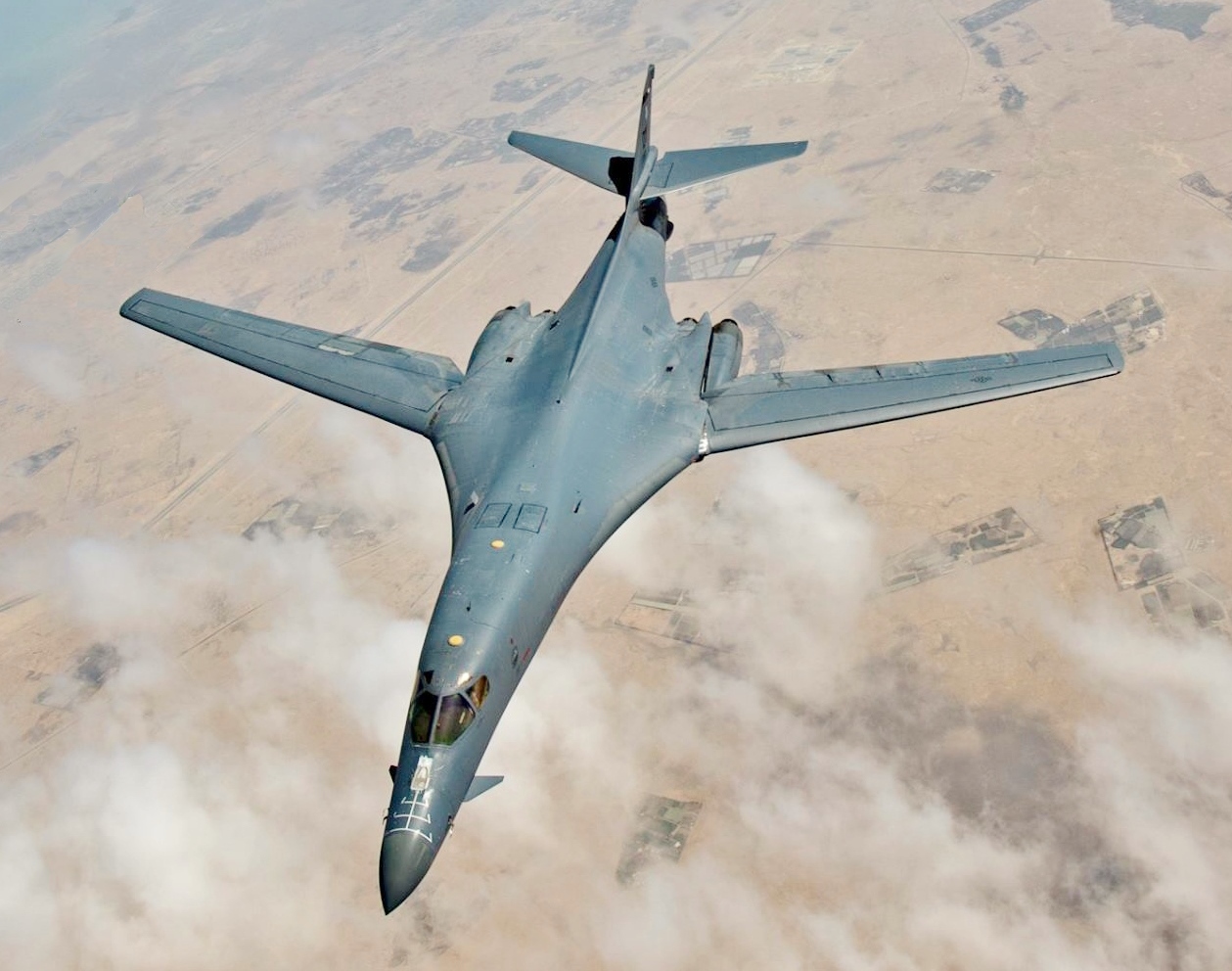
Rockwell B-1B Lancer
Overview
The B-1B Lancer is a supersonic variable-sweep wing strategic bomber that represents America's conventional strike workhorse and a critical component of the nuclear triad. Originally conceived during the Cold War as a nuclear penetrator designed to slip under Soviet radar coverage, the Lancer evolved into the backbone of U.S. long-range precision strike operations following extensive conventional weapons integration in the 1990s. The B-1B's design philosophy centers on speed, payload capacity, and survivability through low-level penetration. Its variable-geometry wings allow for efficient high-altitude cruise and high-speed, low-altitude ingress, while radar-absorbent materials and careful shaping reduce its radar cross-section to roughly that of a fighter aircraft despite its massive size. With the largest conventional payload of any U.S. bomber at 75,000 pounds, the Lancer can deliver more precision-guided munitions in a single sortie than an entire squadron of tactical fighters. In the current threat environment, the B-1B serves as America's primary theater strike asset, capable of providing rapid response to emerging crises and sustained bombardment operations. Its combination of speed (Mach 1.25+ at altitude), range (5,500+ nautical miles unrefueled), and massive payload makes it uniquely suited for high-intensity conventional conflicts where large numbers of targets must be serviced quickly. Compared to its strategic bomber peers, the B-1B occupies a unique niche. While the B-2 Spirit excels in contested airspace penetration and the B-52 Stratofortress dominates in permissive environments and standoff strike, the Lancer bridges the gap with moderate stealth characteristics, high speed, and unmatched conventional payload capacity. However, its complexity and maintenance requirements have proven challenging, with availability rates often below 60% limiting its operational impact despite its impressive theoretical capabilities.
Deployment Map
Home ports from known hull assignments. Operating areas reflect typical AORs — individual deployments will vary.
Timeline
Specifications
Armament
Primary standoff weapon
Extended range variant
Being phased out
2000 lb GPS-guided
500 lb GPS-guided
GPS/laser guidance
Wind-corrected dispenser
Strategic nuclear role (rarely loaded)
Operational Patterns
Typical Deployment
Rotational deployments to forward bases (Qatar, Diego Garcia, Guam) for theater strike missions
Deployment Length
6 months
Typical Task Group
Operates independently or with minimal escort, relies on standoff weapons and route planning
Readiness
Chronic maintenance challenges limit surge capacity; typically 35-45 aircraft mission capable at any time
Key Operating Areas
Peer Comparison Matrix
Tu-160 is faster (Mach 2+) and longer-ranged but carries fewer precision weapons and has limited conventional capability compared to B-1B's massive JDAM capacity
Video angle: Cold War titans compared: speed vs. precision strike capacity in modern warfare
H-6K focuses on standoff cruise missiles and anti-ship missions while B-1B excels in penetrating strike with large conventional payloads
Video angle: Pacific bomber face-off: China's cruise missile truck vs. America's penetrating striker
B-52 has longer range and lower operating costs but B-1B delivers larger payloads faster with better survivability in medium-threat environments
Video angle: USAF bomber showdown: payload king vs. endurance champion
B-2 penetrates advanced air defenses with stealth but B-1B carries 3x the conventional payload at much lower per-flight cost
Video angle: America's strategic bombers: stealth vs. brute force approaches to target destruction
Similar low-level penetration design but Tornado is tactical-range while B-1B provides strategic reach with massive payload advantage
Video angle: Variable-sweep warriors: tactical vs. strategic applications of swing-wing design
Combat History
B-1Bs conducted first combat missions, launching AGM-86C CALCMs against Iraqi targets during four-day bombing campaign
Combat debut demonstrated conventional strike capability and validated years of modification work
B-1Bs flew missions over Kosovo, delivering JDAM and conventional bombs against Serbian forces
First sustained combat deployment, proving long-range precision strike capability in European theater
B-1Bs became primary close air support platform in Afghanistan, dropping 40% of all coalition munitions despite being <5% of aircraft
Redefined role from strategic bomber to tactical CAS platform, demonstrating flexibility and massive payload advantage
B-1Bs conducted opening night strikes and sustained operations, delivering precision munitions against Iraqi Republican Guard and infrastructure
Validated high-intensity conventional warfare capabilities in contested environment
B-1Bs began operations against ISIS in Iraq and Syria, conducting over 3,700 sorties and dropping over 17,500 munitions
Demonstrated sustained deployment capability and effectiveness against distributed targets
B-1B dropped GBU-43/B MOAB (Mother of All Bombs) on ISIS tunnel complex in Afghanistan
First combat use of largest non-nuclear bomb, showcasing unique heavy payload delivery capability
Known Vulnerabilities
Maintenance complexity
Variable-sweep wing mechanisms and complex avionics result in mission capable rates often below 60%, limiting operational availability
Context: High maintenance requirements reduce surge capability and increase operational costs in budget-constrained environment
Mitigation: Sustainment programs focus on reliability improvements and parts availability
Survivability in contested airspace
Limited stealth characteristics and large size make it vulnerable to modern integrated air defense systems
Context: Peer competitors like Russia and China field advanced SAM systems that can detect and engage B-1Bs at standoff ranges
Mitigation: Shift to standoff weapons like JASSM-ER and future hypersonic missiles to avoid SAM engagement zones
Electronic warfare susceptibility
Aging defensive systems struggle against modern jamming and cyber threats
Context: GPS jamming and datalink disruption could severely degrade precision strike capability
Mitigation: Planned avionics upgrades include improved EW systems and alternative navigation capabilities
Aircrew fatigue
Long-duration missions up to 24+ hours strain four-person crews without relief capability
Context: Sustained operations in CENTCOM have pushed crews to limits, affecting safety and effectiveness
Mitigation: Mission planning emphasizes crew rest and tanker scheduling to minimize fatigue factors
Variants
| Variant | Designation | Years | Count | Status | Key Changes |
|---|---|---|---|---|---|
| B-1A | 74-0158 to 74-0161 | 1974-1981 | 4 | retired | Original supersonic nuclear penetrator with Mach 2+ capability and escape pods |
| B-1B Block 0 | 84-0001 to 85-0063 | 1985-1988 | 100 | active | Reduced RCS, conventional capability, fixed air intakes limiting speed to Mach 1.25 |
Fleet Roster (2)
| Hull | Name | Variant | Commissioned | Home Port | Status |
|---|---|---|---|---|---|
| 86-0109 | B-1B #1 | Block 0 | 1986-06-29 | Ellsworth AFB, SD | active |
| Various | 62 aircraft remaining | Block 0 | 1986-1988 | Ellsworth AFB, SD / Dyess AFB, TX | active |
Modernization Programmes
Integrated Battle Station (IBS)
Upgraded avionics, displays, and mission systems with modern computing architecture and Link-16 datalink capability
Impact: Improved situational awareness and interoperability with joint forces
Sustainment Block 16
Engine modifications, structural repairs, and reliability improvements to extend service life
Impact: Addressed critical maintenance issues and improved mission capable rates
B-1B Offensive Avionics System
Radar upgrades, improved electronic warfare systems, and enhanced targeting capabilities for contested environments
Impact: Maintains relevance against peer competitors with advanced air defenses
LRSO Integration
Integration of Long Range Standoff weapon to replace aging nuclear cruise missiles
Impact: Modernizes nuclear deterrent capability for next-generation threats
Hypersonic Weapon Integration
Modification to carry AGM-183A ARRW hypersonic missiles externally
Impact: Provides time-critical target engagement capability against heavily defended targets
Images


Frequently Asked
How many Rockwell B-1B Lancer are in service?
2 Rockwell B-1B Lancer are currently in service with U.S. Air Force.
When was the first Rockwell B-1B Lancer commissioned?
The first Rockwell B-1B Lancer entered service in 1986-10-01.
Who builds the Rockwell B-1B Lancer?
The Rockwell B-1B Lancer is built by Rockwell International (now Boeing).
What variants of the Rockwell B-1B Lancer exist?
Known variants include: B-1A, B-1B Block 0.
How much does a Rockwell B-1B Lancer cost?
Unit cost is approximately $283M per hull.
Watch Rockwell B-1B Lancer in Action
Iron Command produces in-depth comparison and analysis videos for military equipment.
Watch on YouTube