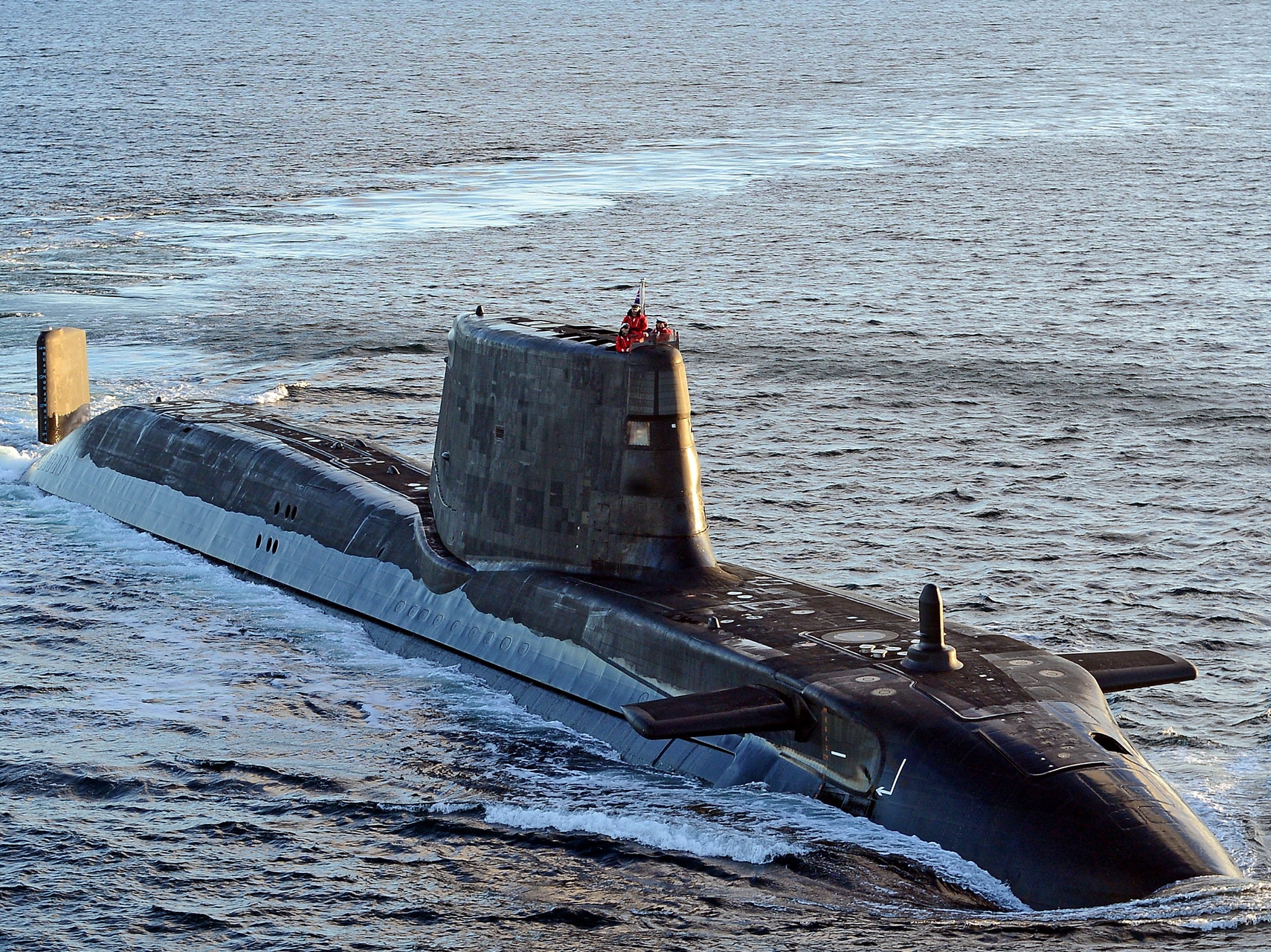
Astute-class submarine
Compare with
Overview
The Astute-class represents the Royal Navy's most advanced nuclear attack submarine capability and arguably the world's most sophisticated conventionally-armed SSN. These boats combine cutting-edge sonar technology, nuclear propulsion that never requires refueling, and a weapons loadout optimized for both anti-submarine warfare and land attack missions. The class was designed to maintain Britain's undersea dominance in an era of resurgent submarine threats from Russia and China's expanding naval capabilities. Strategically, the Astute-class serves as the backbone of the Royal Navy's submarine force, filling the critical gap between ballistic missile submarines and surface combatants. Their primary missions include intelligence gathering, special forces insertion, anti-submarine warfare in the GIUK gap, and precision strike capabilities via Tomahawk cruise missiles. The boats feature a revolutionary sonar suite that can reportedly detect ships leaving port in New York from a position south of the English Channel. The design philosophy emphasizes stealth, endurance, and multi-mission capability over raw firepower. Unlike American Virginia-class boats with their large VLS sections, Astute-class submarines rely on torpedo tube-launched weapons, including the Tomahawk Block IV. This approach prioritizes acoustic signature reduction and operational flexibility. The class incorporates pump-jet propulsion for reduced noise signature and advanced reactor design providing 25+ year core life. In the current threat environment, Astute-class submarines provide the UK with a credible deterrent against submarine threats in the North Atlantic while maintaining power projection capabilities globally. Compared to peers like the Virginia-class or Yasen-class, the Astute offers superior sonar performance and stealth characteristics but carries fewer weapons and lacks dedicated VLS cells. The class represents Britain's commitment to maintaining a world-class submarine capability despite budget constraints and industrial challenges that have plagued the program.
Deployment Map
Home ports from known hull assignments. Operating areas reflect typical AORs — individual deployments will vary.
Timeline
Specifications
Armament
Launched from torpedo tubes
Wire-guided with 300kg warhead
For anti-submarine warfare
Doctrine & Employment
Role
Multi-domain power projection and sea control, maintaining Britain's ability to conduct independent submarine operations globally while supporting NATO collective defence in the GIUK gap and other critical chokepoints.
Design Philosophy
Prioritized acoustic stealth and sensor superiority over speed and weapons capacity, accepting a smaller magazine (38 weapons vs 48+ on Virginia-class) in exchange for the world's most advanced sonar suite and minimal acoustic signature. The design emphasized endurance and crew habitability for extended solo deployments, sacrificing some automation for proven reliability in critical systems.
Employment
Typically deployed on extended solo patrols lasting 3-4 months, conducting intelligence gathering, anti-submarine warfare, and maintaining continuous at-sea deterrent presence. Operates independently or in coordination with surface task groups, with command relationships flowing through Fleet Command Northwood to national leadership. Mission profiles emphasize covert operations, strategic reconnaissance, and the ability to strike high-value land targets with Tomahawk missiles in crisis escalation scenarios.
Threat Context
Designed during the 2000s to counter improved Russian submarines in the North Atlantic while maintaining overmatch against potential adversaries globally. The threat environment has intensified since initial design with Russian submarine resurgence, Chinese naval expansion into global waters, and increased emphasis on submarine-launched land attack capabilities in hybrid warfare scenarios.
How to Compare
Compare primarily on acoustic signature and sonar performance rather than magazine capacity or speed—all modern SSNs achieve similar tactical speeds. Focus on sensor range, signature management, and endurance as key differentiators, with weapons flexibility (torpedo vs cruise missile loadout) as a secondary consideration.
Operational Patterns
Typical Deployment
Independent patrols in North Atlantic, Mediterranean, and increasingly Indo-Pacific regions. Often operates in support of CSG deployments.
Deployment Length
6 months
Typical Task Group
Usually operates independently, occasionally with CSG or as part of multinational submarine exercises
Readiness
Availability rates have been impacted by industrial delays and complex maintenance requirements for advanced systems
Key Operating Areas
Peer Comparison Matrix
Virginia-class has 12 VLS cells providing greater weapons capacity and mission flexibility, but Astute arguably has superior sonar performance and stealth characteristics. Virginia-class has better industrial production rate.
Video angle: Anglo-American submarine design philosophy differences - VLS vs torpedo tube launched weapons
Yasen-class carries significantly more weapons (32 VLS cells plus torpedoes) and has higher surface/submerged speed, but likely inferior sonar and stealth characteristics. Russian industrial challenges limit production.
Video angle: Western vs Russian submarine design priorities - stealth vs firepower
Chinese boats likely inferior in sonar, stealth, and reactor technology but being produced in larger numbers. Significant capability gap but China rapidly improving design and industrial capacity.
Video angle: Quality vs quantity in submarine warfare - British expertise vs Chinese industrial capacity
French boats smaller with pump-jet propulsion like Astute but carry fewer weapons and have less advanced sonar. Both programs experienced similar industrial challenges and delays.
Video angle: European submarine programs comparison - shared challenges and different solutions
Conventional submarine with AIP but excellent stealth characteristics and advanced sonar. Limited by battery endurance but potentially quieter than nuclear boats in littoral operations.
Video angle: Nuclear vs conventional submarines in modern warfare - endurance vs stealth trade-offs
Combat History
HMS Astute conducted surveillance operations off Libya during NATO intervention, providing intelligence on coastal defenses and naval movements.
First operational deployment demonstrated boat's intelligence gathering capabilities in contested waters
HMS Astute ran aground off the Isle of Skye during sea trials, requiring tug assistance and causing significant embarrassment to the Royal Navy.
Highlighted training and operational challenges with the new class, leading to revised procedures
HMS Ambush fired Tomahawk missiles at Syrian chemical weapons facilities as part of coordinated strikes with US and French forces.
First combat use of Tomahawk from Astute-class, validating land attack capability
HMS Artful conducted extended patrol in South China Sea and Indo-Pacific region as part of CSG21 deployment.
Demonstrated global reach and ability to operate in contested regions far from home waters
Known Vulnerabilities
Industrial delivery schedule
Significant delays and cost overruns in construction program, with boats delivered years behind schedule and billions over budget.
Context: Limits Royal Navy's ability to maintain adequate SSN force levels as older boats retire
Mitigation: Improved project management and industrial base investment, but fundamental issues remain
Weapons capacity limitation
Only 38 weapons total capacity with no dedicated VLS cells limits sustained combat capability compared to competitors.
Context: In high-intensity conflict, limited magazine depth reduces operational persistence and mission flexibility
Mitigation: None planned - fundamental design constraint that cannot be easily addressed
Single reactor design risk
Any reactor design flaw affects entire class, and PWR2 reactor has experienced some technical challenges.
Context: Could potentially ground entire fleet if serious reactor issues emerge, as seen with other single-design fleets
Mitigation: Extensive testing and quality control, but risk remains inherent to single-design approach
Variants
| Variant | Designation | Years | Count | Status | Key Changes |
|---|---|---|---|---|---|
| Astute-class Batch 1 | S119-S121 | 2010-2016 | 3 | active | Initial production standard with Thales 2076 sonar and SUBTICS combat system |
| Astute-class Batch 2 | S122-S125 | 2017-2025 | 4 | building | Enhanced communications systems, improved combat management software, updated sensor processing |
Fleet Roster (7)
| Hull | Name | Variant | Commissioned | Home Port | Status |
|---|---|---|---|---|---|
| S119 | HMS Astute | Batch 1 | 2010-08-27 | Faslane | active |
| S120 | HMS Ambush | Batch 1 | 2013-03-01 | Faslane | active |
| S121 | HMS Artful | Batch 1 | 2016-03-18 | Faslane | active |
| S122 | HMS Audacious | Batch 2 | 2020-04-23 | Faslane | active |
| S123 | HMS Anson | Batch 2 | 2022-08-25 | Faslane | active |
| S124 | HMS Agamemnon | Batch 2 | 2024-01-01 | Faslane | fitting out |
| S125 | HMS Ajax | Batch 2 | 2025-01-01 | Faslane | building |
Modernization Programmes
Combat System Upgrade
Upgrading SUBTICS combat management system software, enhanced sensor processing, and improved communications systems across the class.
Impact: Enhanced target tracking, improved data fusion, and better integration with joint forces
Tomahawk Block V Integration
Integration of advanced Tomahawk Block V with enhanced range and multi-mission capabilities.
Impact: Extends land attack range and provides maritime strike capability against moving targets
Sonar Processing Enhancement
Software upgrades to Thales 2076 sonar system incorporating AI-assisted target classification and tracking algorithms.
Impact: Improved detection range and classification accuracy, reduced operator workload
Images


Recent News
Frequently Asked
How many Astute-class submarine are in service?
5 Astute-class submarine are currently in service with Royal Navy, with 1 under construction.
When was the first Astute-class submarine commissioned?
The first Astute-class submarine entered service in 2010-08-27.
Who builds the Astute-class submarine?
The Astute-class submarine is built by BAE Systems Submarines.
What variants of the Astute-class submarine exist?
Known variants include: Astute-class Batch 1, Astute-class Batch 2.
How much does a Astute-class submarine cost?
Unit cost is approximately $2.1B per hull.
Curated Research
essential
RUSI consistently provides the most authoritative analysis of Royal Navy submarine doctrine and capability development from British perspectives.
Official UK doctrinal publication explaining how submarine capabilities integrate with broader British defence strategy and multi-domain operations.
RUSI analysis of how British submarine capabilities must evolve to meet emerging threats in contested undersea environments.
recommended
Friedman's analysis of British naval design philosophy provides essential context for understanding Royal Navy procurement decisions and operational requirements.
O'Rourke's CRS reports provide comparative context for understanding how Astute-class capabilities compare to allied submarine programs.
CSBA analysis contextualizes British submarine capabilities within broader nuclear strategy and alliance frameworks.
reference
Comprehensive technical specifications and program timeline for the Astute-class development and deployment.
Watch Astute in Action
Iron Command produces in-depth comparison and analysis videos for military equipment.
Watch on YouTubeSources