
Arleigh Burke-class guided missile destroyer
Compare with
Iron Command Video Analysis
Arleigh Burke vs Type 055 — Which Destroyer Actually Wins?
Overview
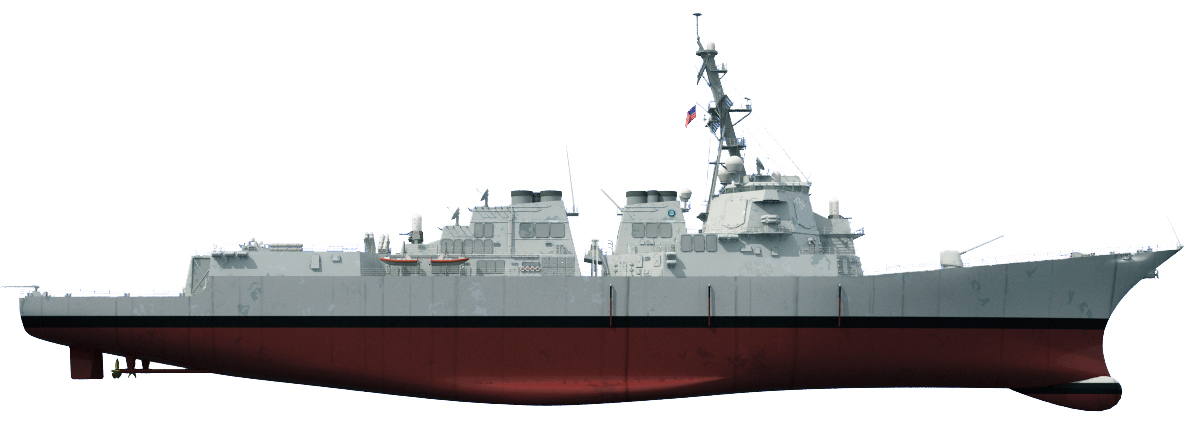
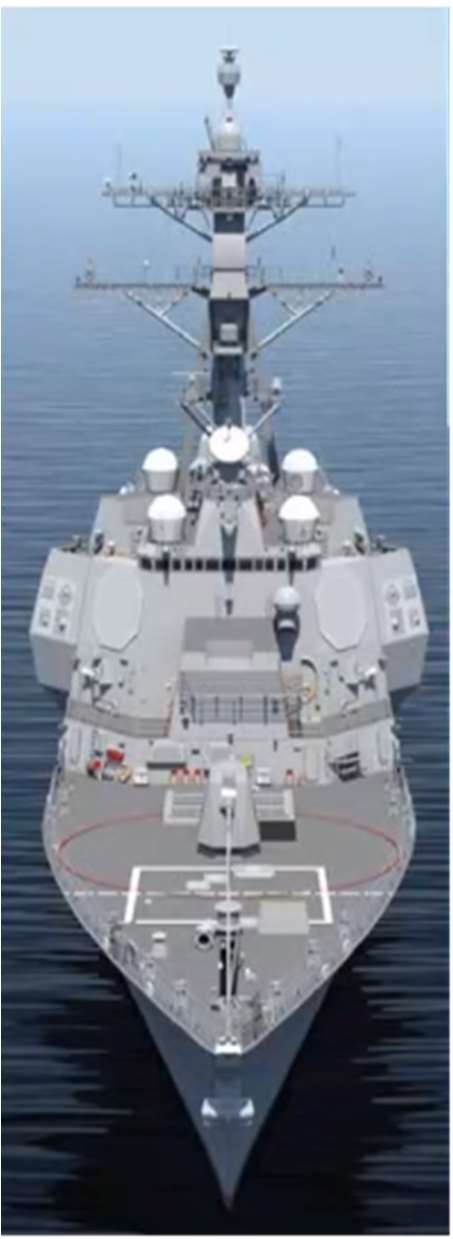
The Arleigh Burke-class destroyer represents the backbone of US Navy surface combatant power, with 73 ships commissioned and more building. Built around the Aegis Combat System, these destroyers serve as multi-mission platforms capable of anti-air warfare (AAW), ballistic missile defense (BMD), anti-submarine warfare (ASW), and land attack missions. The class emerged from the need to replace aging destroyers while providing organic air defense for carrier strike groups and independent operations. Strategically, the Burke class fills the critical gap between smaller frigates and larger cruisers, offering significant firepower in a more affordable package. The design philosophy emphasizes survivability through redundancy, stealth shaping, and advanced damage control systems. Each destroyer carries 90-96 Mk 41 VLS cells capable of launching Tomahawk cruise missiles, SM-2/3/6 surface-to-air missiles, and ASROC anti-submarine rockets, making them among the most versatile combatants afloat. In today's threat environment, Burke-class destroyers are increasingly tasked with ballistic missile defense missions, particularly in the Western Pacific and European theaters. The latest Flight III variant introduces the AN/SPY-6(V)1 radar, dramatically improving air and missile defense capabilities against advanced threats like hypersonic weapons and swarming drone attacks. Compared to international peers like China's Type 055 or Britain's Type 45, the Burke class sacrifices some individual platform capability for numbers and proven reliability. While newer designs may feature larger VLS loads or more advanced propulsion, the Burke's combat-proven Aegis system and extensive operational experience provide significant advantages in actual conflict scenarios.
Deployment Map
Home ports from known hull assignments. Operating areas reflect typical AORs — individual deployments will vary.
Timeline
Specifications
Armament
Can launch Tomahawk, SM-2/3/6, ESSM, ASROC
Primary surface gun, 20 rounds/minute
Last-line missile defense
Anti-submarine warfare
Doctrine & Employment
Role
Fleet air defense and distributed lethality within contested maritime environments, serving as the primary multi-mission combatant for both carrier strike group escort and independent surface action group operations.
Design Philosophy
Prioritized magazine depth and Aegis integration over traditional destroyer attributes like speed and helicopter facilities. The design sacrificed a second helicopter hangar, reduced accommodations quality, and accepted 30-knot speed to maximize the 90-96 cell Mk 41 VLS capacity and ensure robust air defense radar performance in high sea states.
Employment
Typically deployed as part of carrier strike groups providing area air defense, or in surface action groups of 2-4 destroyers for distributed maritime operations. Standard loadouts vary by mission: heavy SM-2/SM-6 for air defense, balanced loads for multi-mission, or Tomahawk-heavy for land attack. Burke-class destroyers operate under tactical control of strike group commanders but maintain significant independent capability for distributed operations across multiple threat axes.
Threat Context
Originally designed for Cold War fleet air defense against Soviet bomber-launched anti-ship missiles, the class has evolved to address ballistic missile threats, distributed anti-ship missile attacks, and near-peer surface combatants. The threat environment now emphasizes longer-range precision strikes and multi-domain operations rather than the massed air attacks the Aegis system was optimized to counter.
How to Compare
Compare primarily on VLS cell count, radar performance, and magazine flexibility rather than traditional metrics like speed or gun armament. Both Chinese and European designers have accepted similar speed limitations, making sensor range, missile inventory depth, and combat system integration the key differentiators for modern surface combatants.
Operational Patterns
Typical Deployment
Carrier Strike Group escort, independent BMD patrols, freedom of navigation operations
Deployment Length
7 months
Typical Task Group
Usually 1-2 destroyers per CSG, or independent surface action groups
Readiness
Maintenance backlog issues affecting some hulls, training pipeline stress limiting availability
Key Operating Areas
Peer Comparison Matrix
Type 055 is larger (13,000t) with 112 VLS cells and dual-band radar, but lacks combat experience. Burke has proven Aegis system and extensive operational history.
Video angle: David vs Goliath: Experience vs Raw Capability - can proven systems overcome numerical disadvantages?
Type 45 has superior SAMPSON/PAAMS air defense but lacks land-attack capability and VLS flexibility. Burke trades some AAW performance for multi-mission capability.
Video angle: Specialist vs Generalist: Should modern destroyers optimize for one mission or maintain flexibility?
Enlarged Burke design (11,000t) with 128 VLS cells and Korean modifications. Shows evolution path for Burke concept with larger magazine.
Video angle: Student surpasses teacher? How allies improved on American designs
Smaller (7,000t) with focus on area air defense using PAAMS system. Less VLS capacity (48 cells) but different operational concept.
Video angle: National philosophies in warship design: American quantity vs European sophistication
Smaller (5,000t) frigate with advanced weapons including Zircon hypersonics. Trades magazine depth for individual weapon lethality.
Video angle: Quantity vs Quality: Large magazines vs hypersonic weapons - which wins?
Combat History
USS Laboon (DDG-58) and USS Shiloh launched 27 Tomahawk missiles at Iraqi air defense targets
First operational Tomahawk strikes by Burke-class, proving land-attack capability
USS Gonzalez (DDG-66) and USS The Sullivans (DDG-68) conducted sustained Tomahawk strikes against Yugoslav targets
Demonstrated sustained combat operations and VLS reload procedures
Multiple Burke-class destroyers launched opening Tomahawk salvos against Taliban and Al-Qaeda targets in Afghanistan
Showcased rapid deployment and precision strike capabilities
USS Fitzgerald (DDG-62) collided with merchant vessel ACX Crystal off Japan, killing 7 sailors
Exposed training and watchstanding deficiencies, led to major surface force reforms
USS John S. McCain (DDG-56) collided with merchant tanker Alnic MC near Singapore, killing 10 sailors
Second major collision highlighted systemic surface warfare training issues
USS Carney (DDG-64) intercepted multiple Iranian-backed Houthi missiles and drones in Red Sea
First large-scale combat air defense operations, proved modern Aegis effectiveness
Multiple Burke-class destroyers conducted Tomahawk strikes against Houthi missile sites in Yemen
Latest operational validation of precision strike capability against defended targets
Known Vulnerabilities
Manning and Training
Chronic understaffing and reduced training time leading to basic seamanship failures
Context: Multiple collisions and groundings demonstrate fundamental watchstanding breakdowns
Mitigation: Surface Warfare Officer School redesign, increased manning levels, extended training periods
Electronic Warfare
AN/SLQ-32(V)3 EW suite increasingly obsolete against modern jamming and spoofing
Context: Russian and Chinese EW capabilities can potentially degrade Aegis tracking and engagement
Mitigation: Next Generation Jammer integration and EW suite upgrades planned
Magazine Depth
96 VLS cells insufficient for sustained high-intensity combat without underway replenishment
Context: Peer competitors like Type 055 carry 112+ cells, limiting engagement capacity
Mitigation: No structural solution available; operational planning must account for reload requirements
Power Generation
Flight I/II/IIA lack sufficient electrical power for future directed-energy weapons
Context: Modern threats require high-power defensive systems that exceed current generation capacity
Mitigation: Flight III addresses this; backfit options limited for existing ships
Variants
| Variant | Designation | Years | Count | Status | Key Changes |
|---|---|---|---|---|---|
| Flight I | DDG-51 to DDG-71 | 1991-1999 | 21 | active | Initial production variant with AN/SPY-1D radar, basic Aegis baseline |
| Flight II | DDG-72 to DDG-78 | 1999-2001 | 7 | active | Minor improvements, better electronics cooling, upgraded Aegis baseline |
| Flight IIA | DDG-79 to DDG-124+ | 2000-present | 45 | active | Helicopter hangar and flight deck, AN/SPY-1D(V) radar, improved ASW capability |
| Flight III | DDG-125 to DDG-155+ | 2023-present | 12 | building | AN/SPY-6(V)1 AESA radar, enhanced power generation, improved BMD capability |
Fleet Roster (4)
| Hull | Name | Variant | Commissioned | Home Port | Status |
|---|---|---|---|---|---|
| DDG-51 | USS Arleigh Burke | Flight I | 1991-07-04 | Norfolk, VA | active |
| DDG-52 | USS Barry | Flight I | 1992-12-12 | Norfolk, VA | active |
| DDG-53 | USS John Paul Jones | Flight I | 1993-12-18 | Pearl Harbor, HI | active |
| DDG-125 | USS Jack H. Lucas | Flight III | 2023-09-30 | San Diego, CA | active |
Modernization Programmes
Flight III Construction
New construction with AN/SPY-6(V)1 AESA radar, enhanced power generation, improved cooling systems
Impact: Dramatically improved air and missile defense capability against advanced threats
Aegis Baseline 9/10 Upgrades
Software and hardware upgrades to existing ships for improved BMD and integrated air defense
Impact: Enhanced ability to engage ballistic missiles and integrate with joint forces
SPY-6 Backfit Studies
Feasibility studies for retrofitting Flight IIA ships with SPY-6 radar
Impact: Would extend service life and capability of existing fleet
Hypersonic Defense Upgrades
Software and potentially hardware modifications to engage hypersonic weapons
Impact: Critical capability against emerging Chinese and Russian hypersonic threats
Images






Recent News
Frequently Asked
How many Arleigh Burke-class guided missile destroyer are in service?
4 Arleigh Burke-class guided missile destroyer are currently in service with United States Navy.
When was the first Arleigh Burke-class guided missile destroyer commissioned?
The first Arleigh Burke-class guided missile destroyer entered service in 1991-07-04.
Who builds the Arleigh Burke-class guided missile destroyer?
The Arleigh Burke-class guided missile destroyer is built by General Dynamics Bath Iron Works, Huntington Ingalls Industries.
What variants of the Arleigh Burke-class guided missile destroyer exist?
Known variants include: Flight I, Flight II, Flight IIA, Flight III.
How much does a Arleigh Burke-class guided missile destroyer cost?
Unit cost is approximately $1.9B per hull.
Curated Research
essential
Friedman provides the definitive technical and doctrinal development history of the Arleigh Burke class from conception through early variants.
CRS report provides current procurement status, modernization programs, and congressional perspective on Burke-class capabilities and costs.
recommended
CSBA analysis explains how Burke-class destroyers fit into the Navy's distributed lethality concept and future surface warfare doctrine.
Premier venue for US Navy surface warfare doctrinal analysis and Burke-class employment concepts from serving officers and analysts.
Official US Navy doctrinal publication outlining surface combatant roles including Burke-class employment in joint maritime operations.
USNI Proceedings regularly features Burke-class operational employment and Aegis system evolution from fleet operators and program managers.
reference
Comprehensive technical specifications and variant differences across all Burke-class flights with detailed weapons loadout options.
Consistent coverage of Burke-class modernization programs, new construction, and evolving mission requirements from defense industry perspective.
Watch Arleigh Burke in Action
Iron Command produces in-depth comparison and analysis videos for military equipment.
Watch on YouTube