
America-class amphibious assault ship
Compare with
Overview
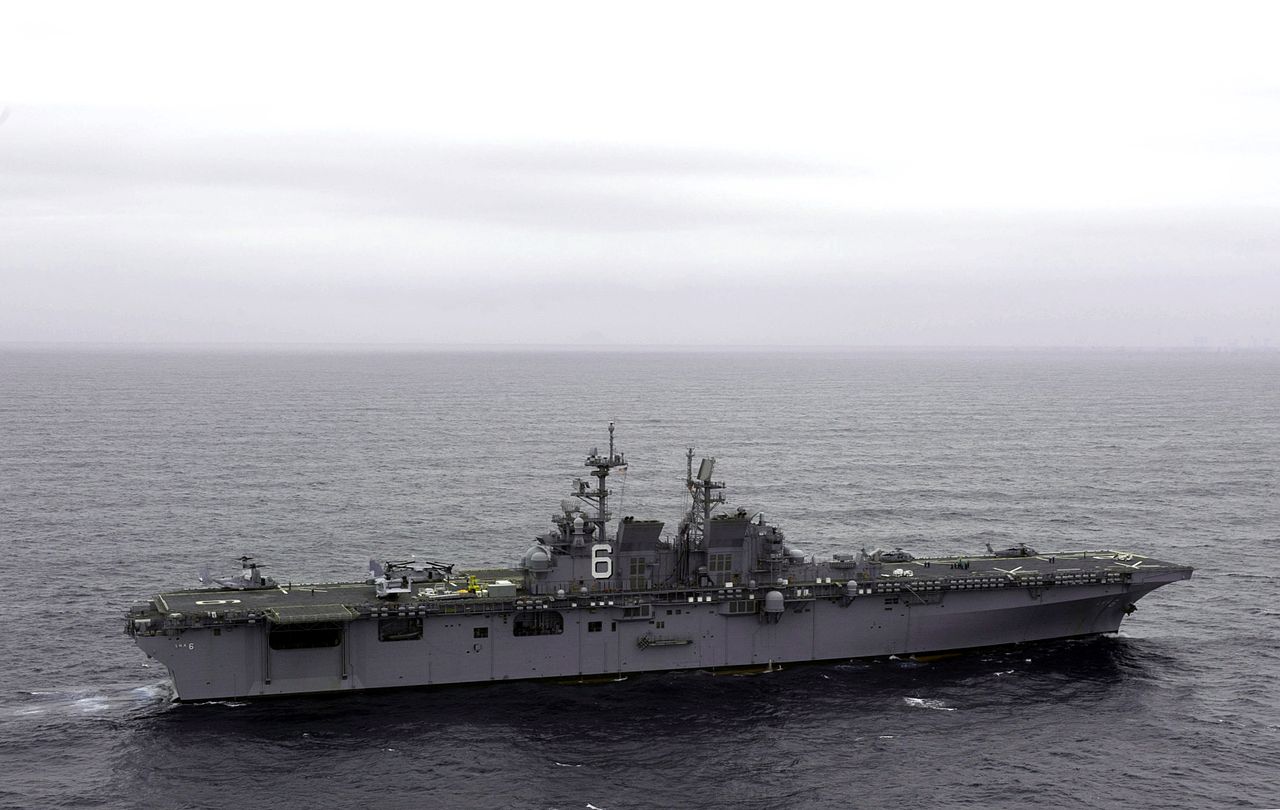
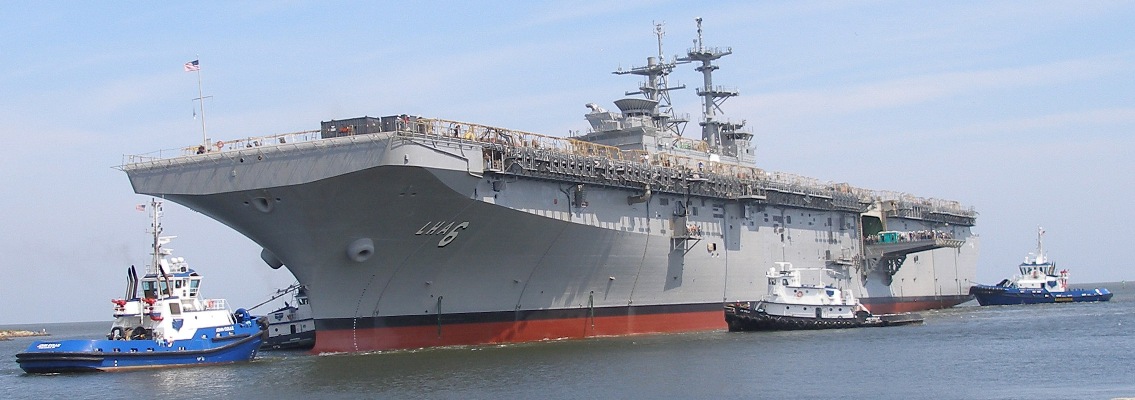
The America-class amphibious assault ship represents the U.S. Navy's latest evolution in power projection platforms, designed primarily as aviation-centric assault ships optimizing vertical lift capability over traditional well deck operations. Unlike its predecessor Wasp-class, the America-class was initially designed without a well deck to maximize aviation fuel storage and hangar space, though this was reversed starting with LHA-8. Strategically, these ships serve as the backbone of Marine Expeditionary Units (MEUs), capable of launching F-35B Lightning II operations from their flight decks while simultaneously supporting Marine Corps air-ground task forces. The class embodies the shift toward distributed maritime operations and island-hopping campaigns in contested environments, particularly relevant for Pacific theater operations against peer adversaries. The design philosophy prioritizes aviation operations above all else, with the flight deck and hangar optimized for the F-35B's operational requirements including specialized maintenance facilities and weapons handling. This represents a fundamental shift from balanced amphibious warfare to aviation-dominant power projection, reflecting lessons learned from Iraq and Afghanistan where helicopter and fixed-wing close air support proved critical. In the current threat environment, America-class ships provide the Navy-Marine Corps team with a distributed, mobile airfield capability that can operate F-35Bs in contested airspace while remaining outside the range of most land-based anti-ship missiles. However, their large signature and high value make them prime targets for enemy long-range precision fires, requiring robust escort and defensive measures.
Deployment Map
Home ports from known hull assignments. Operating areas reflect typical AORs — individual deployments will vary.
Timeline
Specifications
Armament
Point defense against missiles and aircraft
Self-defense against anti-ship missiles
Small boat defense
Doctrine & Employment
Role
Power projection platform designed to enable Marine Corps distributed operations across vast Pacific distances, serving as a mobile aviation base that can operate independently or as part of larger amphibious ready groups.
Design Philosophy
Prioritized maximum aviation capacity and fuel storage over traditional amphibious assault capabilities, sacrificing well deck space and surface connector capacity to accommodate larger aircraft complements and extended aviation operations. The design reflects a shift from World War II-style beach assault doctrine toward distributed aviation-centric operations across the Pacific's vast distances.
Employment
Typically operates as the centerpiece of an Amphibious Ready Group (ARG) paired with Marine Expeditionary Units (MEU), though increasingly employed in distributed operations supporting Expeditionary Advanced Base Operations (EABO). Mission profiles emphasize aviation-centric assault, crisis response, and humanitarian operations rather than traditional beach assault. Command relationships place these ships under Expeditionary Strike Group commanders, with embarked Marine Air-Ground Task Force commanders controlling aviation assets.
Threat Context
Originally designed for post-Cold War crisis response and irregular warfare scenarios, but threat evolution toward great power competition has highlighted vulnerabilities to advanced anti-ship missiles and submarines. The platform now operates in an environment where Chinese A2/AD capabilities can threaten traditional amphibious operations within the first island chain.
How to Compare
Compare primarily on aviation capacity, fuel storage, and operational range rather than traditional amphibious metrics like vehicle capacity or landing craft complement. Aviation fuel storage, aircraft spotting factors, and ability to sustain distributed operations matter more than beach assault capability when evaluating against foreign helicopter carriers or light carriers.
Operational Patterns
Typical Deployment
Forward deployed with MEU, rotating between Pacific and Atlantic theaters, increasingly used as 'lightning carrier' with all F-35B loadout
Deployment Length
7 months
Typical Task Group
Amphibious Ready Group with San Antonio-class LPD and Whidbey Island-class LSD, plus Arleigh Burke escort
Readiness
F-35B maintenance requirements strain deployment readiness, particularly for sustained high-tempo operations
Key Operating Areas
Peer Comparison Matrix
Chinese ship focuses on helicopter operations with well deck, lacks F-35B equivalent capability. America-class prioritizes fixed-wing aviation but sacrifices surface assault capacity in early variants.
Video angle: East vs West amphibious warfare philosophy - aviation dominance versus balanced approach
Queen Elizabeth is pure aircraft carrier optimized for F-35B operations with larger air wing. America-class maintains amphibious mission with Marines but smaller air wing capacity.
Video angle: Specialized carrier versus multi-mission amphib - design compromises and mission flexibility
Italian ship proved feasibility of F-35B operations from smaller platform. America-class scales up concept with much larger capacity and full amphibious capability.
Video angle: Evolution of light carrier concept from European pioneers to US supersize implementation
Japanese ships being modified for F-35B operations but lack amphibious warfare capability entirely. America-class provides both missions but with complexity trade-offs.
Video angle: Constitutional constraints versus operational requirements - Japanese helicopter destroyer evolution
Combat History
USS America conducted first operational F-35B Lightning II deployments, proving concept of distributed aviation operations from amphib platform
Validated the America-class design philosophy and F-35B integration for contested environment operations
USS Tripoli conducted extensive F-35B operations in South China Sea, demonstrating lightning carrier concept with 20 F-35Bs embarked
Proved viability of amphib as supplemental carrier in distributed maritime operations against peer threats
USS Bataan (Wasp-class) operations demonstrated amphib vulnerability to drone/missile threats, informing America-class defensive upgrades
Highlighted need for enhanced defensive systems on high-value amphibious platforms
Known Vulnerabilities
High-value target signature
Large radar cross-section and high electromagnetic signature make these ships easily detectable and prime targets for anti-ship ballistic missiles
Context: Chinese DF-21D and DF-26 specifically designed to target large naval vessels at extended ranges
Mitigation: Requires robust escort including Aegis destroyers and submarines, limits operating areas in contested environments
Limited self-defense capability
Minimal organic defensive armament compared to threats faced - only SeaRAM and Phalanx against sophisticated missile attacks
Context: Iran and China have demonstrated saturation missile attack capabilities exceeding ship's defensive capacity
Mitigation: Enhanced escort requirements and potential laser weapon integration being studied
Aviation fuel vulnerability
Massive JP-5 fuel storage creates catastrophic fire/explosion risk if hull is penetrated, particularly critical given increased capacity
Context: Lesson from Falklands War and USS Bonhomme Richard fire - aviation fuel fires extremely difficult to control
Mitigation: Enhanced firefighting systems and damage control training, but fundamental vulnerability remains
Manning challenges
Complex aviation maintenance requirements strain crew, particularly for F-35B operations requiring specialized training
Context: Navy-wide manning shortfalls particularly acute for specialized aviation maintenance ratings
Mitigation: Increased contractor support and cross-training programs, but remains persistent challenge
Variants
| Variant | Designation | Years | Count | Status | Key Changes |
|---|---|---|---|---|---|
| Flight 0 (No Well Deck) | LHA-6 to LHA-7 | 2014-2018 | 2 | active | Initial design without well deck, maximized aviation fuel storage and hangar space, optimized for F-35B operations |
| Flight I (Well Deck Restored) | LHA-8 to LHA-14 | 2024-ongoing | 5 | building | Well deck restored for surface assault craft, reduced fuel capacity but restored traditional amphibious capability |
Fleet Roster (5)
| Hull | Name | Variant | Commissioned | Home Port | Status |
|---|---|---|---|---|---|
| LHA-6 | USS America | Flight 0 | 2014-10-11 | Sasebo, Japan | active |
| LHA-7 | USS Tripoli | Flight 0 | 2020-07-15 | San Diego, CA | active |
| LHA-8 | USS Bougainville | Flight I | 2024-08-31 | San Diego, CA | active |
| LHA-9 | USS Fallujah | Flight I | TBD | TBD | fitting out |
| LHA-10 | TBD | Flight I | TBD | TBD | under construction |
Modernization Programmes
F-35B Integration Block 4
Upgrading maintenance facilities, weapons handling, and support systems for F-35B Block 4 capabilities including new weapons
Impact: Enables advanced F-35B weapons employment including long-range precision fires
Enhanced Self-Defense
Additional SeaRAM systems, improved EW suite, and potential laser CIWS integration to counter drone swarms
Impact: Addresses vulnerability to small boat swarms and drone attacks demonstrated in recent conflicts
Well Deck Restoration
LHA-8 and follow-on ships include well deck for landing craft operations, restoring traditional amphibious assault capability
Impact: Balances aviation focus with surface assault requirements identified by Marine Corps
Images





Recent News
Frequently Asked
How many America-class amphibious assault ship are in service?
3 America-class amphibious assault ship are currently in service with United States Navy.
When was the first America-class amphibious assault ship commissioned?
The first America-class amphibious assault ship entered service in 2014-10-11.
Who builds the America-class amphibious assault ship?
The America-class amphibious assault ship is built by Huntington Ingalls Industries.
What variants of the America-class amphibious assault ship exist?
Known variants include: Flight 0 (No Well Deck), Flight I (Well Deck Restored).
How much does a America-class amphibious assault ship cost?
Unit cost is approximately $3.4B per hull.
Curated Research
essential
Friedman provides the most comprehensive technical and doctrinal evolution of U.S. amphibious ship design including the America-class development.
O'Rourke's CRS report provides current analysis of America-class procurement, costs, and strategic rationale within broader Navy force structure.
recommended
CSBA analysis directly addresses how America-class design supports the Navy's distributed operations concept in contested environments.
Official U.S. Navy doctrine explaining the role of amphibious platforms in modern naval warfare and power projection.
Marine Corps doctrinal publication explaining how America-class ships enable distributed operations in the Pacific theater.
reference
Comprehensive technical specifications and configuration details for comparing aviation capacity and design trade-offs.
Provides ongoing analysis of amphibious warfare evolution and great power competition impacts on platform employment.
Watch America in Action
Iron Command produces in-depth comparison and analysis videos for military equipment.
Watch on YouTubeSources