
Agni-V intercontinental ballistic missile
Compare with
Overview
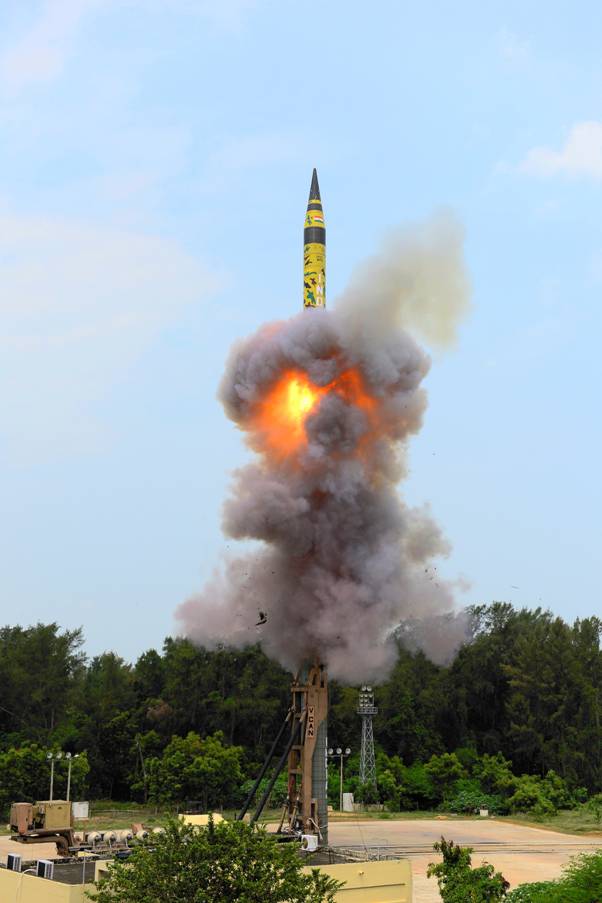
The Agni-V is the apex of India's land-based nuclear deterrent — a long-range, solid-fuelled ballistic missile that, for the first time, lets India hold all of China at risk from launchers deep inside its own territory. Developed by DRDO and inducted from the early 2020s, it is the backbone of India's credible-minimum-deterrence posture against its principal strategic rival. With a range generally cited at around 5,000–5,500 km (and assessed by some to be greater), the Agni-V brings every major Chinese city within reach. It is a three-stage, solid-fuel missile designed for canisterised, road- or rail-mobile launch, which keeps it concealed, survivable and ready to fire at short notice. In 2024, India tested a multiple independently-targetable re-entry vehicle (MIRV) capability under "Mission Divyastra," allowing a single missile to carry several warheads — a significant step in sophistication. For an analyst, the Agni-V is the strategic counterweight in the India–China relationship. Where shorter-range Agni variants covered Pakistan, the Agni-V extends deterrence to Beijing and beyond, and the move to MIRVs and canisterised mobility mirrors the maturation of other Asian missile forces. It is a relatively small but symbolically and strategically weighty piece of the Indo-Pacific nuclear balance.
Deployment Map
Home ports from known hull assignments. Operating areas reflect typical AORs — individual deployments will vary.
Timeline
Specifications
Doctrine & Employment
Role
Long-range land-based nuclear ballistic missile providing India a China-spanning deterrent.
Design Philosophy
Credible minimum deterrence — reach all of China survivably, now with MIRVs.
Employment
Concealed canisterised mobile launch for survivable second-strike under a no-first-use policy.
Threat Context
The strategic counterweight in the India–China relationship.
How to Compare
Read against China's DF-26/DF-41 and North Korea's Hwasong-17.
Operational Patterns
Typical Deployment
Concealed canisterised road/rail-mobile launchers for survivable second-strike.
Typical Task Group
Strategic Forces Command.
Readiness
Inducted; MIRV-capable from 2024.
Key Operating Areas
Peer Comparison Matrix
China's IRBM force is far larger and more mature; the Agni-V is India's primary China-spanning deterrent.
Video angle: The India–China missile balance.
Both are emerging-power long-range missiles; the Agni-V is solid-fuelled and canisterised.
Video angle: Asia's new long-range missiles.
China's longer-range MIRVed ICBM dwarfs the Agni-V in reach and numbers.
Video angle: Why India built the Agni-V.
Combat History
India flight-tested an Agni-V with MIRV capability under 'Mission Divyastra'.
Demonstrated multiple-warhead capability — a major leap for India's deterrent.
Successful test ahead of induction into the Strategic Forces Command.
Confirmed a China-spanning land-based deterrent.
Known Vulnerabilities
Small force / no-first-use
A modest deterrent force under a declared no-first-use policy.
Context: Survivability and second-strike are the priorities.
Mitigation: Canisterised mobility and concealment.
Defence penetration
Must penetrate improving Chinese missile defences.
Context: China fields HQ-19-class interceptors.
Mitigation: MIRVs and penetration aids.
Variants
| Variant | Designation | Years | Count | Status | Key Changes |
|---|---|---|---|---|---|
| Agni-V | — | 2021– | — | active | Long-range canisterised solid-fuel ICBM |
| Agni-V MIRV (Mission Divyastra) | — | 2024– | — | active | Multiple independently-targetable warheads |
Modernization Programmes
MIRV & range growth
MIRV deployment and reported longer-range Agni follow-ons.
Impact: Increases warhead count and reach of India's deterrent.
Images




Frequently Asked
When was the first Agni-V intercontinental ballistic missile commissioned?
The first Agni-V intercontinental ballistic missile entered service in 2021.
Who builds the Agni-V intercontinental ballistic missile?
The Agni-V intercontinental ballistic missile is built by Defence Research and Development Organisation (DRDO).
What variants of the Agni-V intercontinental ballistic missile exist?
Known variants include: Agni-V, Agni-V MIRV (Mission Divyastra).
Curated Research
recommended
Arsenal overview
reference
Range, MIRV, basing
Watch Agni-V intercontinental ballistic missile in Action
Iron Command produces in-depth comparison and analysis videos for military equipment.
Watch on YouTube