
Admiral Kuznetsov-class aircraft carrier
Compare with
Overview
**Admiral Kuznetsov** represents Russia's sole operational aircraft carrier and the last remnant of the Soviet Union's blue-water naval ambitions. Originally designed as Project 1143.5, she embodies a uniquely Soviet approach to carrier aviation—combining traditional carrier capabilities with heavy surface combatant armament, including anti-ship missiles and defensive systems that Western carriers delegate to escorts. Strategically, Kuznetsov serves as the flagship of the Russian Navy and the centerpiece of Russian power projection capabilities, though her operational history reveals significant limitations. Her ski-jump launch system restricts aircraft payload and fuel capacity compared to catapult-equipped carriers, while chronic mechanical issues and limited dry-dock facilities have severely impacted readiness rates. The ship typically operates with 15-20 fixed-wing aircraft versus the 60-90 carried by US supercarriers. The carrier's design philosophy reflects Soviet doctrine emphasizing self-defense and anti-surface warfare. Unlike American carriers that rely on escort vessels for protection, Kuznetsov mounts twelve P-700 Granit supersonic anti-ship missiles and comprehensive air defense systems. This approach sacrifices aircraft capacity for organic firepower, making her more of a hybrid aviation cruiser than a pure carrier. In the current threat environment, Kuznetsov represents both Russia's naval prestige and its technological limitations. Her deployments to Syria (2016-2017) demonstrated Russia's commitment to power projection but also exposed severe operational deficiencies, including aircraft losses and propulsion failures. Compared to modern Chinese carriers or US Navy supercarriers, she represents 1980s Soviet technology struggling to maintain relevance in contemporary naval warfare, hampered by sanctions limiting access to Western components and Ukraine's control of her original construction facilities.
Deployment Map
Home ports from known hull assignments. Operating areas reflect typical AORs — individual deployments will vary.
Timeline
Specifications
Armament
Primary anti-surface warfare capability
Point defense system
Close-in weapons system
240mm anti-submarine mortars
Primary fixed-wing aircraft
Doctrine & Employment
Role
Power projection and sea control within defended bastions, serving as the centerpiece of Russia's Northern Fleet for Arctic and North Atlantic operations. Kuznetsov exists to challenge NATO naval supremacy in Russia's near-abroad while providing limited expeditionary capability for showing the flag in distant waters.
Design Philosophy
Soviet designers prioritized survivability and self-sufficiency over aircraft capacity, incorporating heavy anti-ship missiles (P-700 Granit) and robust defensive systems that Western carriers delegate to escorts. This approach sacrificed hangar space and aviation fuel storage for magazine depth and armored protection, resulting in a smaller air wing (24 fixed-wing aircraft vs 60+ on comparable Western carriers) but greater independent combat capability.
Employment
Operates as flagship of carrier strike groups typically including Kirov-class battlecruisers, Udaloy-class destroyers, and nuclear submarines for integrated air-surface warfare. Primary missions include fleet air defense, anti-submarine warfare coordination, and limited strike operations using embarked Su-33 fighters and Ka-27/29 helicopters. Command structure integrates with Northern Fleet headquarters for regional operations, though mechanical reliability severely constrains operational tempo and deployment duration.
Threat Context
Designed during the Cold War to operate under intense NATO air attack in the Norwegian Sea, facing coordinated strikes from land-based aviation, submarines, and carrier battle groups. The modern threat environment has shifted toward precision-guided munitions, space-based ISR, and distributed maritime operations, making Kuznetsov's heavy armor less relevant while exposing vulnerabilities in electronic warfare and missile defense systems.
How to Compare
Compare on air wing composition and sortie generation rates rather than displacement—Kuznetsov's hybrid cruiser-carrier design makes tonnage comparisons misleading. Focus on defensive armament integration, ski-jump vs catapult trade-offs, and operational availability rates, as Russian carrier doctrine emphasizes combat resilience over sustained aviation operations.
Operational Patterns
Typical Deployment
Flagship of Northern Fleet, primarily operates in North Atlantic and Arctic regions with occasional Mediterranean deployments
Deployment Length
4 months
Typical Task Group
Usually operates with Kirov-class cruiser, Udaloy-class destroyers, and nuclear submarines for protection
Readiness
Extremely limited operational availability due to maintenance issues - typically 1-2 deployments per decade rather than regular rotations
Key Operating Areas
Peer Comparison Matrix
Sister ship completed by China with improved electronics, better maintenance, and more reliable operations. Liaoning demonstrates what Kuznetsov could be with proper industrial support and investment.
Video angle: Sister ships, different fates - how Chinese investment transformed Soviet hull into more capable platform
Nuclear powered, catapult launch system, modern electronics. Significantly more capable despite smaller size due to superior launch/recovery systems and higher operational availability.
Video angle: Old vs new carrier design philosophy - Soviet quantity vs Western quality approach
Heavily modified Kiev-class with ski-jump added, similar limitations but better industrial support and modernization. Shows alternative path for Soviet carrier development.
Video angle: Soviet carrier evolution - different paths for similar designs
Modern ski-jump design optimized for F-35B STOVL aircraft, much larger flight deck, no organic weapons. Represents modern interpretation of ski-jump carrier concept.
Video angle: Ski-jump carriers old vs new - how technology changed the concept
Nuclear powered, electromagnetic catapults, 3x aircraft capacity, dedicated aviation platform without organic weapons. Represents completely different carrier philosophy prioritizing air power over self-defense.
Video angle: Carrier philosophy clash - Soviet hybrid cruiser-carrier vs American pure aviation platform
Combat History
Admiral Kuznetsov deployed to Eastern Mediterranean, conducting air strikes against Syrian opposition forces. Lost 2 aircraft (Su-33 and MiG-29K) due to arresting gear failures, forced to operate from Syrian airfields.
First combat deployment exposed significant operational limitations and maintenance issues with carrier aviation systems
Deployment cut short due to mechanical problems and aircraft losses. Heavy black smoke from propulsion issues became international embarrassment.
Highlighted chronic readiness problems and limited sustainable deployment capability
Floating dry dock PD-50 sank during maintenance, damaging Kuznetsov with falling crane. Ship suffered hull damage and flooding.
Severely impacted maintenance schedule and highlighted Russia's limited naval infrastructure
Major fire during refit killed 2 workers and caused extensive damage to internal systems during welding operations.
Further delayed modernization program and raised questions about Russian shipyard capabilities
Known Vulnerabilities
Propulsion Reliability
Chronic issues with steam boilers and propulsion plant, frequently producing visible black smoke and limiting speed/maneuverability. Lost propulsion during Syrian deployment.
Context: Severely limits operational deployment capability and creates vulnerability during combat operations
Mitigation: Current overhaul includes complete propulsion system renovation, but underlying design issues remain
Aircraft Operations
Ski-jump launch system limits aircraft payload and fuel capacity. Arresting gear failures caused multiple aircraft losses. Limited to 15-20 operational aircraft versus 60-90 on US carriers.
Context: Significantly reduces strike capability and operational flexibility compared to catapult-equipped carriers
Mitigation: Pilot training improvements and arresting gear modifications planned, but fundamental launch limitations cannot be addressed without major reconstruction
Industrial Support
Built in Ukraine (now hostile), limited dry-dock facilities in Russia, and sanctions restricting access to Western components for electronics and systems.
Context: Makes major repairs and modernization extremely difficult and expensive, limiting long-term viability
Mitigation: Attempting to develop domestic alternatives, but technological gaps remain significant especially in electronics and precision manufacturing
Air Defense Saturation
While heavily armed for self-defense, older radar systems and limited missile inventory vulnerable to coordinated saturation attacks by modern anti-ship missiles.
Context: In conflict with peer adversary, would require significant escort protection despite organic defensive armament
Mitigation: Modernization includes some radar updates, but fundamental sensor and processing limitations remain
Variants
| Variant | Designation | Years | Count | Status | Key Changes |
|---|---|---|---|---|---|
| Project 1143.5 Kuznetsov | Admiral Kuznetsov (063) | 1991-present | 1 | active | Original configuration with full armament suite and ski-jump launch system |
| Project 1143.6 Varyag | Varyag (later Liaoning) | 1988-1998 (incomplete) | 1 | transferred | Sister ship sold incomplete to China, became Liaoning with significant modifications |
| Project 1143.7 Ulyanovsk | Ulyanovsk (cancelled) | 1988-1991 | — | cancelled | Nuclear-powered variant with catapults and arresting gear, cancelled at 40% completion |
Fleet Roster (1)
| Hull | Name | Variant | Commissioned | Home Port | Status |
|---|---|---|---|---|---|
| 063 | Admiral Kuznetsov | Project 1143.5 | 1991-01-21 | Severomorsk | active |
Modernization Programmes
Major Overhaul and Modernization
Complete overhaul including propulsion system repair, new boilers, updated electronics, and flight deck improvements. Originally planned to include new aircraft arresting systems.
Impact: Intended to extend service life to 2040s and improve operational availability, though multiple delays and accidents have compromised timeline
Aircraft Wing Modernization
Replacement of aging Su-33s with MiG-29K/KUB aircraft and Ka-52K helicopters for improved multi-role capability.
Impact: Would provide more modern avionics and precision strike capability, though numbers remain limited
Images

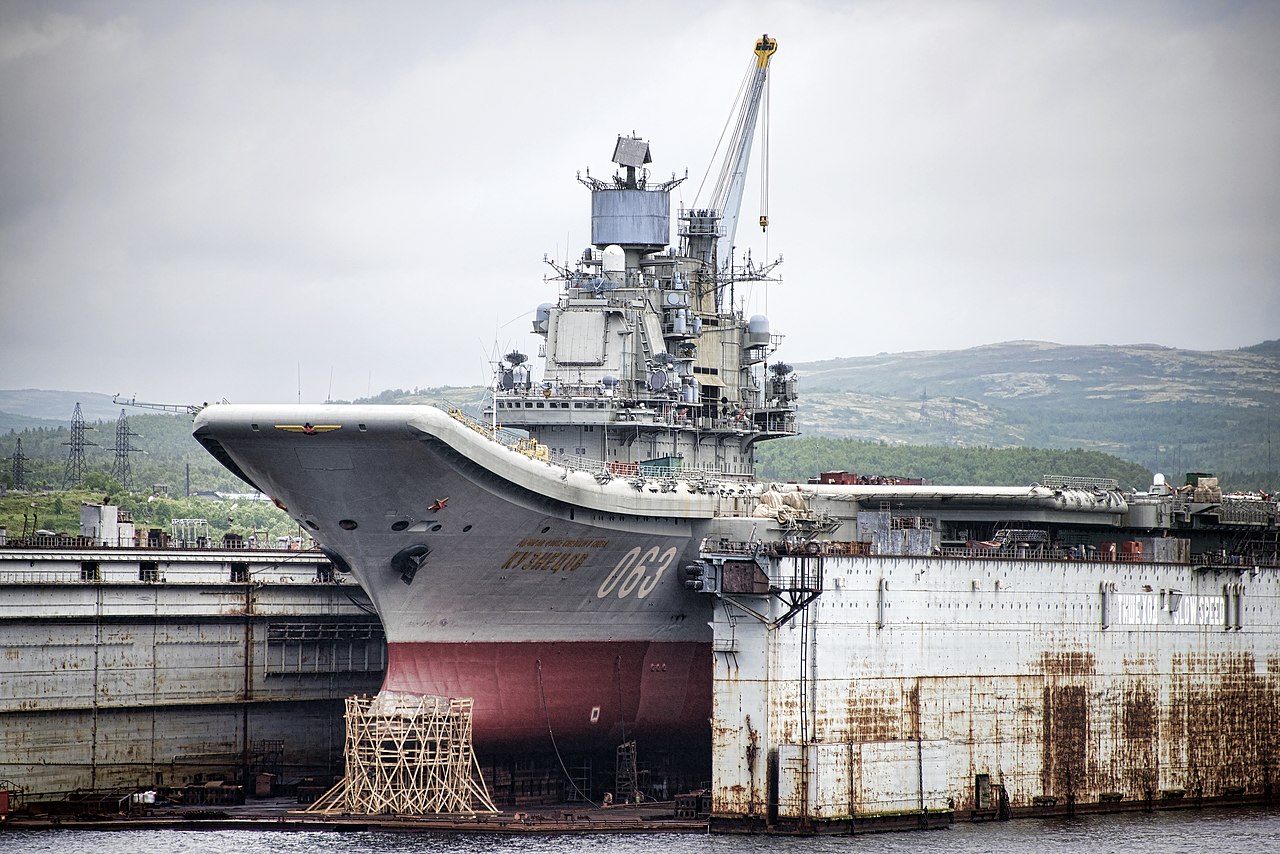


Frequently Asked
How many Admiral Kuznetsov-class aircraft carrier are in service?
1 Admiral Kuznetsov-class aircraft carrier are currently in service with Russian Navy.
When was the first Admiral Kuznetsov-class aircraft carrier commissioned?
The first Admiral Kuznetsov-class aircraft carrier entered service in 1991-01-21.
Who builds the Admiral Kuznetsov-class aircraft carrier?
The Admiral Kuznetsov-class aircraft carrier is built by Nikolayev South Shipyard (Ukraine).
What variants of the Admiral Kuznetsov-class aircraft carrier exist?
Known variants include: Project 1143.5 Kuznetsov, Project 1143.6 Varyag, Project 1143.7 Ulyanovsk.
How much does a Admiral Kuznetsov-class aircraft carrier cost?
Unit cost is approximately $4.5B per hull.
Curated Research
essential
IISS assessment covering Kuznetsov's role in Russian naval modernization and Arctic strategy implementation.
RUSI analysis of Russian carrier development within broader fleet modernization context and operational constraints.
recommended
Provides historical context for Russian naval aviation development and the strategic thinking behind Project 1143.5's unique design philosophy.
Leading open-source analyst providing regular updates on Kuznetsov's operational status, refits, and deployment patterns.
CSIS strategic assessment of Russian naval priorities and Kuznetsov's role in future fleet architecture planning.
reference
Comprehensive technical specifications and operational history database for Project 1143.5 class carriers.
Authoritative reference for current specifications, sensors, and weapons systems aboard Admiral Kuznetsov.
Watch Admiral Kuznetsov in Action
Iron Command produces in-depth comparison and analysis videos for military equipment.
Watch on YouTube