
Admiral Gorshkov-class frigate
Overview
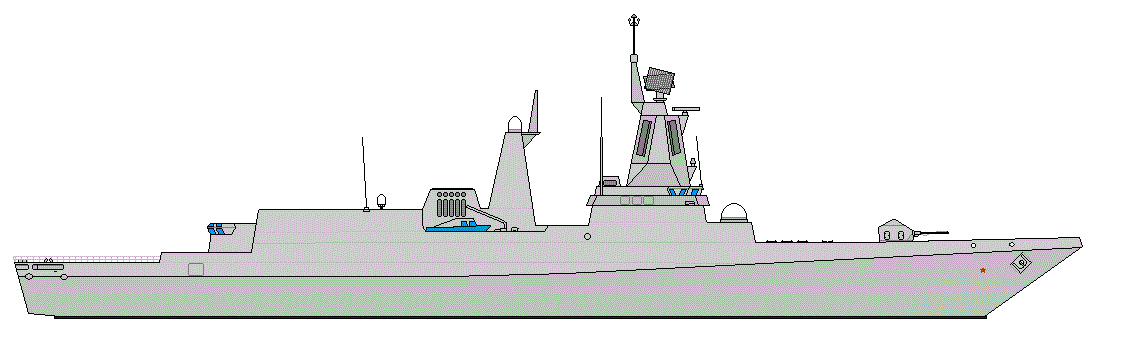
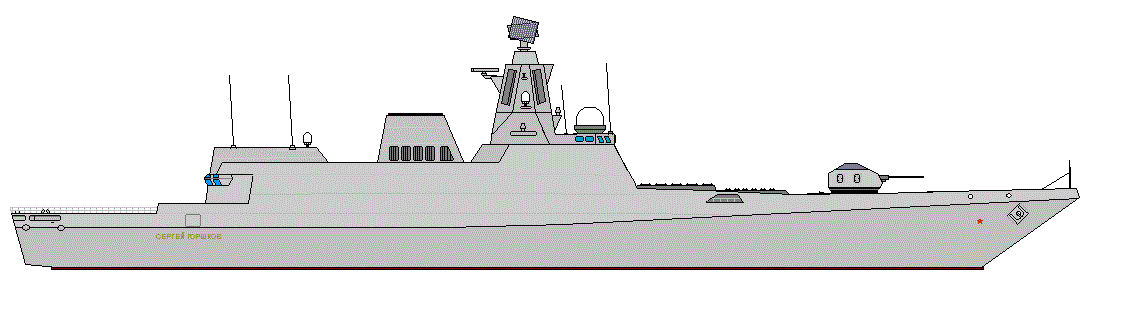
The Admiral Gorshkov-class (Project 22350) represents Russia's attempt to modernize its surface fleet with a multi-role frigate combining advanced sensors, versatile armament, and stealth features. These 4,500-ton frigates are designed as the backbone of Russia's blue-water navy, capable of anti-surface, anti-air, and anti-submarine warfare in contested environments. Strategically, the Gorshkov-class fills the gap between Russia's aging Soviet-era destroyers and smaller corvettes, providing a modern platform for power projection and fleet escort duties. The design emphasizes reduced radar cross-section, advanced combat management systems, and flexibility through its UKSK vertical launch system that can accommodate various missile types from anti-ship Kalibr cruise missiles to Zircon hypersonics. The class incorporates Russia's most advanced naval technologies, including the Poliment-Redut air defense system and Zaslon combat management system. However, production has been severely hampered by Western sanctions affecting propulsion systems and electronics, with only four hulls commissioned as of 2024 despite the program beginning in the early 2000s. In the current threat environment, these frigates represent Russia's most capable surface combatants, regularly deployed to the Mediterranean and conducting long-range Kalibr strikes during the Syria and Ukraine conflicts. While individually capable, their small numbers and production delays limit their strategic impact compared to Western frigate programs like the Type 26 or FFG(X).
Deployment Map
Home ports from known hull assignments. Operating areas reflect typical AORs — individual deployments will vary.
Timeline
Specifications
Armament
Can fire Kalibr, Oniks, Zircon missiles
9M96E/9M100 missiles, quadpack capable
Fully automated gun mount
Missiles and 30mm guns
324mm torpedoes and ASW missiles
Doctrine & Employment
Role
Distributed sea control and expeditionary support within 1,000nm of Russian shores, providing credible surface combatant presence where Soviet-era destroyers are too valuable to risk and corvettes lack endurance.
Design Philosophy
Prioritised sensor integration and VLS magazine depth over traditional Russian emphasis on large anti-ship missiles, reflecting shift toward NATO-style engagement envelopes. Sacrificed some single-mission lethality (compared to Udaloy ASW focus) for multi-mission flexibility, accepting higher unit cost for reduced fleet logistics burden through improved reliability and maintainability.
Employment
Typically operates in task groups of 2-3 frigates with submarine support, conducting extended patrols in the Baltic, Black Sea, and Mediterranean. Primary missions include convoy escort, naval diplomacy, and forward area air defence for amphibious operations. Command relationship varies between Northern Fleet flag operations and regional fleet integration, with increasing emphasis on independent deployment capability to reduce dependence on fleet auxiliaries.
Threat Context
Designed for high-intensity NATO naval opposition with integrated air-sea battle concepts, emphasising survival against coordinated air-surface missile attacks. The threat has evolved toward more sophisticated electronic warfare and hypersonic weapons that challenge the platform's air defence assumptions, while submarine threats have intensified in traditional Russian operating areas.
How to Compare
Compare primarily on VLS capacity versus displacement efficiency and sensor integration maturity, not raw speed or single-mission firepower. Both Western and Russian designers accept 29-30 knot maximums as sufficient, making magazine depth per ton and radar horizon management the decisive factors for sustained operations.
Operational Patterns
Typical Deployment
Mediterranean patrol, Northern Fleet flagship duties, show-of-force deployments
Deployment Length
6 months
Typical Task Group
Usually operates independently or with support vessels, occasionally with Admiral Kuznetsov
Readiness
High readiness when operational but limited numbers restrict simultaneous deployments
Key Operating Areas
Peer Comparison Matrix
Type 26 emphasizes ASW with quieter propulsion and better sonar, while Gorshkov prioritizes land-attack with more strike missiles. Type 26 has superior build quality but higher cost.
Video angle: Modern frigate philosophies - stealth vs firepower, quality vs quantity
FREMM has proven export success and NATO integration, while Gorshkov has more VLS cells and indigenous weapons. FREMM more reliable but less heavily armed.
Video angle: European cooperation vs Russian independence in naval design
Constellation prioritizes air defense and networking while Gorshkov emphasizes strike warfare. US frigate has better sensors and datalinks but fewer offensive weapons.
Video angle: Next-generation frigate designs - US distributed lethality vs Russian concentrated firepower
Type 054A built in much larger numbers (40+ hulls) but less capable individually. Chinese frigate more reliable production but less advanced weapons and sensors than Gorshkov.
Video angle: Russian precision vs Chinese mass production in naval modernization
Gorshkov adopted some Sachsen air defense concepts but added strike warfare emphasis. German frigate more specialized for air defense, Russian more multi-role.
Video angle: Technology transfer and adaptation - how Russian designs evolved from Western concepts
Combat History
Admiral Gorshkov conducted first operational deployment, demonstrating long-range cruise capability and integration with Syrian operations
Proved operational readiness and strategic reach of the class
Admiral Gorshkov successfully tested Zircon hypersonic missile from UKSK VLS, achieving Mach 8+ speeds
Demonstrated platform's ability to deploy next-generation hypersonic weapons
Admiral Gorshkov fired Kalibr cruise missiles at Ukrainian targets from the Barents Sea, demonstrating 1000+ km strike capability
First wartime use of the class, proving long-range precision strike capability
Known Vulnerabilities
Production bottlenecks
Severe delays due to sanctions affecting propulsion and electronics supply chains. Original 8-year build time now extending to 12+ years per hull
Context: Limits fleet expansion and operational availability when Russia needs modern surface combatants most
Mitigation: Domestic substitution programs ongoing but with performance compromises
Limited VLS capacity
Only 16 UKSK cells limits simultaneous engagement capability compared to Western contemporaries with 32+ cells
Context: In high-intensity conflict, would rapidly exhaust long-range strike missiles
Mitigation: Project 22350M promises increased cell count but timeline uncertain
Single-ship operations
Low numbers force individual deployments rather than task group operations, reducing overall combat effectiveness and survivability
Context: Cannot sustain simultaneous multi-theater operations or absorb combat losses
Mitigation: None viable given production constraints
Maintenance infrastructure
Advanced systems require sophisticated maintenance capabilities not widely available in Russian fleet
Context: Operational availability rates may suffer, particularly for forward deployments
Mitigation: Investment in shore infrastructure ongoing but resource-intensive
Variants
| Variant | Designation | Years | Count | Status | Key Changes |
|---|---|---|---|---|---|
| Project 22350 | Admiral Gorshkov to Admiral Golovko | 2018-present | 4 | active | Initial production standard with German diesel engines and Western electronics where available |
| Project 22350M | Planned future hulls | 2025+ | 2 | building | Enlarged design, 48-64 VLS cells, domestically sourced propulsion and electronics |
Fleet Roster (6)
| Hull | Name | Variant | Commissioned | Home Port | Status |
|---|---|---|---|---|---|
| 454 | Admiral Gorshkov | Project 22350 | 2018-07-28 | Severomorsk | active |
| 417 | Admiral Kasatonov | Project 22350 | 2020-07-21 | Severomorsk | active |
| 431 | Admiral Golovko | Project 22350 | 2023-12-25 | Severomorsk | active |
| 432 | Admiral Isakov | Project 22350 | 2024-11-07 | Severomorsk | active |
| 433 | Admiral Amelko | Project 22350 | — | TBD | fitting out |
| 434 | Admiral Chichagov | Project 22350 | — | TBD | building |
Modernization Programmes
Domestic propulsion replacement
Replacing German MTU diesel engines with Russian alternatives due to sanctions, using NPO Saturn powerplants
Impact: Reduces Western dependency but may affect reliability and fuel efficiency
Project 22350M enlarged variant
Larger hull with 6000+ ton displacement, 48-64 VLS cells, improved sensors and longer range
Impact: Would transform class into destroyer-equivalent capability
Electronics indigenization
Replacing Western electronic components with Russian alternatives in navigation, communications, and combat systems
Impact: Sanctions compliance but potentially reduced capability and reliability
Images


Frequently Asked
How many Admiral Gorshkov-class frigate are in service?
4 Admiral Gorshkov-class frigate are currently in service with Russian Navy, with 1 under construction.
When was the first Admiral Gorshkov-class frigate commissioned?
The first Admiral Gorshkov-class frigate entered service in 2018-07-28.
Who builds the Admiral Gorshkov-class frigate?
The Admiral Gorshkov-class frigate is built by Severnaya Verf.
What variants of the Admiral Gorshkov-class frigate exist?
Known variants include: Project 22350, Project 22350M.
How much does a Admiral Gorshkov-class frigate cost?
Unit cost is approximately $500M per hull.
Curated Research
essential
Essential context for understanding Project 22350 within broader Russian naval modernisation and strategic priorities.
Authoritative analysis of Russian naval platform development philosophy and the transition from Soviet-era design principles.
Leading Western analyst of Russian military capabilities with frequent commentary on Project 22350 developments and operational deployment patterns.
recommended
Provides doctrinal framework for understanding Russian surface warfare concepts and multi-mission frigate employment in contested waters.
Strategic context for Project 22350 role in Russian naval power projection and Mediterranean operations.
reference
Comprehensive technical specifications and construction timeline for understanding platform capabilities and program challenges.
Detailed specifications database with sensor and weapons system integration details critical for capability assessment.
Watch Admiral Gorshkov in Action
Iron Command produces in-depth comparison and analysis videos for military equipment.
Watch on YouTubeSources